11 December 2025
Our final day in the Peloponnese begins with a visit to iconic ancient rock ruins before a stop-over to see a big cut into solid rock accomplished by human engineering, not gods. We load up and head east.
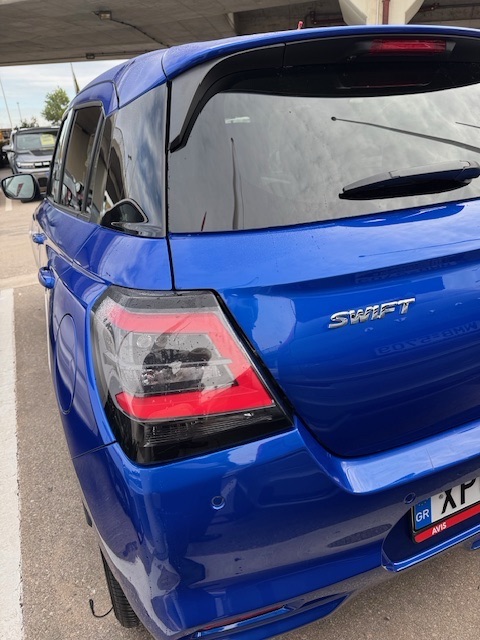
Our Swiftie zips into the peaceful, green Greek countryside. Undaunted, fearless, scoffing at these crazy Greek drivers. “Eat my dust,” declares Swiftie.
Swiftie believes Stop signs indicate the need to stop. White lines indicate road lanes.
All those mini-chapels along the roadsides hint at the number of foolish drivers who passed cars while going uphill and around blind corners. Generally, two lane roads indicate just that – two lanes. Swiftie refuses to be intimidated.
Our destination is simple and less than 15 miles north. We visit two remarkable sites that lie not far apart, yet span centuries of Greek history—the Heraion of Argos, one of Greece’s oldest sanctuaries dedicated to the goddess Hera and the legendary citadel of Mycenae, home to Agamemnon and the heroes of Homer. It promises a day where myth and stone, legend and landscape, all converge under a bright Greek sun.
Heraion of Argos site
The Heraion of Argos is known as one of the oldest sanctuaries dedicated to Hera, the queen of the Olympian gods and protector of women, marriage, and family. Its location served as the religious center of this Argolid region for more than a thousand years, from the Mycenaean through the Roman periods.
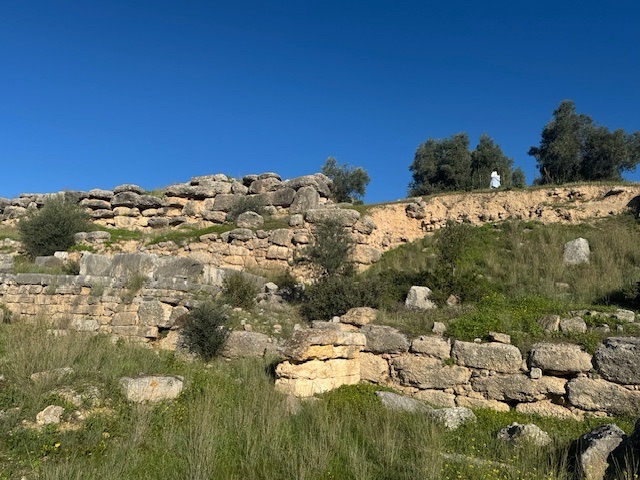
The sanctuary is especially significant for its long history of worship and architectural evolution. Early remains date back to the 8th century BCE. Later phases included grand temples, altars, and stoas built on terraced levels overlooking the plain. The most famous temple constructed around 420 BCE, after the earlier one burned in a fire, became a model of classical Greek design. Here, regional festivals and athletic games honored Hera.
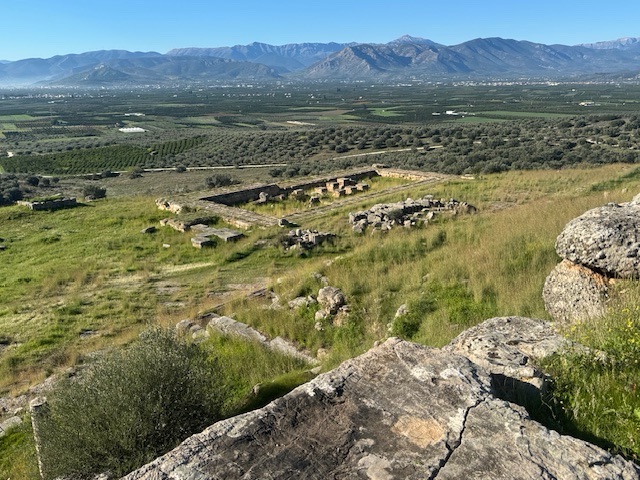
The foundations of the great Classical Temple of Hera remain. Its broad stone platform and column bases clearly outline the temple’s once-imposing size. Lower down the terraced hillside lie the remains of earlier Mycenaean walls and steps. Other visible ruins include altars, stoas, and subsidiary temples, along with portions of the sacred way that once connected the Heraion to Argos. Scattered fragments of columns and decorative stonework hint at the sanctuary’s former grandeur. Panoramic views across the Argolid plain are impressive.
Marble and Whispered Memories – 1981
“Mycenae – impressive burial hive and acropolis ruins, climbing rocks to clank of goat bells on opposite hillside, down 101 steps to cistern.”
Strolling Among the Living Stones
I do remember Mycenae. This magnificent site would be difficult to forget. Mycenae holds immense significance as one of the most important centers of early Greek civilization and the heart of the Mycenaean world during the late Bronze Age (circa 1600–1100 BCE).
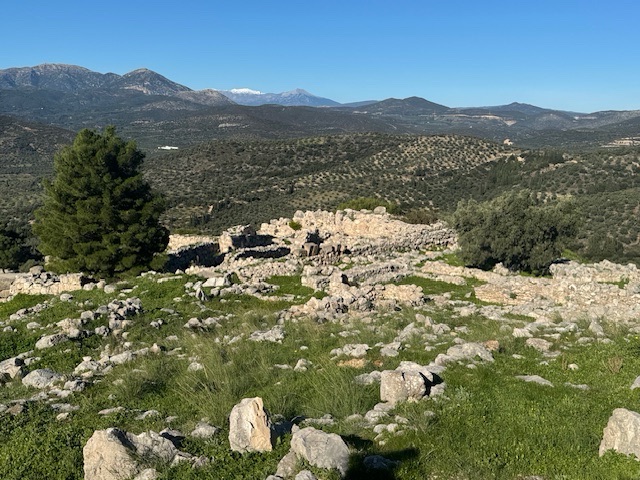
It was a powerfully fortified city whose influence spread across much of the Aegean, giving its name to an entire era of Greek culture. According to legend, Mycenae was the kingdom of King Agamemnon, the leader of the Greek forces in the Trojan War, immortalized in Homer’s Iliad.
Archaeologically, Mycenae is extraordinary because of its Cyclopean walls, Lion Gate, royal palaces, and tholos tombs—monuments that reveal both technical mastery and social organization.
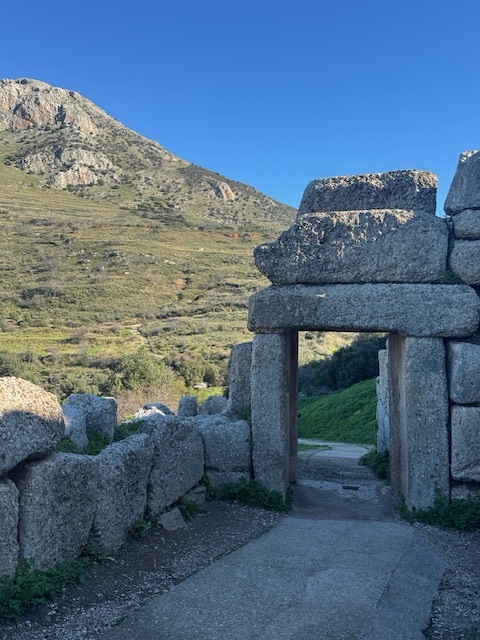
The discovery of the so-called Mask of Agamemnon and other rich grave goods by Heinrich Schliemann (also found the ruins at Troy) in the 19th century confirmed that Mycenae acted as a sophisticated, wealthy society long before classical Greece. (Alas, later research showed the Mask of Agamemnon comes from a period much earlier than the time of Agamemnon.)
Perhaps the most impressive sight when entering the area is The Lion Gate. This monumental entrance to the citadel is one of the most iconic symbols of Mycenaean architecture. Dating to around 1250 BCE, its name comes from the pair of stylized lions carved in relief above the doorway, standing on either side of a central column. The lions stand in a heraldic pose, facing each other with their front paws on the column, a motif believed to symbolize royal power and divine protection over the city.
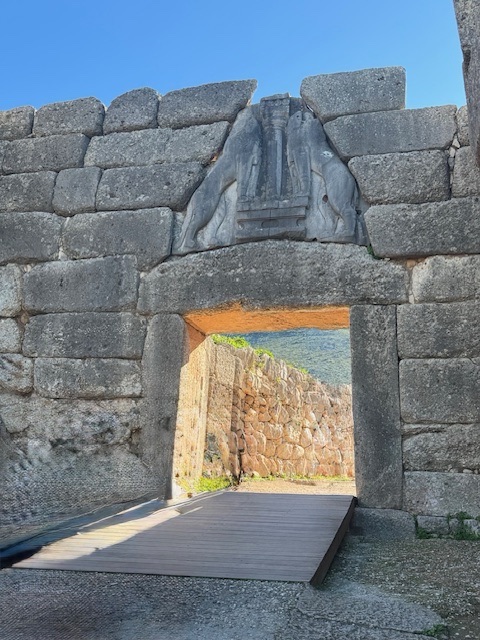
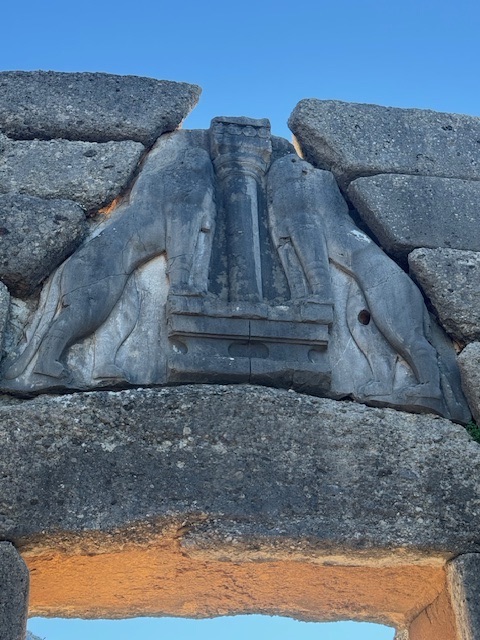
Constructed from massive limestone blocks in the signature Cyclopean style, the gate forms a post-and-lintel structure. A triangular stone sits above the lintel to reduce weight and prevent collapse. I am amazed at the scale of the stones and the skill required to assemble them.
Mycenae’s significance lies not only in its scale and architecture but in its role as a bridge between myth and history. Mycenae represents a place where the heroes of epic poetry meet the tangible remains of a real Bronze Age power. This laid the groundwork for later Greek culture, politics, and art.
Archeological Museum of Mycenae
This museum houses one of the most important collections from the Bronze Age, highlighting the power and culture of the Mycenaean civilization. The museum focuses on a wonderful collection of Mycenaean artifacts that brings the Bronze Age to life. Highlights include the Mask of Agamemnon, finely crafted gold jewelry, weapons, pottery, and fresco fragments that showcase the artistry, wealth, and daily life of Mycenae’s elite. (Even though the mask dates later than Agamemnon, it still retains this honorific title.)
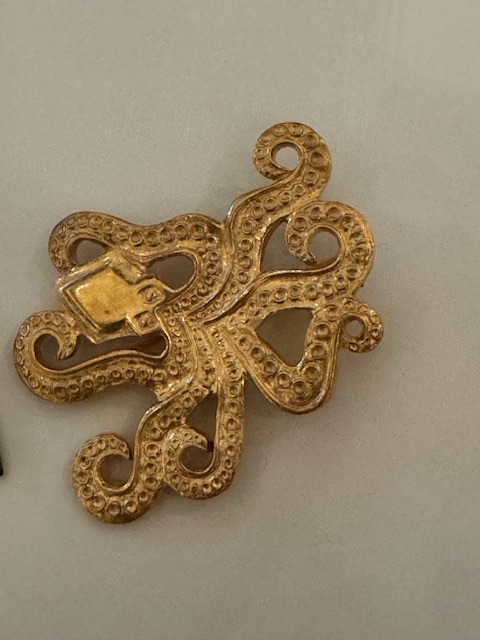
One can see evidence of military strength in bronze weapons and depictions of battle on frescoes and pottery, as well as the legendary wealth reflected in finely crafted gold and precious artifacts. Scenes of daily life, vivid frescoes, and figurines reveal their appreciation for beauty, joy, and the divine. The collection offers a vivid glimpse into a civilization whose people laid the foundations for later Greek achievements in science, philosophy, and democracy.
Marble and Whispered Memories – 1981
“At Corinth Canal for lunch, but Daphni closed because of earthquake. After theater in Epidauras, we drove to ancient ruins of Corinth. Sick of guide; he owes me at this point. Traveled over Canal of Isthmus cut from sheer rock. Water only 27’ deep. Back in Athens by 5. Tour can be easily done on own, driving or by bus and taking tours at sites. Weather has been perfect. People nice. Men seem self-indulging, arrogant asses living on reputations of Paris and Hermes. Food good, prices good.”
Ismus Bridge Cafe
The Isthmia Bridge Café becomes a must stop for a coffee and paninis. It’s located on the canal near the village of Isthmia. The cafe overlooks the entrance to the Corinth Canal and the submersible sinking bridge that allows traffic and vessels to pass.
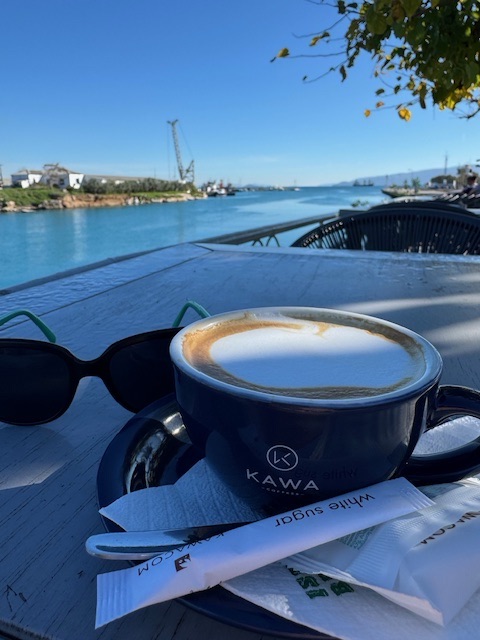
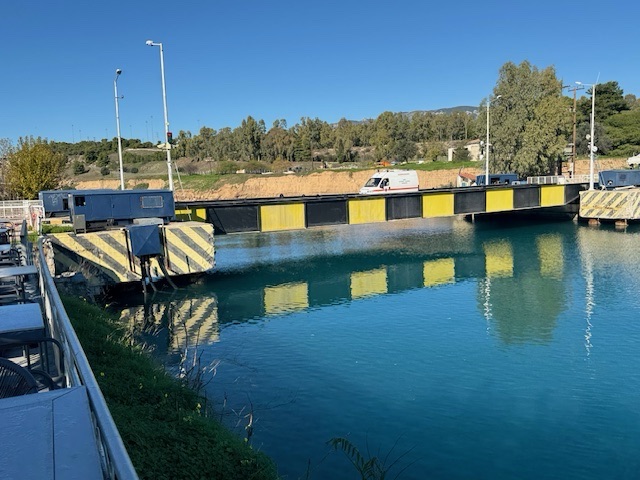
One can watch how the car bridge moves up or down below the waterline whenever boats are scheduled to pass. No boats while we ate, but well worth the pause and quiet.
Ismus Canal
One does not forget a huge slice cut into a solid rock wall.
The Isthmus Canal, also known as the Corinth Canal, cuts through the narrow Isthmus of Corinth, linking the Aegean Sea with the Ionian Sea. This separates the Peloponnese from mainland Greece. The dream of building a canal here dates back to ancient times.
As early as the 7th century BCE, a proposal was made to cut through the isthmus, but the project proved too ambitious with the tools of the time. Instead, the Greeks constructed the Diolkos, a paved trackway over which ships were dragged on wheeled platforms, allowing them to cross the narrow land strip without sailing around the Peloponnese.
The idea for a canal revived during the Roman period—Emperor Nero even began digging with 6,000 slaves. However, it wasn’t until the late 19th century, using modern engineering methods, that the canal became a reality. The modern canal, measuring nearly 4 miles long but only 69 feet wide, was completed in 1893 after years of planning and financial difficulties. Its completion was seen as a triumph of engineering for Greece and a major step forward in connecting maritime trade routes.
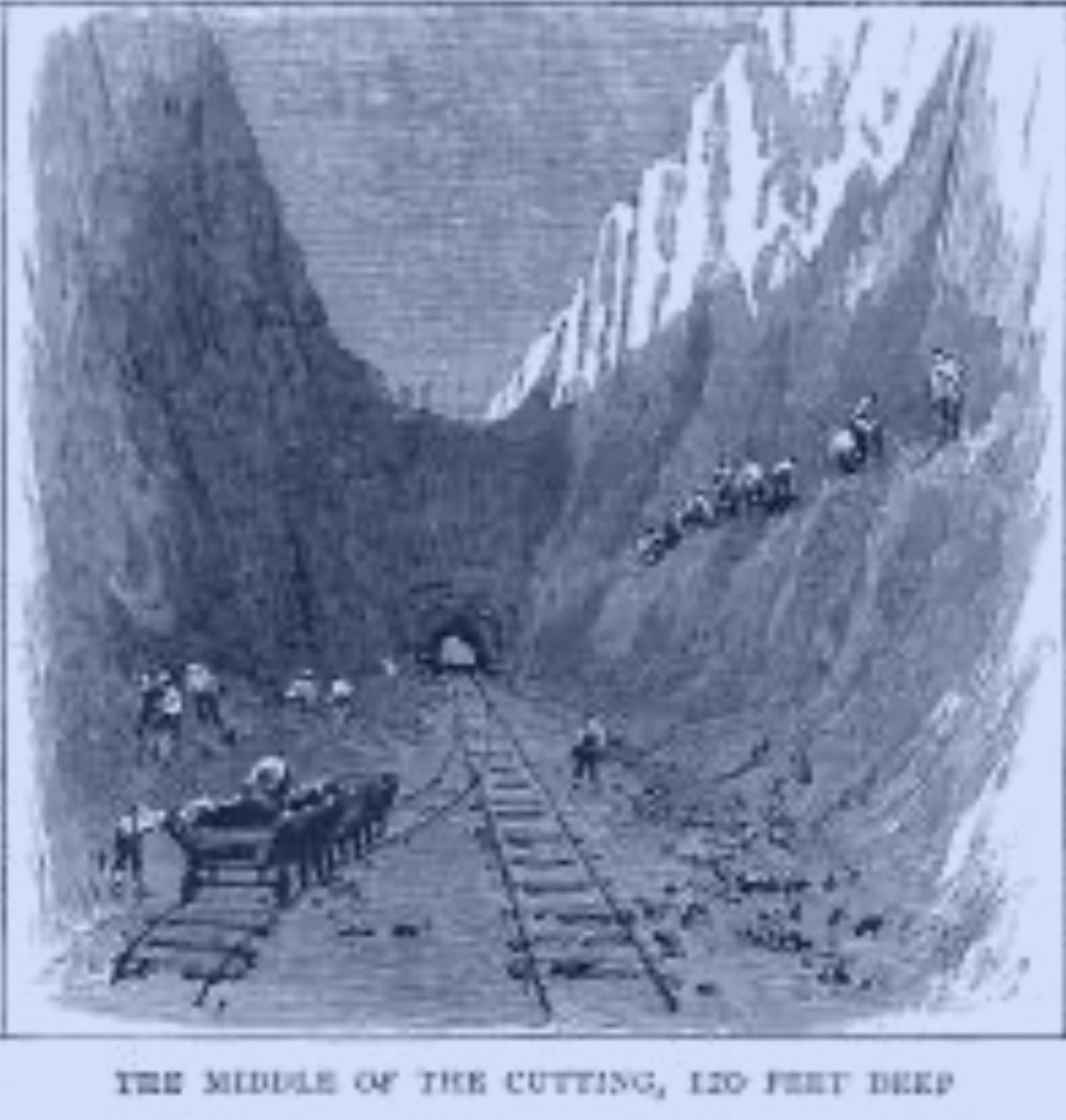
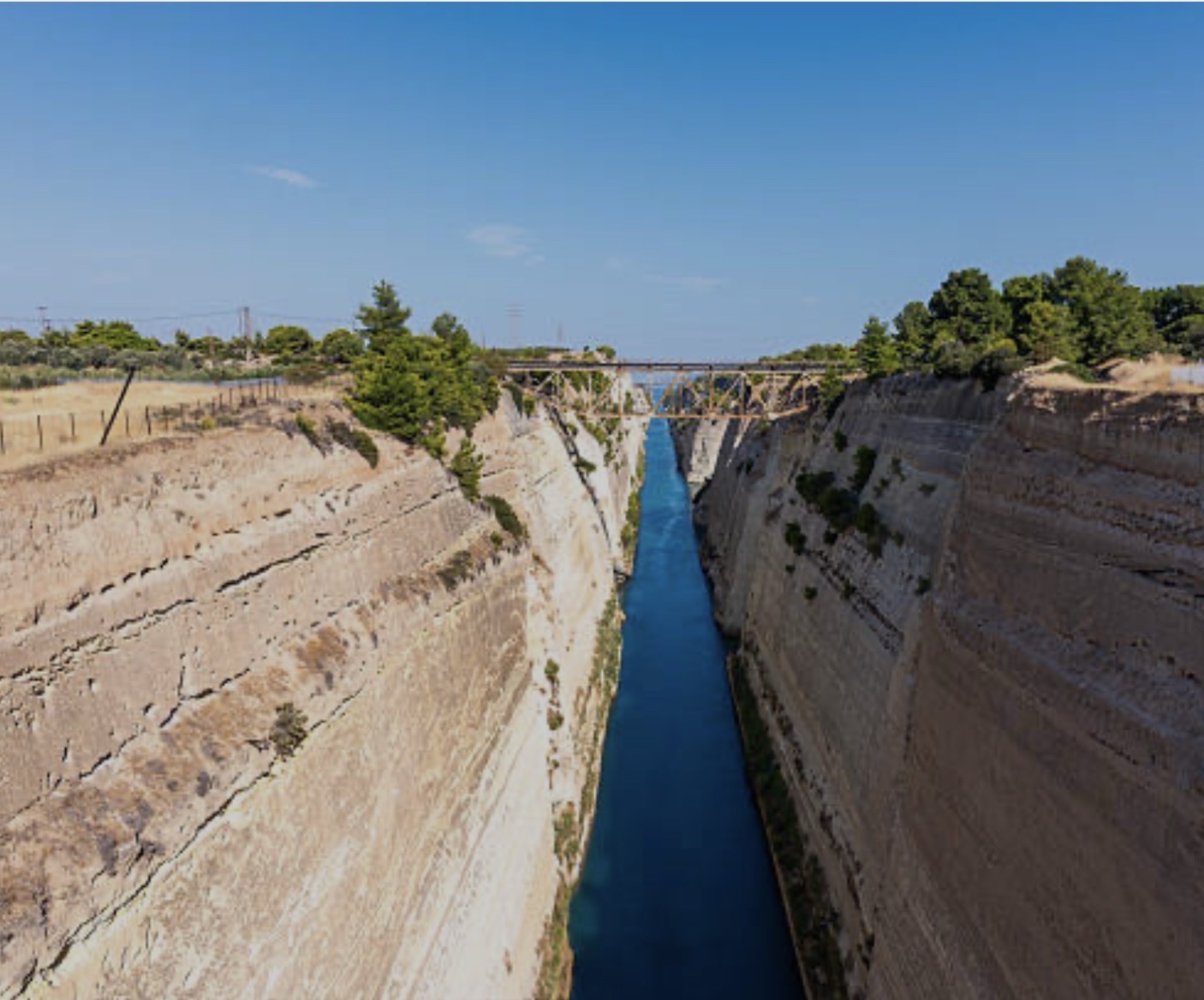
Canal before & after water
Today, the canal is both a practical waterway and a dramatic landmark. While too narrow for most modern ships, it remains a popular route for smaller vessels and cruise boats. The steep limestone walls rise up 300 feet above the water, offering breathtaking views from the bridges above. It acts as a striking reminder of how human ambition and persistence can reshape the landscape.
Drive to Athens International Airport
Athens International Airport lies about 66 miles along a fast toll route. The tolls become burdensome but the route is smooth and easy. For one who has driven in and out of airports like LAX, ORD and SFO, ATH is a breeze.
We drop off our trusty little blue Suzuki Swiftie. Everything “is fine, is perfect” becomes music to this renter’s ears. We say farewell to Swiftie after over 930 miles of beeps and flashes.

Walking to the train, we board the Metro M3 into the city of Athens. A very slow 50 minutes later, we debark in the center of Syntagma Square.
Well, We’re Not on Kansas Anymore
We ride the escalators up from the bowels of Syntagma Square Station. We departed the calm of the countryside to erupt straight into a full-blown Athens jolt—Syntagma Square in full holiday roar.
“Santa Claus Is Coming to Town” blares over the speakers and sensory overload explodes with lights flashing, trees sparkling, decorations everywhere. After a week of quiet places and empty roads, the crush of people hit us like a festive shock—electric, loud, and wonderfully alive.
Marble and Whispered Memories – 1981
“Roomed at George’s Guest House in Plaka area. Spartan, shared shower but cost is $4. It isn’t much but certainly interesting. Dutch boy shared room; a German girl stumbling in late; 2 Aussies, one sleeping on the floor. Drunk on the steps this morning added interest as did the guy in the shower! Athens smoggy, noisy and humid. Walked up to Acropolis. Marble, even in the heat, is cool to the touch. Walk up is murder. Went to the Acropolis’ Sound and Light Show. Traffic is deadly. Horn was a big mistake here. Smelly, noisy, smoggy. Everything of marble, even gutters. Many street signs are in English. Serene cemetery quite a walk but worth it. Time spent at the flea market at base of Acropolis Cape (bought wonderful pair of silver roosters and day trip to Sunion. Had great lamb and eggplant. Tourism is down because of an earthquake earlier in the year.”
Athens Lodging
My lodgings have improved quite a bit since I last visited. We stay at the Niki Athena Hotel within minutes of Syntagma Square. This room offers a private bath, refrigerator, coffee maker, cable, Netflix, and wifi. No Dutch boys sleeping on the floor.
I remember when last in Athens, the gods were angry and Zeus sent a few lightning bolts to shut off the power. This time around, Zeus remains silent, power on, and wine can chill in the fridge.
The Drunky Goat
We couldn’t resist a bar called The Drunky Goat—I mean, any establishment bold enough to name itself after a tipsy farm animal absolutely earns a visit. Their “unique service” turned out to be wine-tasting and a game where you guess the flavors in each glass. We were suddenly competing in the Olympics of Oenology!
Gabrielle and I started strong: four flavors, four correct guesses, and the smug confidence of people who suddenly believe they could be sommeliers. For one glorious moment, we believed Dionysus himself had blessed our taste buds.
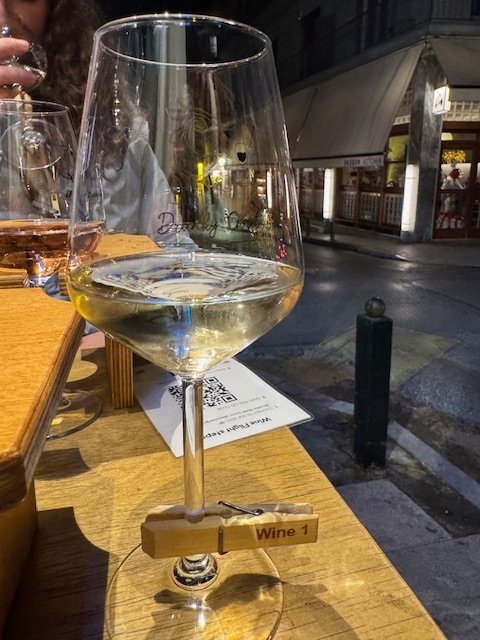
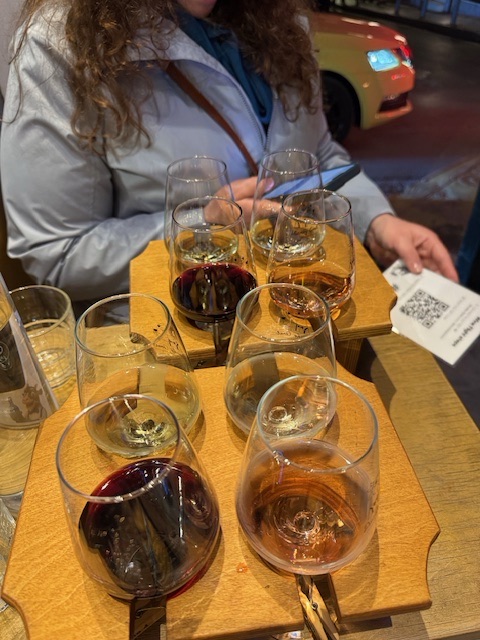
Then came the next three rounds, where our tasting superpowers faded. We limped through the remaining glasses and wrapped the night with a heroic-yet-proud-but-humbled 58%, which we’re pretty sure still earns a participation medal from Mount Olympus.
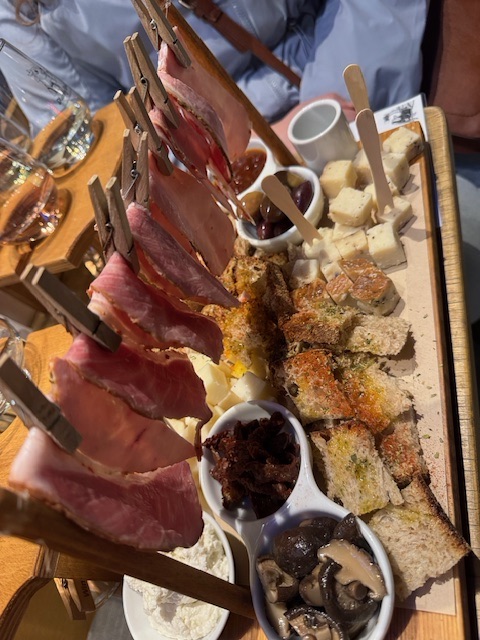
We paired all this with a charcuterie board that vanished far too quickly while we watched Athens traffic behave like its own competitive sport. Thankfully, The Drunky Goat sits only a few feet from our lodging—close enough that even if we’d lived up to the bar’s name, we could’ve staggered home without incident.

0 Comments