12 December 2025

Fortified with our usual breakfast of Greek yogurt and fruit, we face a full day filled with rocks, columns, more rocks, and ancient ruins.
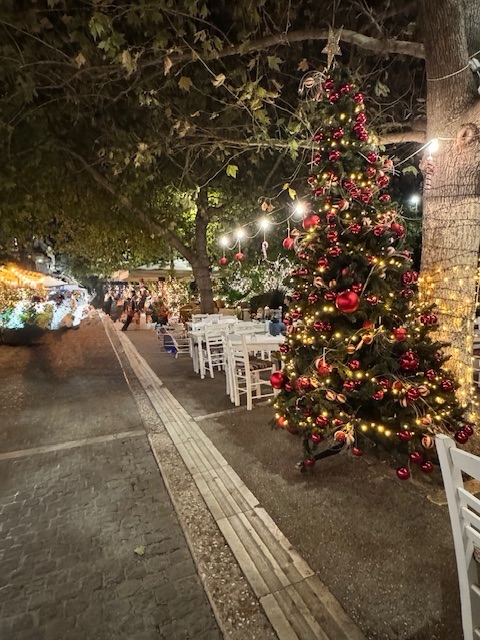
Everywhere one looks, the city is decked out for the holidays.
Athens is a sprawling metropolis of around 3.2 million people, making it home to nearly one-third of Greece’s entire population. The city stretches from the base of surrounding hills all the way to Piraeus on the Saronic Gulf. However, the city municipality consists of about 650k. Its modern life moves among layers of more than 3,000 years of history. Its core, centered around the Acropolis, is compact enough for walking.
Unique districts invite exploration beyond Syntagma Square. The Plaka, with its winding lanes and blooming bougainvillea, sits in the shadow of the Acropolis. It feels like a small village nestled in the heart of the city. The district of Monastiraki buzzes with energy — a jumble of shops, tavernas, street musicians and Byzantine churches.
Acropolis Museum
The Acropolis Museum boasts to be one of the finest archaeological museums in the world, dedicated entirely to the art, architecture, and daily life of the Acropolis and its surrounding slopes. Opened in 2009, the sleek glass-and-steel building stands opposite the Acropolis hill, purposefully aligned for views of the Parthenon through a wall of windows while exploring its treasures.
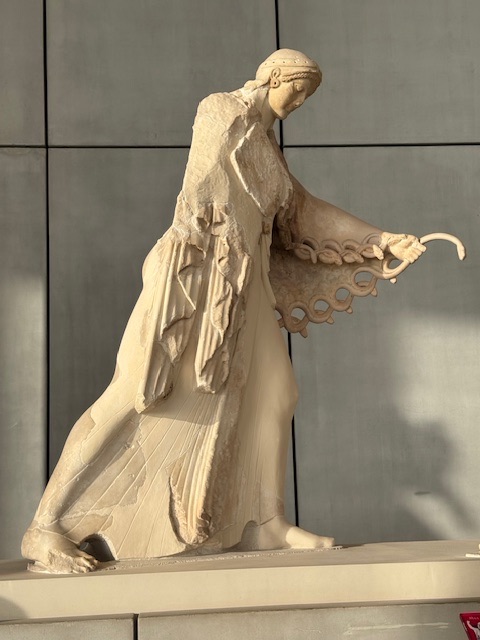
Athena defeating a Giant (a scene from the Gigantomachy, the mythical battle between the Olympian gods and the Giants.
Inside, exhibits trace the history of the Acropolis from prehistory through classical Greece, chronologically arranged over several floors. The ground level displays artifacts from the slopes of the Acropolis, including household objects, sculptures, and offerings found near the shrines of Dionysus and Asclepius. The Archaic Gallery, filled with free-standing sculptures from the 7th to 5th centuries BCE, is especially striking. Its open layout allows walking around the statues, including the elegant Kore and Kouros figures with their mysterious smiles.
The top floor Parthenon Gallery represents a highlight. This glass-walled space recreates the exact dimensions and orientation of the Parthenon, displaying the original Parthenon frieze, metopes, and pediments that remain in Greece. These sit alongside plaster casts of those in the British Museum. And no, there has been little movement toward the return of the Parthenon’s sculptures, although the British are in discussion about loaning Greece its marbles.
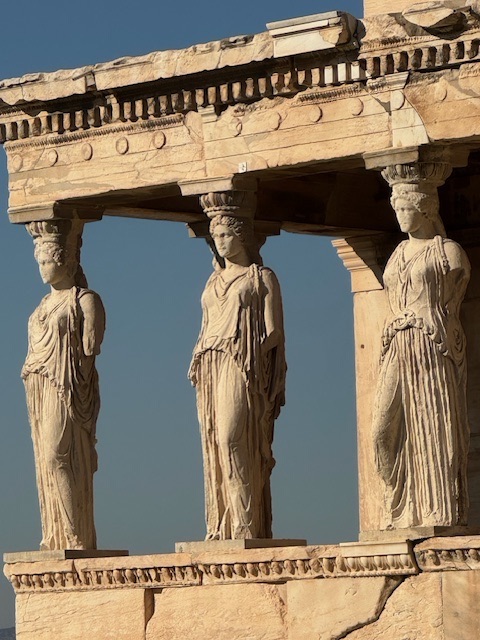
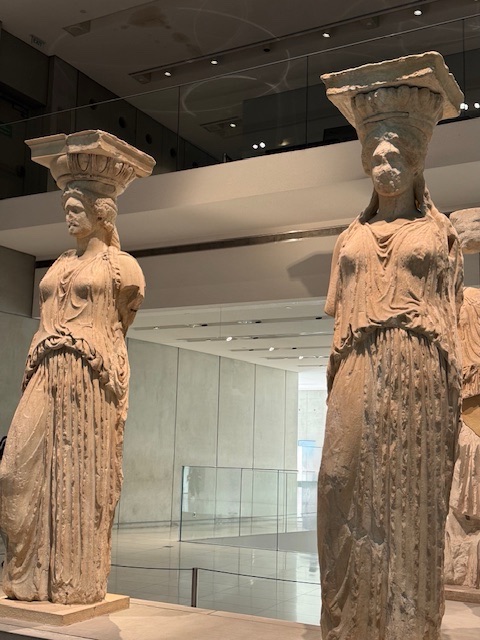
Also displayed are the Caryatids from the Acropolis’ Erechtheion, five of the six original maiden columns that once supported the temple’s south porch (the sixth stands in London). These graceful forms are shown beautifully, with space to appreciate their detail from every angle. These statues have always been some of my favorites. Reproductions stand at the original site atop the Acropolis.
Theatre of Dionysus Eleuthereus
Just steps away on the southern slope of the Acropolis is the Theatre of Dionysus Eleuthereus. The theater is often referred to as the birthplace of Western theater and dedicated to Dionysus. We’ve met Dionysus, the god of wine, fertility, and drama, as an infant in the arms of Hermes, while visiting Olympia.
In this theater, during in the 5th century BCE, the works of Aeschylus, Sophocles, Euripides, and Aristophanes were first performed. The theatre became the centerpiece of the Dionysia festivals. Athenians gathered to celebrate their god through song, dance, and the newly emerging art form of drama.
Originally built of wood, the theatre was reconstructed in stone around the 4th century BCE. Its capacity seated up to 17,000 spectators. Much of the structure lies in ruin.
Odeon of Herodes Atticus
Better restored is the Odeon on the southwestern side of the Acropolis. I once watched a great Sound and Light show from here. Alas, no longer open but a light show does occur nightly over the Acropolis. I would have loved to have heard Maria Callas perform here in 1957; even old blue eyes Frank Sinatra sang here in 1962. Or, be still my heart, Pavarotti performed here.
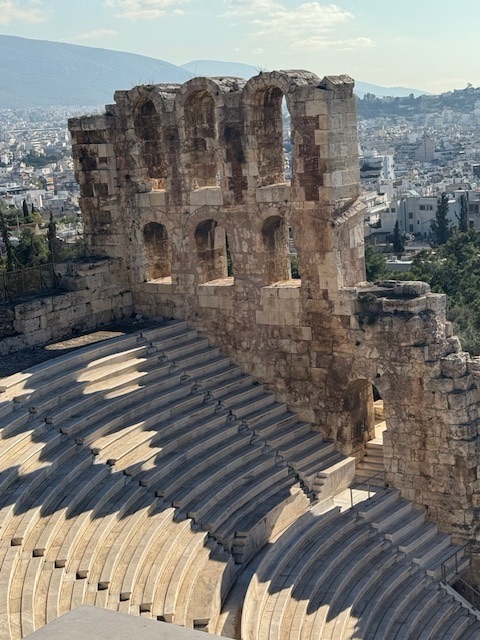
The theatre itself, built in 161 CE by the wealthy Roman Herodes Atticus in memory of his wife Regilla, once had a wooden roof and seated about 5,000 spectators. Its semicircular design and acoustics are still exceptional.
Probably the best view of the Odeon is from above. So, we walk up the gradual slope to the Acropolis entrance. I remember walking around the site in 1981, even being able to walk beneath the soaring columns of the Parthenon! Alas, no longer.
Today, the Acropolis represents the most-visited archaeological site in Greece, receiving over 4.5 million visitors in 2024! Because of this surge in visitation, authorities have introduced daily visitor quotas of around 20,000 persons with time-slot ticketing to reduce overcrowding and protect the monument.
Tickets in hand, we proceed.
The Acropolis
THE Acropolis is a magnificent complex of ancient temples and sanctuaries. It embodys the artistic and political achievements of classical Greece. Perched high above the city, it served as the religious and ceremonial heart of ancient Athens. Today, the site is no less impressive than it was over 2000 years ago. The main sites within the Acropolis are:
The Propylaea – The monumental gateway to the Acropolis, designed by architect Mnesicles.
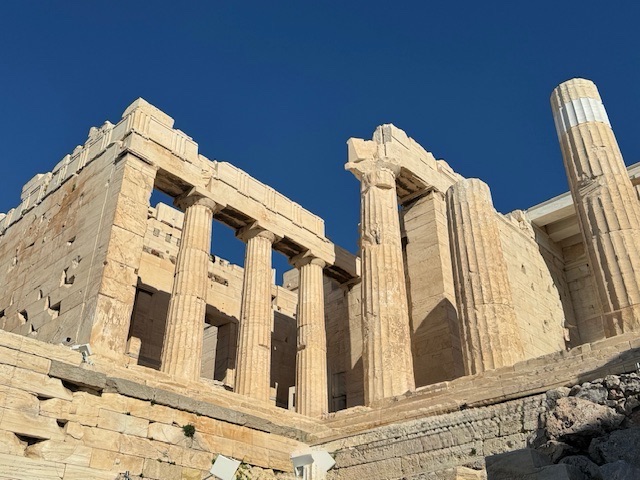
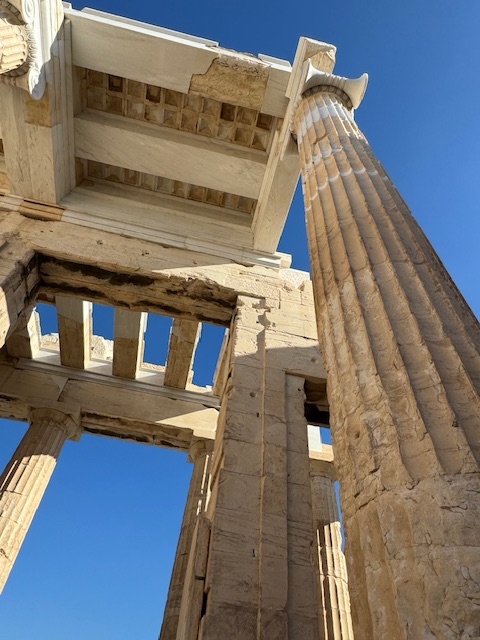
Completed around 432 BCE, it served as both a ceremonial entrance and a powerful architectural statement.It represented the transition from the profane to the sacred world of Athena’s sanctuary. This entrance acts as the main entrance to the Acropolis and sits directly above the museum.
The Parthenon – The centerpiece of the Acropolis and a global symbol of ancient Greece, the Parthenon was dedicated to Athena Parthenos, the city’s patron goddess. Built between 447 and 432 BCE, it represents the height of Doric architecture. It once housed a colossal gold-and-ivory statue of Athena. Its sculpted friezes and pediments celebrated the city’s glory and devotion to the goddess.
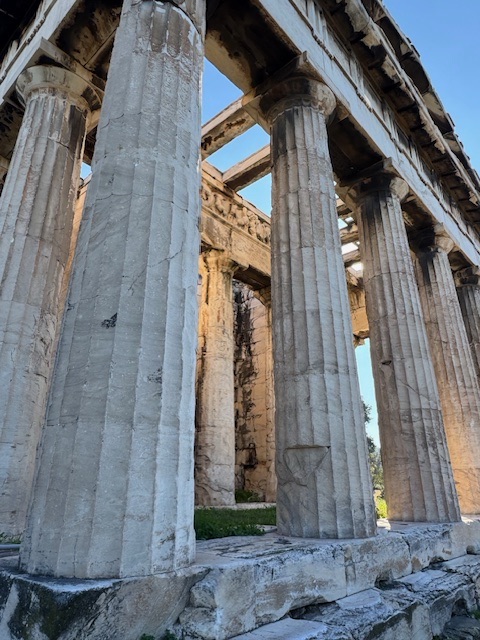
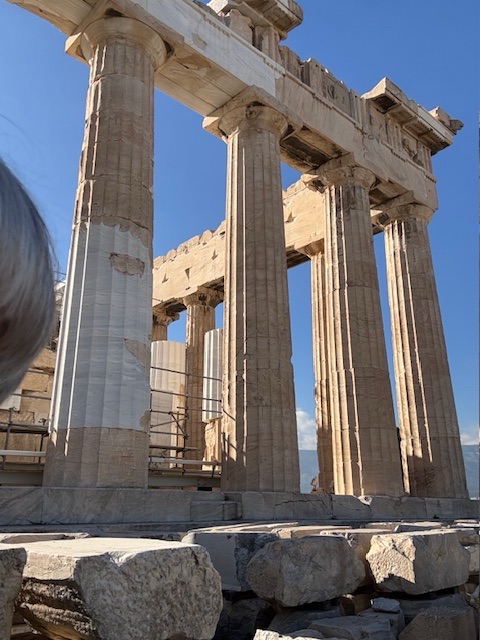
These pediments fell to the pilfering of the Britian, Thomas Bruce, Earl of Elgin. He removed the Parthenon Marbles between 1801 and 1812, during his tenure as British ambassador to the Ottoman Empire, which then ruled Greece. Ottoman authorities supposedly allowed him to make drawings, take casts, and remove “some pieces of stone with inscriptions or figures.”
Interpreting this loosely, he oversaw the removal of about half of the surviving sculptures, as well as pieces from the Erechtheion, the Temple of Athena Nike, and the Propylaea. There was nothing honorable about the theft, as Bruce later sold the marbles to the British Museum. The battle continues for their return.
The Erechtheion – A beautiful asymmetrical temple built to honor both Athena and Poseidon, reflecting an ancient mythic contest between the two gods for the city’s patronage. Its most famous feature is the Porch of the Caryatids, where six graceful maidens replace traditional columns, supporting the roof with poised elegance. The originals are now in the museum below.
The Temple of Athena Nike – Perhaps my favorite, this small but exquisite Ionic temple sits near the entrance (Propylaea), dedicated to Athena as the bringer of victory. Completed around 420 BCE, it commemorated Athenian military triumphs and offered prayers for future success. Its friezes depict battle scenes filled with motion and harmony.
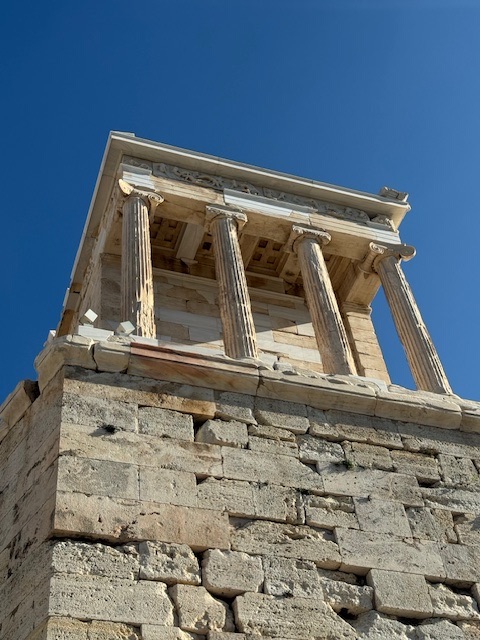
Other smaller shrines – Scattered across the Acropolis are the remains of lesser-known but important sanctuaries. These are dedicated to Artemis Brauronia, Pandion, and Zeus Polieus, reflecting the Acropolis’s broader religious role. Every step upon the Acropolis represents a history of thousands of years, thousands of speeches, and thousands of tiny steps toward the birth and development of democracy.
As one stands amid this significance, overlooking the incredible views of ancient and modern Athens, I contemplate that surely, the US could do better to protect what the Greeks knew thousands of years ago: there is nothing better that free thought, free speech, equality and the benefits of living in a democracy.
Dinner and Volta
The Italians have their passeggiata; the Greeks enjoy their volta. A volta represents a Greek social tradition. It’s the time when people head out after sunset to walk, talk, see friends, and be seen. Greeks wander through pedestrian streets and lively squares, often ending with a coffee, ice cream, or drink at a café. So, when in Athens, do as Athenians do.

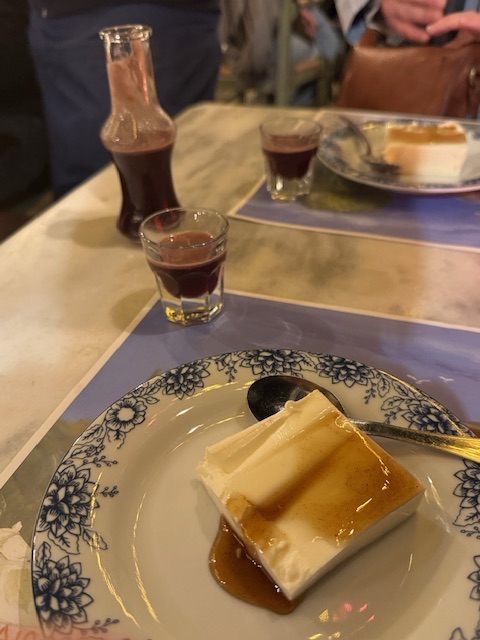

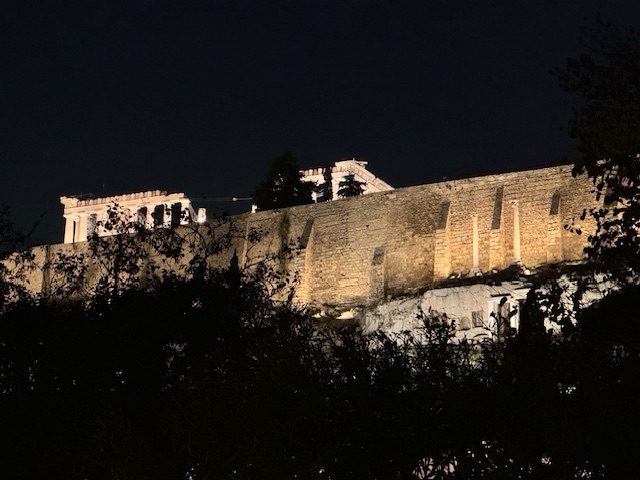
Our volta included the Dionysiou Areopagitou walkway below the Acropolis, thru the Plaka area, with a dinner stop at Dimitropoulos. Delicious fried cheese and honey, Greek salad, chickpea dip topped with a bottle of retsina. All enjoyed while the lights of the Acropolis glowed from above.
The pace is slow, the mood relaxed. Most Greeks eat dinner late, perhaps 9 pm and many restaurants remain open beyond midnight. Tonight is no different. Hoards enjoy the streets and cafes. Everywhere, holiday lights sparkle and flash.
Ah, no doubt, Dionysus would be proud.

0 Comments