7-8 December 2025
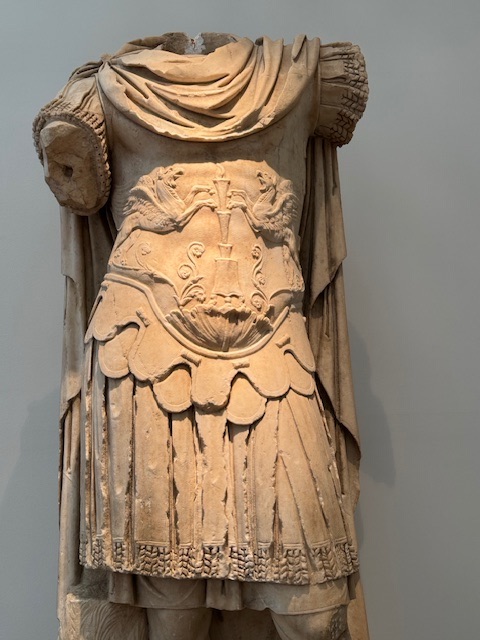
We explore warmer climes and ancient ruins, Greek myths and its heroes. The Peloponnese where ancient history, dramatic landscapes, and modern Greek life exist side by side with the likes of Oedipus, Agamemnon, Menelaus, and Hercules.
I also read Sisyphus ruled here, BBBB (Before Budging Big Boulder).
Historically, the Peloponnese represents a cradle of ancient Greece. Cities include sites like Mycenae, the legendary home of Agamemnon, the ancient theater of Epidaurus, and Olympia the birthplace of the Olympic Games.
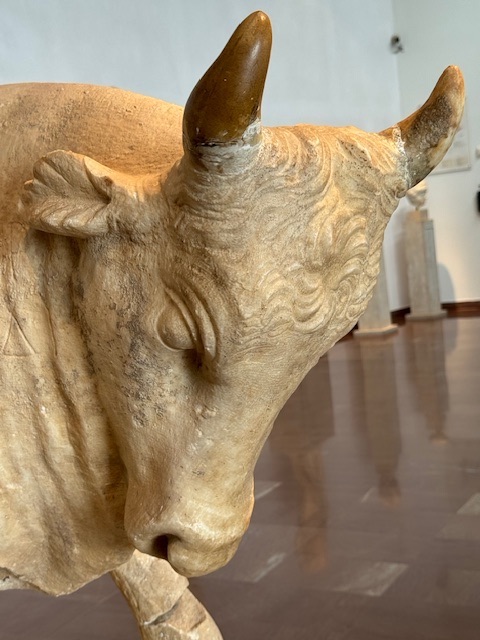
All make the region a treasure trove for history lovers. You can walk among the ruins where myths and history intertwine, imagining heroes and gods to one’s heart’s content.
Marble and Whispered Memories – 1981
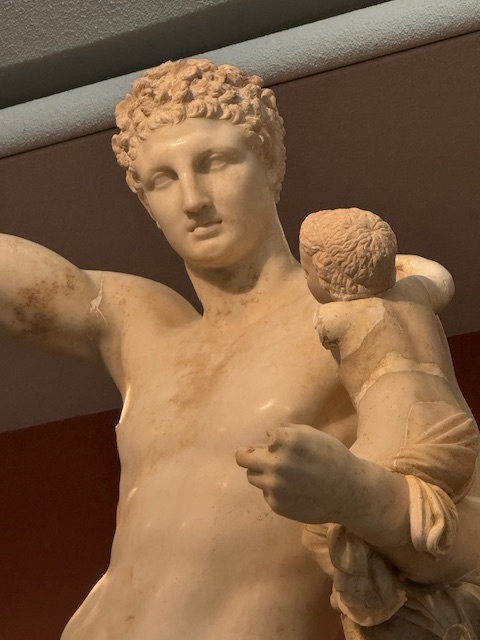
Ah, youth. I don’t remember the nasty guide nor the legs. I look forward to meeting Hermes once again.
“In Olympia few women on streets, mostly in black. There are gypsies. Narrow roads. Greener and simpler here. Crossed Corinth Bay. Water rough and breeze cold. Olympia is lots of rocks. Actually, couldn’t take my eyes off the legs of Mr. South Africa. Hotels have sit down showers and cold water. Highlight of day, beyond legs, was the guide’s talk with zipper down. Walks as if he has a rash. Ate down town via path through grapes. Quiet and no bugs. Awake to chickens. Museum and statue of Hermes, maybe the 3rd best stud.”
Ancient Olympia Highlights
Archimedes Museum
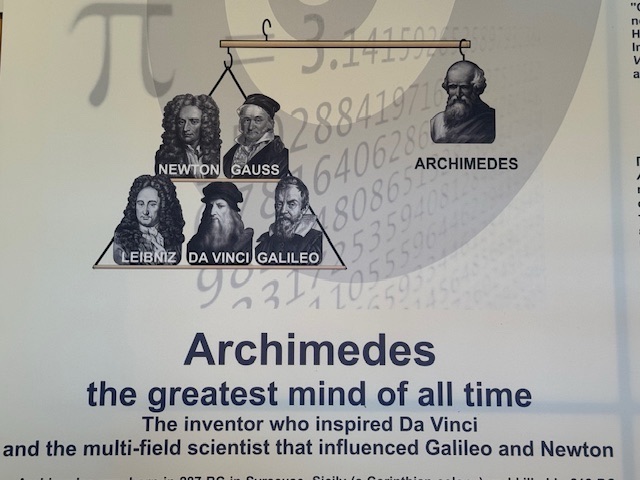
Found in the center of town, this museum dedicates itself to the great Greek polymath Archimedes. It showcases reconstructed models of ancient Greek inventions attributed to Archimedes and his contemporaries.
These include hydraulic screws, mechanical planetariums, automatic clocks, and the famous Antikythera mechanism.
Like any modern science museum, many of the exhibits are interactive, allowing me to fiddle with mechanisms, while audio‐visual material (in English) guides me through the scientific and technological achievements of ancient Greece. Displays show how ancient science and engineering intersected with culture, sport, and everyday life.
Archaeological Museum of Olympia
The Archaeological Museum is one of the most important museums in Greece, housing masterpieces from the sanctuary of Zeus at Olympia. Its exhibits trace the history of the site from prehistoric times through the Roman era.
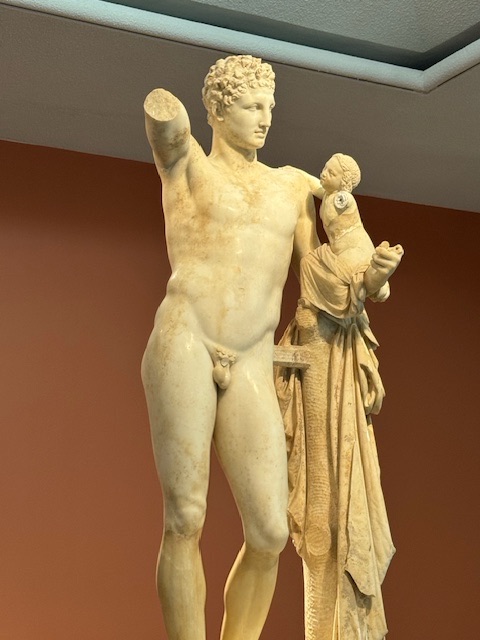
Among its most famous treasures is the statue of Hermes carrying the infant Dionysus. Dionysus was the Greek god of wine, grape harvest, and theater (credited with inventing Western theater). He also had a pretty dark side as the god of religious ecstasy, madness and frenzy. (Think Rome’s Bacchus)
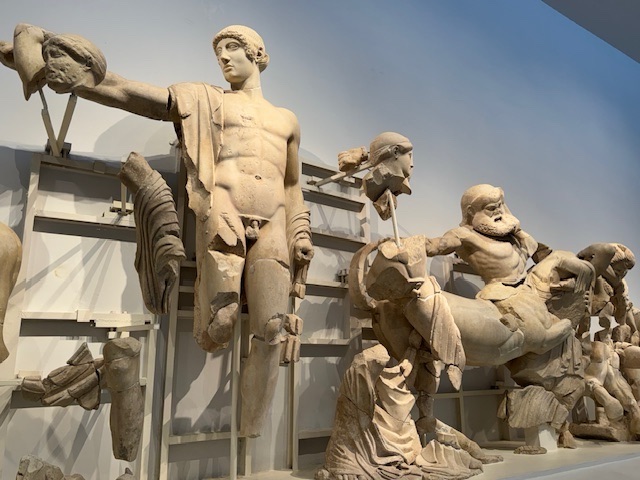
Equally striking are the marble pediments from the Temple of Zeus, which depict mythological scenes such as the chariot race between Pelops and Oenomaus and the battle of the Lapiths and Centaurs.
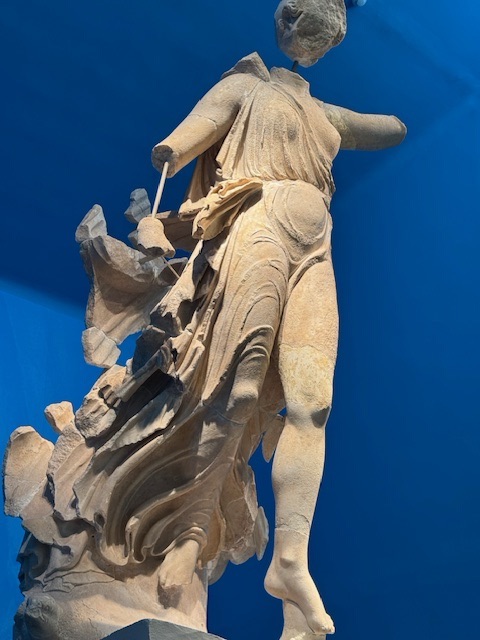
Also special is the Nike of Paionios, a dynamic and elegant statue of the winged goddess descending to earth. What I think of as its sister statue, Winged Victory of Samothrace, stands in the Louvre in Paris.
Other exhibits include countless bronze offerings, helmets, shields, and everyday objects dedicated to the gods by ancient athletes and pilgrims. This museum provides a context for understanding Olympia as both a religious sanctuary and the birthplace of the Olympic Games.
Archaeological Site of Olympia
In 1989, the Archaeological Site of Olympia became a UNESCO World Heritage Site. This recognizes Olympia’s exceptional cultural, historical, and spiritual significance as the birthplace of the Olympic Games and one of the most important sanctuaries of the ancient Greek world.
This designation encompasses the entire sacred area which includes the remains of the Temples of Zeus and Hera, the Palaestra, Gymnasium, Stadium, Philippeion, Bouleuterion and various treasuries and altars. It also encompasses surrounding sites such as the workshop of Phidias, where the sculptor created the monumental statue of Zeus.
Ruins and Reverence
The sun shines in a clear blue sky. This walking route takes us from the museum through a garden of plants native to the area. Crowds are absent. The air is cool and clear. The path leads among columns and stones.
Love a city that honors its gardens, ancient history and its current gods.
Echoes Among the Stones Of Ancient Olympia
This is where our Games started some 2800 years ago. The Olympic flame originates here each time the Games are played anywhere in the world. The site is little more than a brown, barren field of rocks and stones, yet represents much, much more to the world.
Passing under an ancient arch of stone, the landscape opens wide at the Stadium. Starting blocks are still in place, worn smooth by thousands of feet over time. You may step onto the same soil where runners once competed for olive wreaths, where honor mattered more than gold. You become a witness to ancient history resting quietly under a soft, cool blue sky.
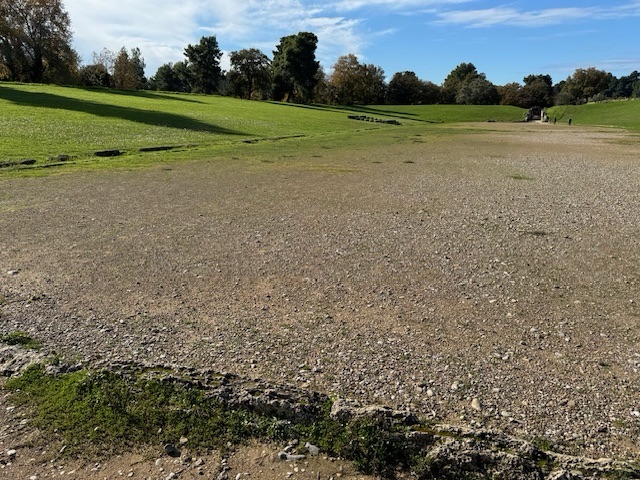
In the Gymnasium, where athletes once trained for the discus and javelin, the long colonnades stand in silence, their columns reaching like weathered sentinels across the open field. You can almost imagine the sound of sandals on the packed earth, the call of a trainer, the rhythm of movement and discipline that filled this space centuries ago. I also imagine that all the men, no women, sprinted, threw javelin and discus, and wrestled competed naked.
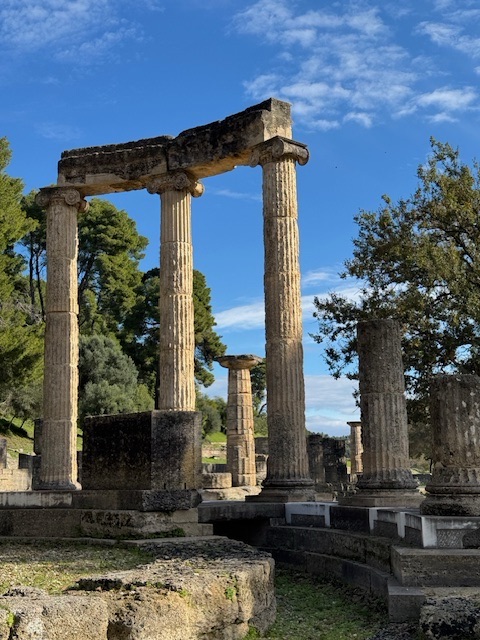
In ancient times, a sacred fire burned continuously on the altar of Hestia, goddess of the hearth, within the sanctuary at Olympia. Torches were also lit at Zeus’s and Hera’s temples as symbols of purity and divine presence. When the modern Olympic Games were revived in 1896, organizers drew on this symbolism. Since 1936, the modern torch relay begins here, passing from hand to hand across Greece and eventually traveling to the host country of the Games. All pays homage to the enduring ideals of peace, friendship and the continuation of ancient Games.
Temples of Zeus and Hera
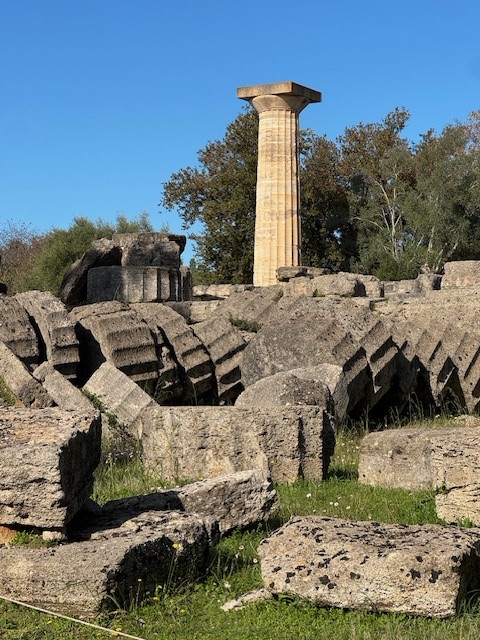
The Temple of Zeus, once the largest in the Peloponnese and the centerpiece of Olympia, was built in the 5th century BCE. It housed Phidias’s colossal gold and ivory statue of Zeus—one of the Seven Wonders of the Ancient World.
Today, massive column drums and fallen capitals lie scattered across the ground, giving an idea of its original grandeur. Standing among them, it’s easy to imagine the awe ancient visitors must have felt. Even in ruin, the site exudes a sense of massive scale and power.
Nearby stands the Temple of Hera, one of the oldest examples of Doric architecture in Greece, dating to around 600 BCE. Though much of it lies in ruins, its foundations and several standing columns clearly mark the temple’s outline. This was the home of Hera’s cult statue and many votive offerings, including the original altar where the modern Olympic flame is still lit for the relay before each Game.

Perhaps the most interesting part of process is the lighting of the torch. Following Greek tradition, each ceremonial ritual begins here. The flame is kindled using the rays of the sun, not fire or matches. A specially designed parabolic mirror focuses sunlight onto a torch, igniting it through the natural concentration of heat. This symbolizes the flame’s divine origin, connecting it directly to the gods of Olympus.
During the ceremony, a High Priestess, the ancient goddess of the hearth, leads the ritual, dressed in flowing robes inspired by ancient Greek attire. She offers prayers to Apollo, god of the sun, and then lights the first torch. The flame is then placed into an urn and carried to the stadium at Olympia, where it begins its journey. In February 2026, the ceremony will occur and the flame will travel to Milan, Italy, there to burn throughout the Games.
No Gods, Just Google Maps: Hinterland Roads
We motor westward toward the Gulf of Kyparissia on the Ionian Sea. Avoiding the tolls, our drive proves peaceful, winding through green hills covered in scrub and Kalamata olive groves and free of tractor brigades. Oleander grow along the roadside. The soft, endless blue sky mirrors the silver hue of the sea, while the mountains rise hazy in the southern distance. The two-lane national road is smooth and quiet.
On command, we turn inland, leaving the coast behind as the road takes us toward Kalamata. Greek drivers continue to attempt intimidation, bus drivers seem to play bumper tag. Neither detract from the scenery. Our little blue Swiftie scoffs at their puny attempts.
At the sign for the Archaeological Site of Malthi, I sigh with regret. Miles into these mountains lies the important ancient site of Messene, founded in 369 BCE by the Theban general Epaminondas, and established after the defeat of Sparta. As much as I would like to see Messene, recent rains have closed some roads. Swiftie prefers the bumper tag over those roads.
We point our little blue Swiftie out of the mountains toward Kalamata and tonight’s lodging. Ahead is the Messiniakos Kilpos/Messenian Gulf.
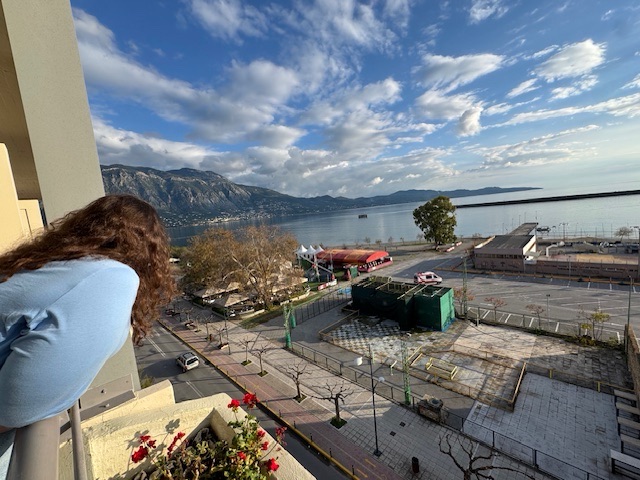
Our lodging for tonight is the Pharae Palace Hotel overlooking the gulf. We find a perfect parking spot in front of the hotel. The gods are with us.
Enjoying a well-deserved chilled wine on the rooftop, we watch the sun set behind the mountains. It’s a fine end to this Monday, December 8, as we toast the memory of my sister overlooking the blue sea and sinking sun.

0 Comments