9 December 2025
After a delicious Mediterranean breakfast—always my favorite—we leave sea and sun to retrace our drive north before turning East. After a short 80 miles or so, we reach the sparkling waters of the Argolic Gulf.
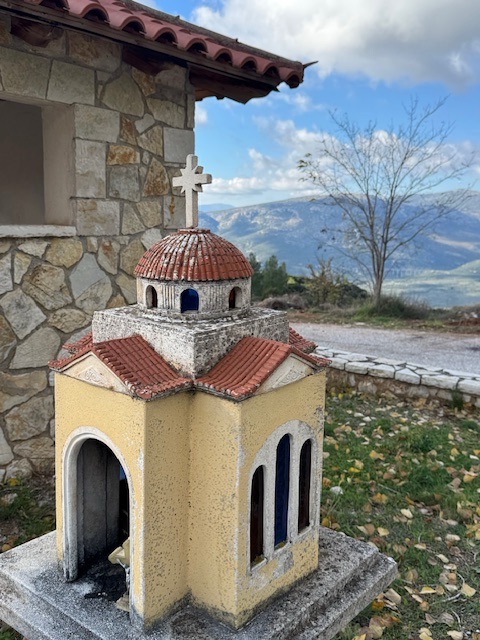
Our drive consists of some twists and turns thru the mountains of the Arcadia Region. This region, Argolis, contains major historical sites with a bit more myth and mythology.
Bumper Tag and Gas Jockeys
We have become accustomed to the crazy Greek drivers. Let them eat our exhaust. Swiftie no longer trembles when the impatient Greek narrowly zooms by while going uphill around a blind curve. So what is the mortality rate on Greek roads?
Greece ranks well above the EU average in fatalities per million inhabitants; in 2022, the rate was around 62.5 deaths/million, higher than the EU average of about 46, with speeding a key issue, especially in non-residential areas. No surprise from me. These drivers truly be crazy.
(California’s road mortality rate in 2023 was about 1.26 deaths per 100 million miles traveled. A different comparison but seems a better average to me.)
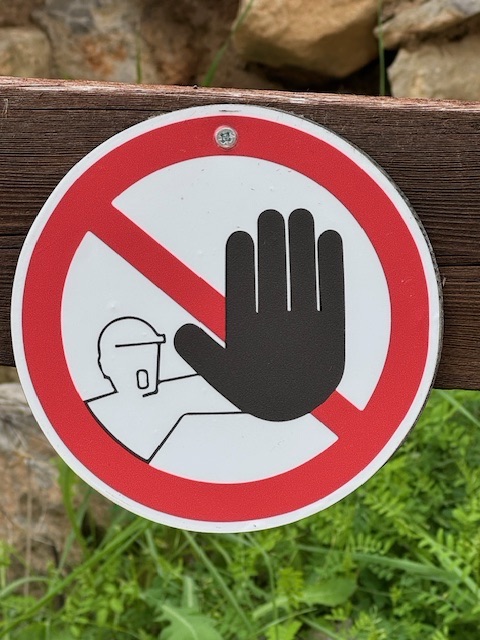
I also investigated the worst gesture you can make in Greece. The moutza is showing the full open palm of your hand with your fingers spread out like a stop sign. It’s the equivalent of giving the finger in the United States. Perhaps, for the next tail-gater?
Paid lots of tolls. Stopped for gas. Here, there is always a gas jockey to pump our gas. We just tell them “full” and use a credit card. Most have toilets but usually little in snacks to purchase.
Where Gods Once Walked?
The Mycenaean Acropolis of Tiryns is a remarkable example of early Greek engineering and power. Dating back to the Bronze Age, around the 14th to 12th centuries BCE, Tiryns was one of the great fortified cities of the Mycenaean civilization, along with Mycenae itself (located further north).
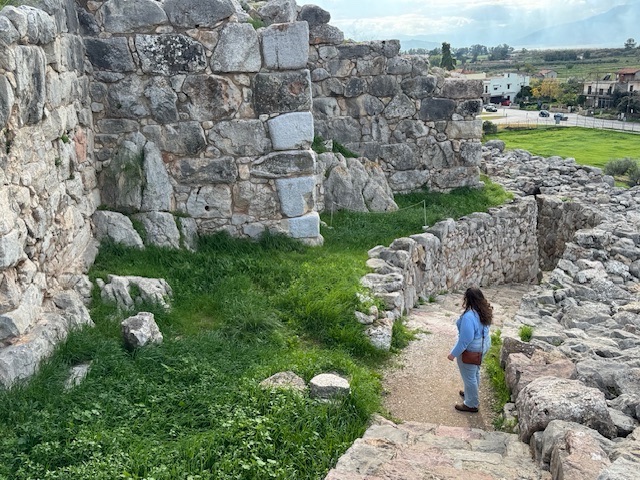
According to legend, it was founded by Perseus, son of Zeus, and later associated with Heracles, who was said to have served King Eurystheus of Tiryns.
What makes Tiryns extraordinary is its Cyclopean architecture—massive stone walls built from limestone blocks so large that later Greeks believed only the mythical Cyclopes could have lifted them.
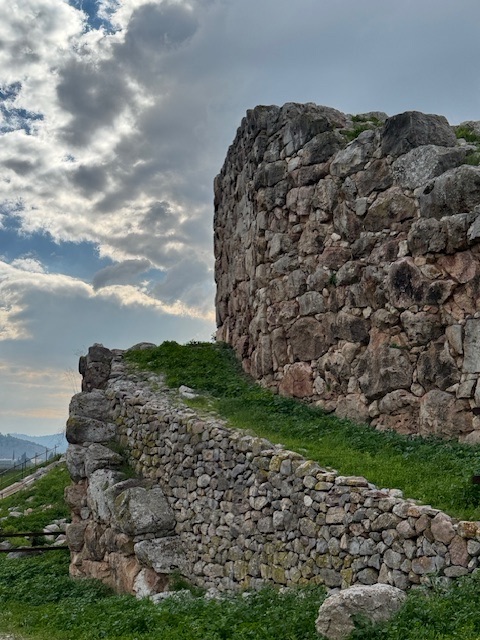
The impressive walls, built of stones even larger than those of Mycenae, are up to 26’ thick and 42’ high. Tradition says that the citadel was founded by Proetus, the prince of Argos. Pursued by his brother, Proetus fled to Lycia (thought to be southwestern part of Anatolia/Turkey) and returned bringing with him the Cyclops who constructed these enormous walls.
These fortifications enclosed palatial structures, storerooms, workshops, and tunnels that reveal the sophistication of Mycenaean society. One must use imagination as little remains beyond rock foundations surrounded my majestic long views of the mountains. Sitting on a low knoll, spectacular views encompass stretches of orchards and agriculture all the way to the gulf and Nafplio. (You also look down on the prison next door.) Massive, thick rock walls encircle portions of the site.
Tholos Tombs
Just east of the citadel, through a village and its orange and olive trees sit the Tholos Tombs. These beehive-shaped underground burial chambers illustrate the wealth and ritual importance of the powerful Mycenaean rulers and elite.

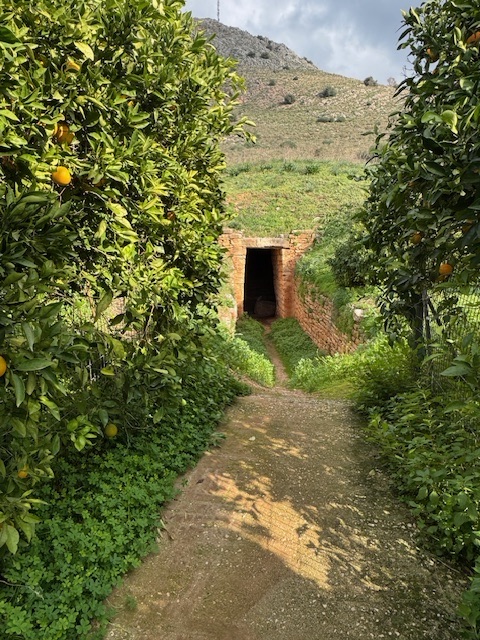
Death and the afterlife held deep significance in Mycenaean culture, and these grand tombs reflected both status and belief. They represented a lasting monument to the individual’s earthly power and divine favor. They also served as a connection between the living and the dead, with offerings and rituals performed to ensure the deceased’s protection and prosperity in the afterlife.
Architecturally, the Mycenaeans developed an ingenious method for constructing these monumental tombs. Built into hillsides, they were approached by a long passageway, leading to a tall, arched entrance framed with massive stones. The circular burial chamber was formed using corbelled vaulting, where each successive ring of stones was slightly overlapped toward the center until the top closed with a single capstone. This technique created soaring interiors that have endured for over 3,000 years.
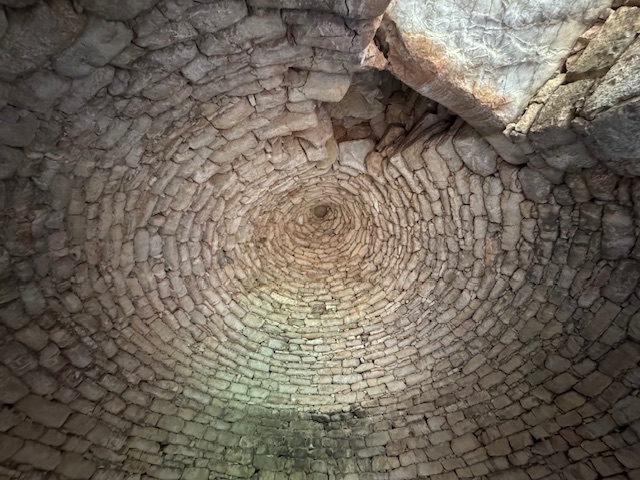
Inside, the tombs once contained luxury goods, weapons, and jewelry. These acted as symbols of wealth and power, much like the treasures found in the Tomb of Agamemnon at Mycenae.
Together, the acropolis and tombs provide a picture of early Greek power, artistry, and belief. All remnants of a civilization that set the foundations for the later legends and heroes of classical Greece.
Marble and Whispered Memories – 1981
“…ended in sunny Nafplion. Brown is beautiful; I like the firs, mountains, oleander, broom, goats, and narrow roads. Visited fortress at Tiryns before arriving to Hotel Nauplia. Nice harbor with impressive castle above town. Have date with Nicholas the Greek tomorrow for dinner.“
Nafplio
I expect Nafplio changed as much as I have in 44 years. We drive into town and leave the car in free parking at the port, then check into our lodging. We room at the Porto Nafplio near the port and overlooking Filellinon Square.
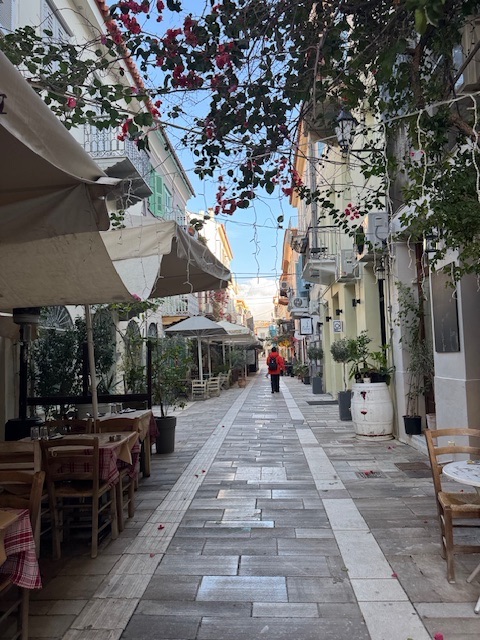
Nafplio’s Old Town represents a stroller’s delight: a maze of narrow lanes lined with neoclassical mansions, bougainvillea-draped balconies, and lively cafés spilling into Venetian-era squares. Being December, the streets are festive and decorated for the upcoming holidays. The atmosphere feels distinctly Mediterranean, with echoes of the city’s layered past—Byzantine, Venetian, and Ottoman—all leaving their mark.
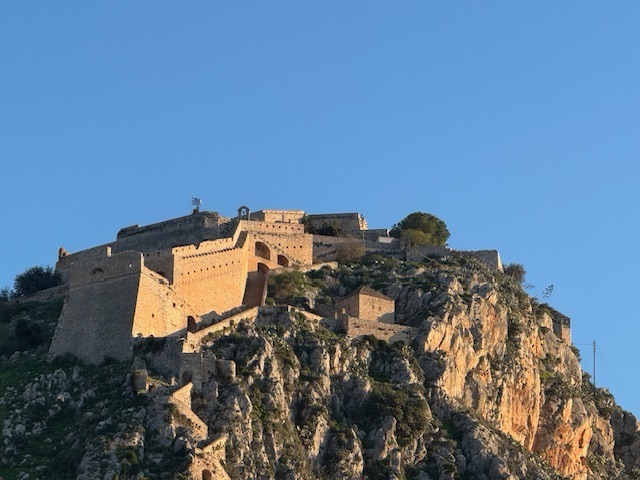
overlooking city and port.
A lively hub framed by graceful neoclassical buildings, Syntagma Square is home to important landmarks such as the Archaeological Museum, the former Parliament and the Trianon Mosque. Once known as Platanos Square for the large plane tree that shaded its center, it was renamed after the 1843 uprising in which citizens demanded a constitution from King Otto—an event that mirrored the spirit of Athens’ Syntagma Square.
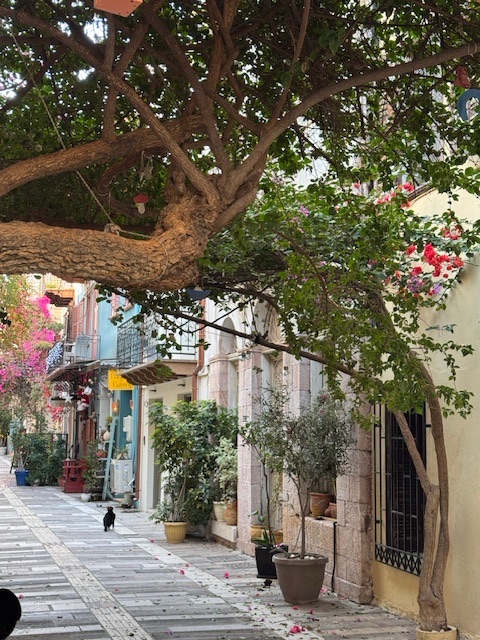
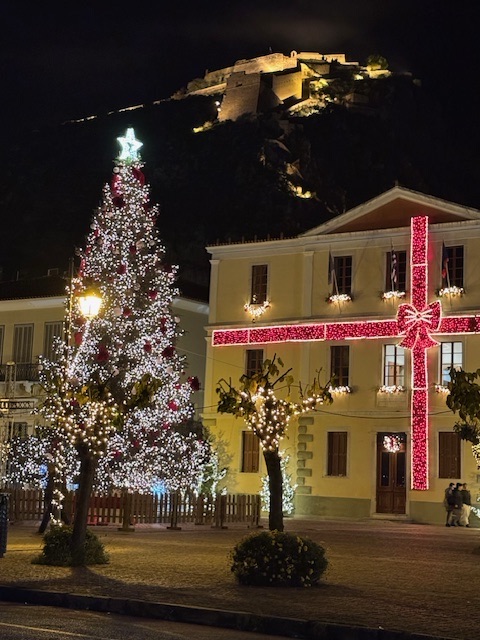
Over time, Syntagma became both political and social heart of Nafplio, serving as the seat of the first Greek Parliament. Today, the square and all Nafplio reflects a fun city filled with cafés, small shops, and an easy rhythm of local life. History and everyday charm naturally mingle, offering a perfect balance of relaxation and exploration.
Museums
In Syntagma Square sits the Archaeological Museum. Though small, the museum displays many artifacts from Mycenae and Tiryns. Built in 1713, the large stone building originally acted as a Venetian naval arsenal.
If time, a boat out to the Bourtzi Castle or a hike up the 900 steps to Palamidi Fortress might be in order. Or, preferably, drive up to the fortress. Both offer good views of Nafplio and surrounding mountains.

The War Museum is worthy of a few minutes. Also small, it chronicles Greece’s fight for independence and their part in World Wars One and Two. There is a sub-titled video highlighting Greece’s WWII resistance, or Ethnikí Antístasi, against brutal Axis occupation (Germany, Italy, Bulgaria). Armed groups of civilians, guerrilla warfare in the mountains, and sabotage tied down Axis troops and ultimately led to Greece’s liberation.
Choosing the Now Over the Ancient

Women cannot live by archaeological ruins and rocks, museums and monasteries alone. We are in Nafplio, the air pleasant, the festival lights lit.
The streets hums with life—shoppers moving about, children playing, couples lingering over wine, and old men chatting beneath the soft glow of streetlamps. Seek one more historical wonder or simply surrendering to the easy rhythm of the evening?
Gabrielle decides. The museums will wait; the moment won’t. So, we choose a table at a pleasant café, order a glass of crisp white wine with a salad and a couple sausages, and let the night unfold—saving a bit of sausage for the local cats.


0 Comments