21 March 2026
Our lesson this morning is Eid Mabrouk, which translates to Blessed Eid or Happy Eid in English. This represents the traditional greeting used by Muslims to celebrate the a major Islamic holiday: Eid al-Fitr (end of Ramadan).
We walk from our hotel down a broad pedestrian passageway toward the Rue de France and Tunis’ Medina. Large, impressive and, historically, this represented one of the wealthiest and most influential Islamic cities between the 12th–16th centuries
Medina – Walled City of Tunis
It is early Saturday, a holiday. Therefore, we walked thru an almost empty Medina. Everyone seems to be opening their stores later than usual. Perhaps sleeping in after last night’s exciting soccer match, or celebrating the end of Ramadan, Tunisia Independence Day and Saturday all in one.
Regardless the reason, our walk proved peaceful allowing one to pause and enjoy the ancient narrow streets of this UNESCO-listed Medina. We stopped at a seller of oils, Jasmine powerfully wafting thru the air.
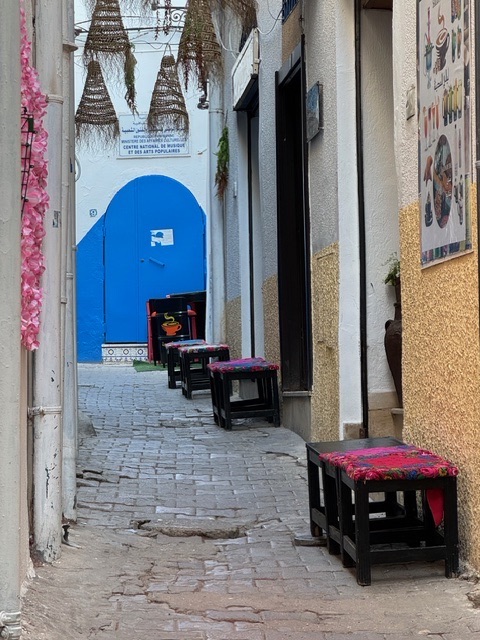
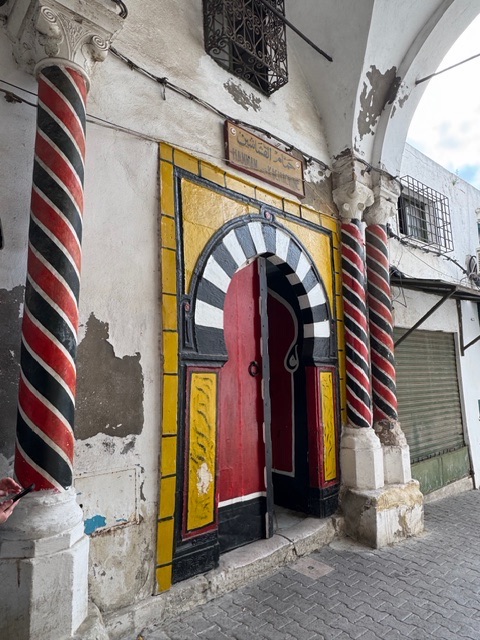
Streets tighten into a challenging labyrinth of twists and turns, smells and noisy motorbikes. Founded in 698 CE, this medina and kasbah sprawls over more than 750 acres with nearly 110,000 residents – one-tenth the population of the entire city of Tunis!
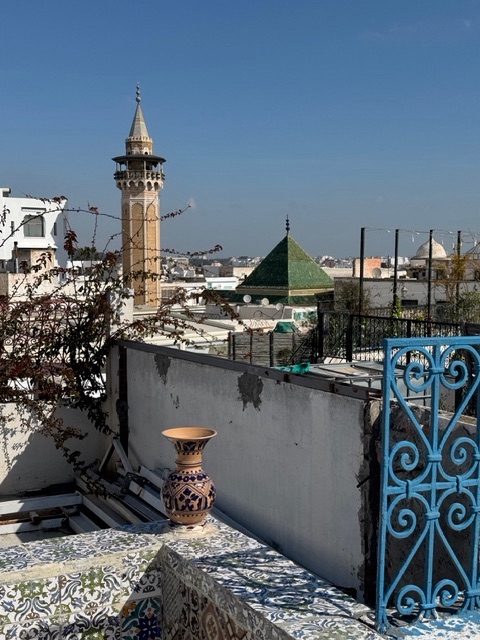
Like most medinas I’ve wandered, it thrives on salesmanship and effort. Being with a guide makes a difference with learning about the Medina yet avoiding the vendors’ hustle. Alleyways twist and funnel us past metalworkers hammering in doorways, spice sellers perfuming the air, fabric merchants stacked floor to ceiling in colorful merchandise, and cafés wedged into centuries-old corners.
The architecture and colors, like most medinas, are captivating. Interesting art decorate walls. Photo opportunities abound.
Unlike many medinas, much of what’s sold here is still bought by Tunisians, which gives the shopping an everyday feel rather than the polished sameness of places designed purely for tourists. Be it leather slippers (balgha), belts, copper items, teapots, door knockers, textiles, oils or spices and foods one will find it here. I’m not sure how much has a Made in China sticker, but I’m thinking most of this is local.
Bardo National Museum
We stop at the Bardo National Museum, a repository for some of the world’s finest Roman mosaics, as well as many works of Tunisia’s art from centuries past.
The mosaic galleries are astounding, especially those from Roman villas in Carthage, Sousse, and Dougga. The Triumph of Neptune mosaic is a standout – a vibrant mosaic of the sea god in his chariot pulled by hippocampi. A hippocampus is a mythical sea creature from Greek and Roman mythology. It has the front half of a horse and the back half of a fish, essentially a sea-horse on a heroic scale. These creatures were said to pull the chariots of sea gods, especially Neptune (Poseidon).
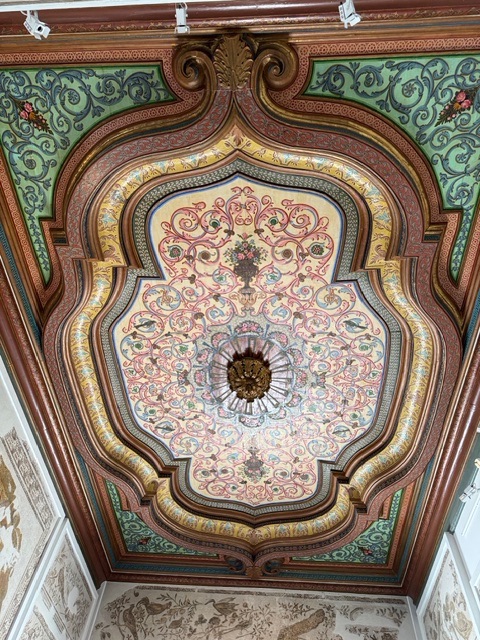
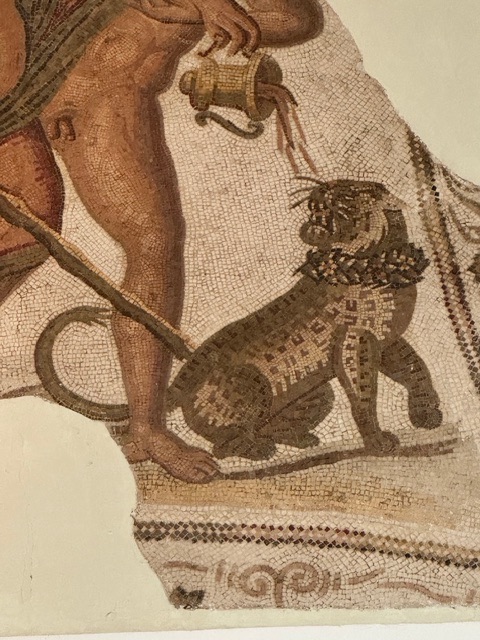
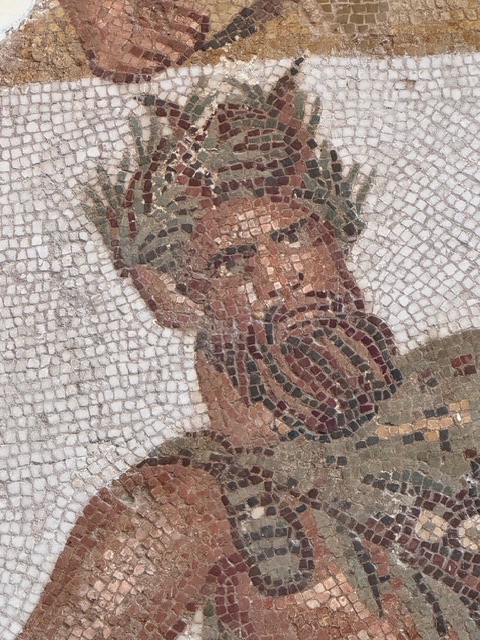
Nearby, the Mosaic of Virgil represents one of the earliest known images of the poet. It depicts Virgil seated with the muses and holding lines from the Aeneid. Hunting scenes, seasonal allegories, and everyday-life mosaics round out these rooms and bring Roman Africa to life. These aren’t just pretty floors; they’re time capsules in stone depicting ancient history with scenes of gods, heroes, everyday people, hunting parties, sea creatures, and mythic epics. The wealthy Roman tended to live well.
But, the Bardo isn’t just mosaics. The museum’s setting — a repurposed palace complex with courtyards and grand halls — mirrors Tunisia’s layered history. Its galleries span Punic Carthage (with votive stelae and funerary objects revealing the beliefs of a once-mighty Mediterranean power). Roman sculpture and everyday artifacts, and early Christian and Byzantine pieces chart cultural shifts after Rome. There’s even rich Islamic art and calligraphy, glazed ceramics, manuscripts, and scientific instruments that reflect Tunisian life under successive dynasties.
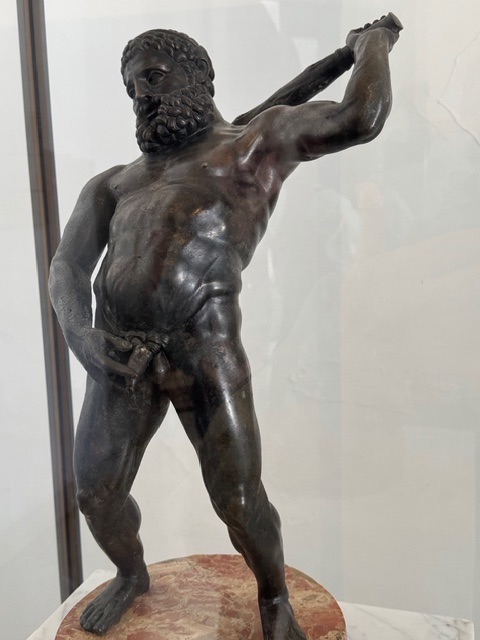
Among the all sit classic sculptures. Even so, it turns from awe to awkward when one comes upon this bronze of a risqué Hercules.
Lunch
We enter through unassuming doors and up a staircase to find a beautiful balcony room courtyard. The noise of the Medina fades to a low yell. Our meal unfolds. Bread arrives warm, torn by hand and dipped into olive oil fresh and grassy.
We have a choice Salad tunisienne comes next —finely chopped tomatoes, cucumbers, onion, and tuna slicked with oil and garlic—followed by unmistakably local dishes.
Tunisian brik is a crispy, deep-fried pastry made from thin malsouka sheets (similar to filo). triangular-shaped, filled with a whole egg, tuna, parsley, capers, and mashed potatoes. with lemon wedges. Extremely greasy and delicious.
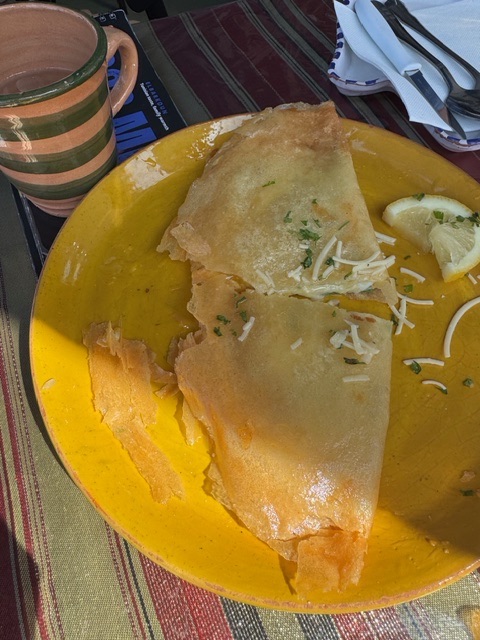
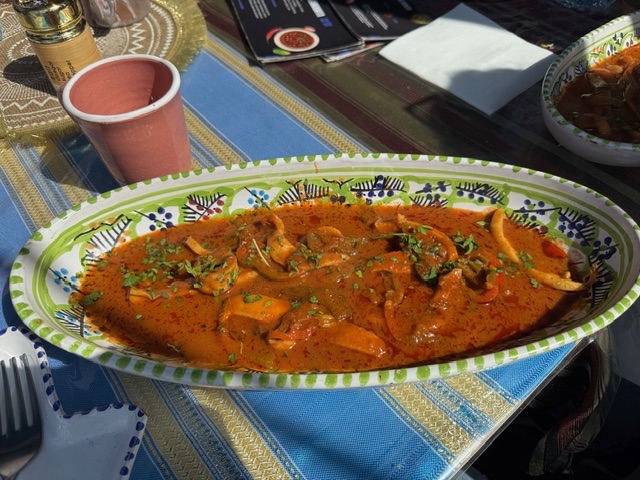
The couscous comes piled high with vegetables and two thin bread sticks poking up, not as chopsticks but for eating. Ojja bubbles in shallow pans, eggs poach in spicy tomato and pepper sauce. However, I order the kamounia stew with calamari. Its rich, fragrant flavor comes from the generous use of kamoun, or cumin. The food is delicious! Not a big bread enthusiast, I happily use a crust to clean every drop of sauce from my plate.
Karthago/Carthage
Carthage was founded by Phoenician settlers from Tyre in the 9th century BCE and grew into a powerful city-state dominating trade across the western Mediterranean. The legendary Queen Dido is said to have founded Carthage after fleeing Tyre; her story is immortalized in Virgil’s Aeneid.
Carthage became famous for its wealth, sophisticated harbors, and skilled navy. Carthage’s rivalry with Rome led to the Punic Wars, the most famous being the Second Punic War with Hannibal crossing the Alps. After Rome finally destroyed the city in 146 BCE, it was later rebuilt as a Roman colony and flourished again under imperial rule.
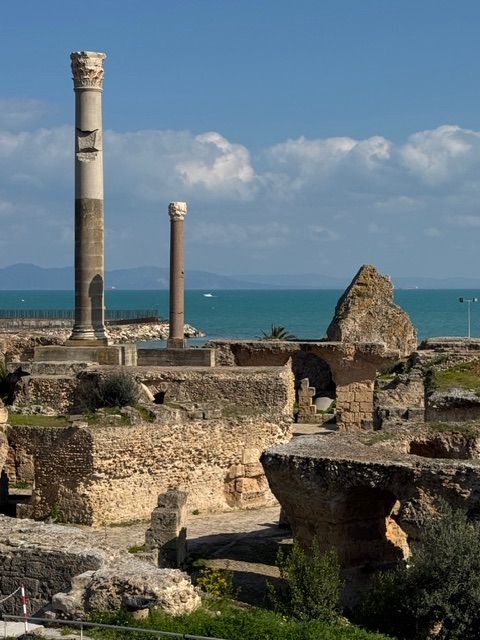
Today, the ruins of Carthage are a mix of Punic, Roman, and early Christian remnants. We explore the remains of ancient baths, villas, and amphitheaters, as well as the Punic port that once made Carthage a maritime empire for five centuries.
Antoninus Baths
The Antoninus Baths represent the ruins of a massive Roman bath complex built around the 2nd century CE, during the reign of Emperor Antoninus Pius. They were one of the largest Roman baths in Africa and accommodated thousands of people at a time. It served not just as a place to bathe but as a social and cultural center for the city. The complex included hot and cold rooms, a frigidarium (cold pool), a tepidarium (warm room), a caldarium (hot bath), as well as exercise areas, gardens, and spaces for conversation and relaxation.
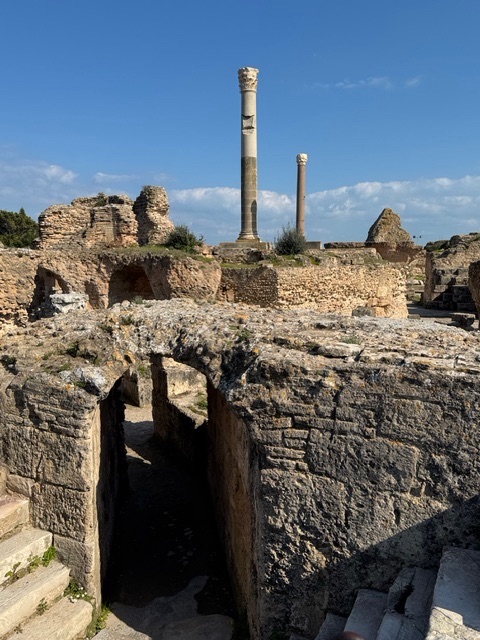
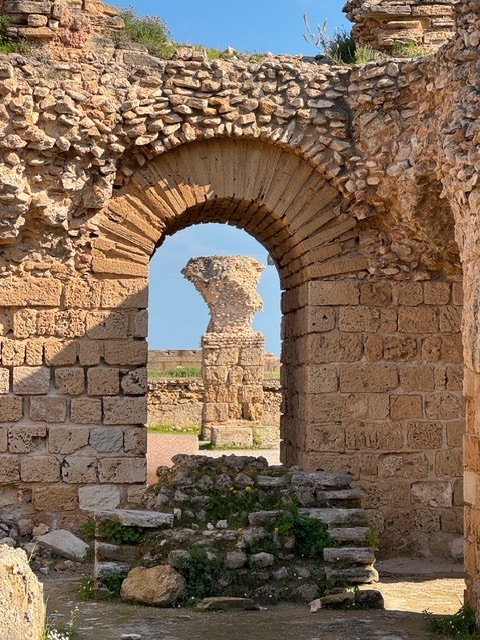
Visiting the Baths today, one sees vast stone foundations, towering columns, and the remnants of the intricate plumbing and heating systems that made the baths function. Even in ruins, their scale is impressive, giving a sense of the grandeur of Roman Carthage and how important these baths were to daily life. It’s easy to imagine citizens strolling through marble halls, meeting friends, and discussing business, politics, or philosophy. Much as people do in cafés today.
Also found at this archaeological site are the foundations of Roman Villas with floors of intricate mosaics depicting daily life, mythology, and nature scenes. The most famous include mosaics from the villas of Bordj Djedid and La Malga.
Byrsa Hill
Atop Byrsa Hill, I enjoy the sweeping views of the blue Mediterranean and the nearby coastal cities and ports. Commanding the top of the hill overlooking the Punic residential ruins of Carthage sits the Saint Louis Cathedral. Built between 1884 and 1890, it was constructed to honor King Louis IX of France (canonized as Saint Louis), who died on this site in 1270 during the Eighth Crusade.
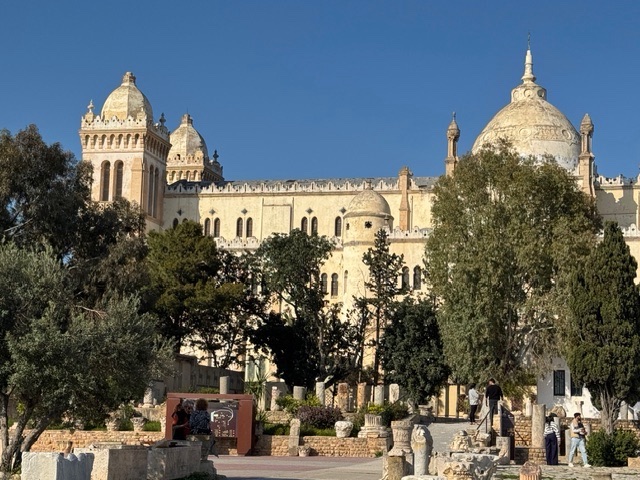
The Cathedral is largely unused, designed in a Byzantine-Moorish architectural style, located at the highest point of the historic Byrsa Hill. The interior, plain and dark in spite of a soaring ceiling, looks to be under long term renovation.
The Byrsa Hill area also contains traces of the original citadel and the small Carthage National Museum, which was also closed. However, one can walk around the area and enjoy the views.
Hannibal Slept Here
Carthage had several famous residents. The most famous is Hannibal Barca, the brilliant military commander who led Carthage’s forces against Rome during the Second Punic War, famously crossing the Alps with elephants.
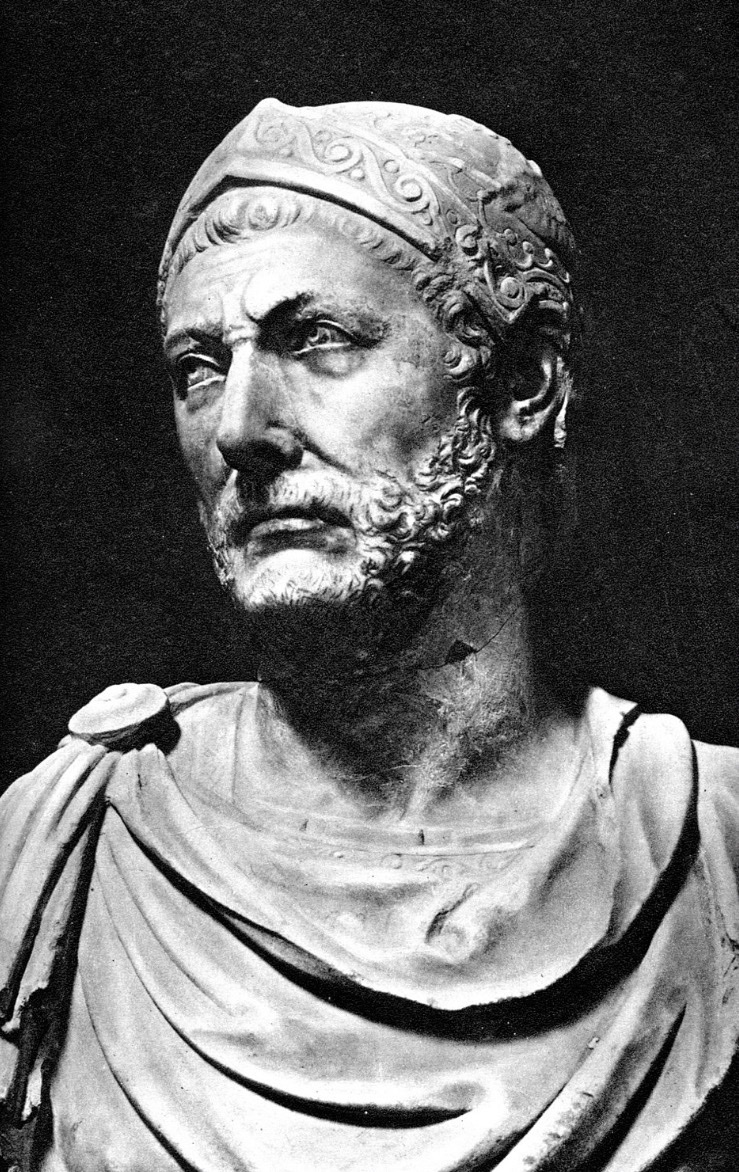
His father, Hamilcar Barca, was also prominent, expanding Carthage’s influence in Spain and setting the stage for Hannibal’s campaigns. Hannibal’s Hannibal’s brothers also fought here.
Walking through the ruins of Carthage today, one imagines the lives of its famous residents. On Byrsa Hill, where Queen Dido is said to have founded the city, you can picture her overseeing the earliest walls and harbors. The ruins and artifacts reflect the ambition and drama along its streets and hillsides. Its massive Roman villas and mosaics hint at the wealth and sophistication that generals like Hamilcar and Hannibal inherited. Meanwhile, the remains of military installations remind me of the campaigns that brought the Barcas fame—and Rome’s hostility.
North Africa American Cemetery and Memorial
The North Africa American Cemetery is a serene 27-acre burial ground overlooking the ruins of ancient Carthage. It honors American soldiers who died in the North African campaigns of World War II. Dedicated in 1960 and maintained by the American Battle Monuments Commission, the cemetery contains the graves of 2,841 U.S. service members (mostly American but a few Canadians) most of whom fought in Tunisia between 1942 and 1943, including those involved in the pivotal Operation Torch and later battles such as that at Kasserine Pass.
A memorial court lists the names of 3,724 missing in action, and mosaics and maps illustrate the broader North African campaign. Like all American National Cemeteries located on foreign soil, this site is lovingly cared for and exudes a quiet dignity.
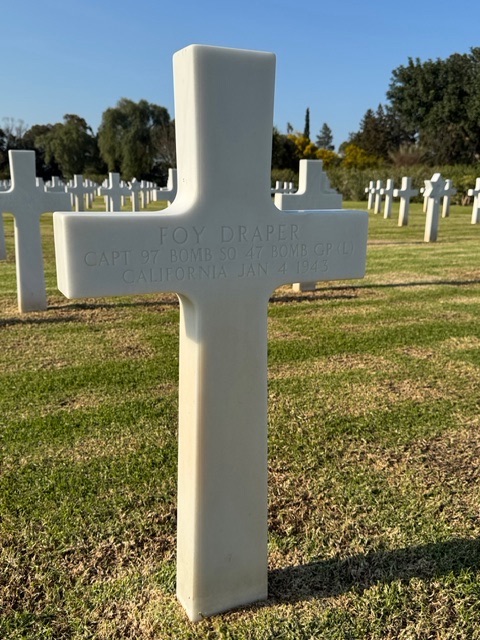
White marble headstones stand in long arcs, framed by Mediterranean gardens. Each marker tells of a soldier who died fighting in the Allied campaign in North Africa. One of those honored is Captain Foy Draper.
During World War II, he served as a pilot on a twin-engine A-20B Havoc in Thelepte, Tunisia. On January 4, 1943, he and two crew members took off to fly to Fonduck, Tunisia, to take part in the Battle of Kassarine Pass, but the plane disappeared and the three men were never heard from again.
Captain Draper also won an Olympic Gold Medal. He competed in the 1936 Summer Olympics in Berlin, Germany, where he won a gold medal in the 4×100 meter relay with Jesse Owens, Ralph Metcalfe, and Frank Wykoff, setting a new world record of 39.8.
Sidi Bou Saïd
Our day ends with a visit to the village of Sidi Bou Saïd. Perched on a cliff overlooking the Mediterranean just north of the ruins of Carthage and overlooking the Bay of Tunis, the village is famous for its blue-and-white Andalusian architecture.
I visited here in 1981 and didn’t like it then and still don’t. It feels like a tourist trap with its souvenir shops, cafes, and crowds. Shoulder to shoulder crowds. Most were Tunisians enjoying g the weekend holiday but the crowds left little room to move.
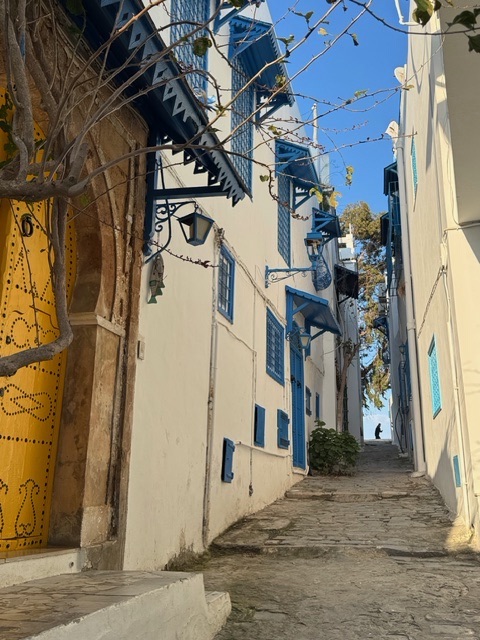
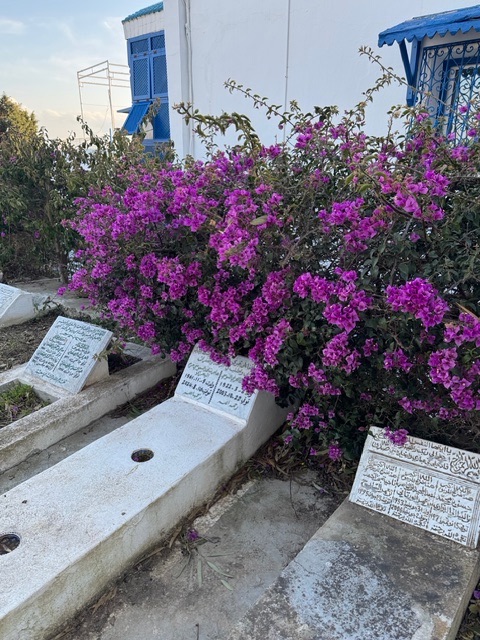
Gabrielle and I turned around to flee up a small side street where we were the only people. A few blocks later and a couple turns and we were looking at the same view as the crowds – alone. Next to the cliffs and spectacular view of the bay sits a small Muslim cemetery. Close by is a small balcony which overlooks the city. Pleasant, only a few locals, and magnificent views.
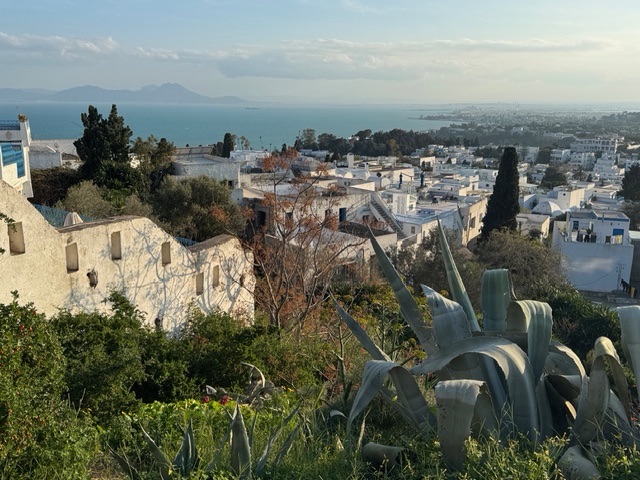
However, the narrow streets, flowering balconies, and whitewashed houses are picturesque. Artists, writers, and musicians have been drawn here, including French painter Paul Klee. So, I will give it that.
Long Day, Good Food
We cruised around the bay and ports of Tunis. We finally stopped in the small but busy village of La Goulette. There, we stared eye to eye with the fish we would eat. We enjoyed dinner in a noisy, lively atmosphere, dining on good fish, but no alcohol served.
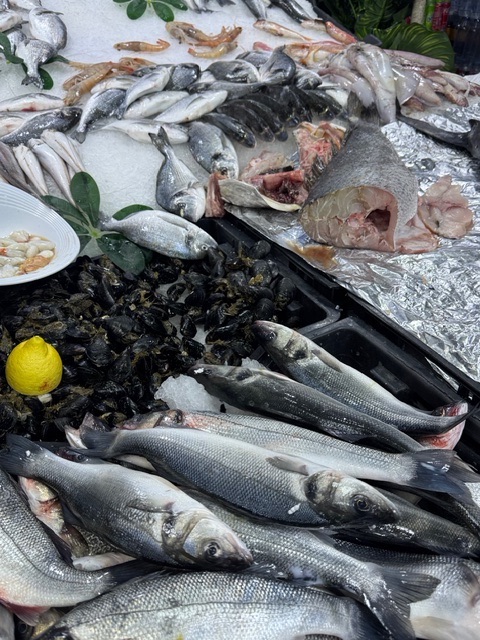
We returned to our lodging at the Radisson totally sated for the day. Tomorrow it is an early departure.
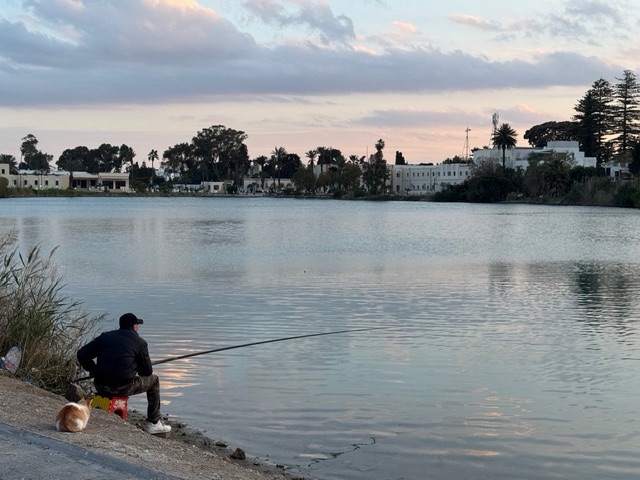
السَّلامُ مَعَكَ، ومياهٌ هادئة، وقطٌّ أليفٌ بقربك.
Peace be with you, calm waters,
and a friendly cat by your side.
