1-3 December 2025
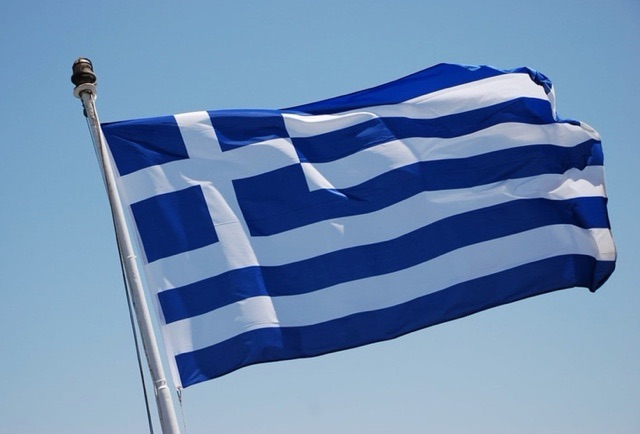
I told my niece Gabrielle, “You choose a place to travel this winter—just warm and keep it simple. ” She chose Greece, and that sounded perfect to me. I hadn’t been back since the summer of 1981, when I was younger and pretty naive about all things travel.
Returning now felt a bit like starting over, a novice once again, ready to rediscover a newish country—this time with a slower pace, a keener eye, and the easy company of my niece.
I won’t repeat the saga of our challenges of facing severe weather, tons of snow, cancelled and delayed flights. For that, read all about it in The Epic Greek Saga of Pat and Gabrielle.
I will add, I had broken my long-standing rule of “front of the bus” and we both flew premium economy—mostly aboard Lufthansa. All that changed as events of our Greek Tragedy unfolded, the flights booked becoming less important than just getting both Gabrielle and I into our final destination on the same day.
I generally like Lufthansa, but their maddening seat-assignment policy drives me crazy. Somehow, I couldn’t choose a seat, while my niece got a seat but we knew it was probably an imaginary one. Some things about air travel just defy logic, and Lufthansa’s seating system is near the top of that list.

In an attempt to cushion the blow, I paid to reserve a seat for the outgoing flight but drew the line on my return. The only option available was a middle bulkhead seat—WTF! No offense, Lufthansa, but paying extra for the only open seat in the cabin felt like adding insult to injury. So, I refused, curious to see what seat I’ll end up with when I check in for my flight home.
Anyway, I’ve made a New Rule: no more Lufthansa for outbound flights. I’ll avoid them entirely for long-haul trips. I may not be able to steer clear of them within Europe, but when it comes to flying in or out of the U.S., I definitely can—and will.
The Road to Delphi
We rented a car for our road trip around Greece. Though my niece researched the itinerary, I am in disbelief of one finding in particular: the cost of car rental. In just the last year I have paid over $700 for a week rental. Four Days in France cost $462. One day in CA cost me $152. Gabrielle found an economy car for $128/week. “NO WAY” I say. Check age limits, I ask. No limit, she writes me.

Ultimately, I play it safe and rent directly from Budget. Economy car (Suzuki Swift), with a second driver, 9 days. Cost? $180.41. I am still in disbelief. Maybe a New Rule: only travel in winter.
After an overnight rest at the comfortable Sofitel, we walk the few feet to the airport rental kiosk. After 15 minutes, we are on the road and heading north. First destination: Delphi
Taste of Toll Roads
Road conditions are generally very good. Greece’s motorway network is the biggest one in Southeastern Europe and one of the most advanced in Europe. Greece is part of the European E-road network, with multiple E-roads crossing the country. The A-Motorways are 4-6 lanes. National Roads (Expressway) are dual lanes of traffic. Motorways have their own white-on-green signs, while National Roads are designated by white-on-blue signs.

Then there are the sections requiring a toll. An electronic tag can be used by locals. Otherwise, cash and credit card/Apple Pay is our friend. Typical toll is between 2 and 5 Euros. Reasonable prices but anytime possible, I usually choose an alternative route and enjoy the detour.
Building Greece’s motorway network was a demanding project because of the challenging terrain. The mainland is extremely mountainous, and both the rugged topography and environmental concerns to protect local flora and fauna influenced the final route design.
To overcome obstacles, engineers relied extensively on tunnels and bridges—about 150 tunnels were constructed along just four of the country’s major motorways, with a combined length of roughly 124 miles.

Our route introduces us to the Greek Toll Road system. One must weigh the situation: time and convenience or checking out the locals. Today, our route is long and we want to directly drive to our destination. We choose to meet the tollsters.
There is little traffic on the roads once past Athens. Driving style seems to be somewhat fast and improvisational. I’ve read that locals may pass on curves, use hazard lights as signals, or stop unexpectedly. All true. These drivers be crazy!
We travel Northwest through miles and miles of agricultural land and hot houses. Brown fallow fields and bright green acres of wheat and barley flow by. Mountains appear in the distance. I look for snow-none yet. Price of petrol is also of interest. Currently about 1.79€ a liter, about $8 a gallon!
Thiva
First stop in the road is Thiva. One could miss it if not aware this represents “Seven-Gated Thebes” as written by Homer in his Iliad. This is one of the oldest continuously inhabited cities in the world. Thebes gave birth to Dionysus and Hercules. Antigone, the first tragedy known in world literature, took place in Thebes. Here, Oedipus was king but later exiled because he unknowingly killed his father and married his mother. After a history of triumphs and defeats, Thebes was destroyed by Alexander the Great around 335 BCE.
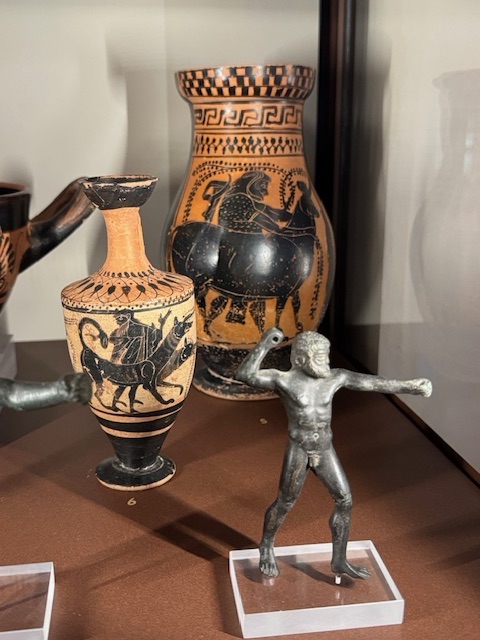
The Archaeological Museum of Thebes presents a fine collection of findings spanning the history of this region of Boeotia from the Paleolithic to the early Ottoman period. Fortunately, information written in English.
One can be overwhelmed by artifacts representing millennia of time but having read Greek mythology, Homer’s works, and a bit of history, some is at least familiar.
Monastery of Hosios Loukas
A second stop along our route is the Holy Monastery of Hosios Loukas. This beautiful Byzantine-style monastery dates to the 10th and 11th century and features spectacular mosaics and frescoes.
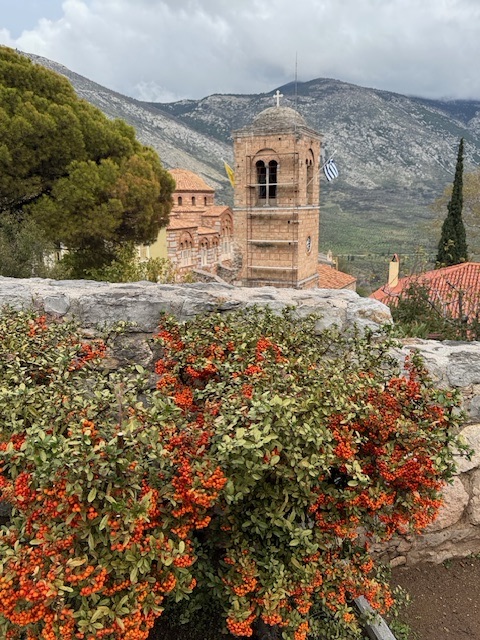
The site was founded by Luke of Steiris (aka Saint Loukas) around 945 – 953 CE when he lived as a hermit. Named a a UNESCO World Heritage Site displaying outstanding Byzantine architecture and decorative art. The complex has two main churches: Theotokos (Virgin Mary) from the 10th century and one of the earliest cross-in-square type churches in mainland Greece, and Katholikon built in early 11th century in the octagonal domed-church form, with eight piers around the central space.
Hosios Loukas attracted pilgrims and followers of Saint Luke’s healing cult, many of whom spent the night not only in the Katholikon but even in the crypt itself. Saint Luke was revered as a miraculous healer, and after his death, every reported miracle was linked to the curative power of his tomb. Pilgrims visited the site both before and after the monastery’s completion, but once the complex was finished, his tomb became the central focus of the flourishing miracle cult devoted to the saint.
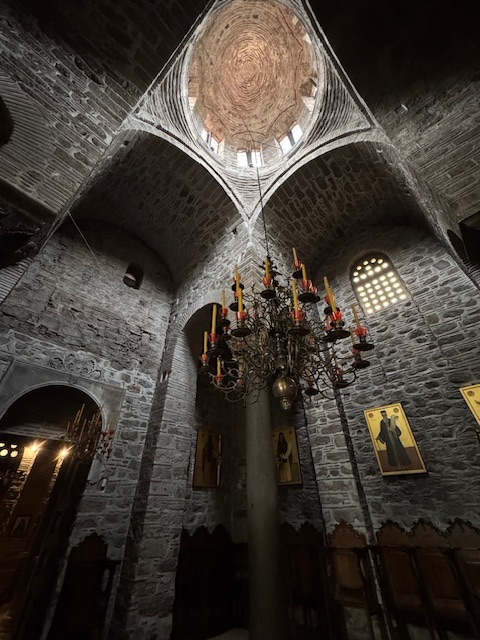
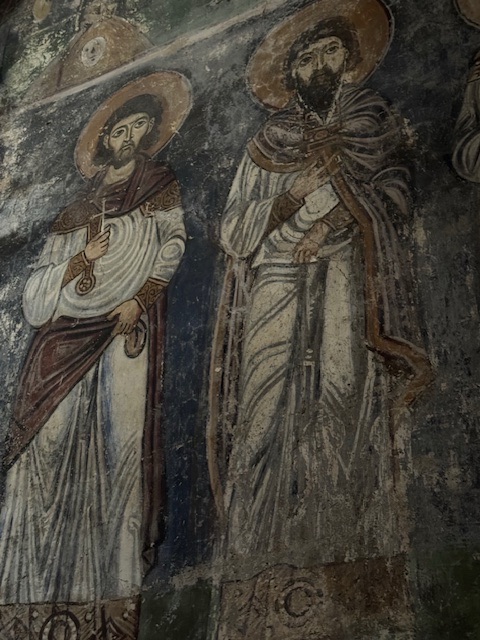
Katholikon’s interior is richly decorated: marble on walls/floors, gold-background mosaics, frescoes — all major features of Byzantine art. In the crypt below the Katholikon: frescoes of the Passion of Christ, and tombs include that of Saint Loukas himself. One particular fresco: the Joshua and Archangel Michael fresco (10th century) in the older church, depicts Joshua in a military role — reflecting the saint’s prophetic/military associations. The monastery represents one of the best‐preserved middle-Byzantine monastic complexes in Greece, especially for its architecture and decoration.
The site also introduced us to friendly, sweet Greek cats. All are approachable, well-groomed and fed.
Marble and Whispered Memories – 1981
“Country is arid and eventually hilly and mountainous. In Delphi visited Temple of Apollo. Guide is nasty. I am sick of mythology already. Walked to Temple of Athena and springs, both quiet and isolated. Valley below full of almond trees with big tankers docked in bay. Only 2 streets in town. Bought hand painted plates.” 1981)
Both Delphi and I have changed a lot over the last 40+ years. Gabrielle is not “nasty” nor am I sick of mythology any longer. We arrive in late-afternoon and plan our excursions over a chilled glass of white wine. Tomorrow morning, hopefully before the rain storms, we will complete our list of Want to Go destinations.
Visiting Sites of Delphi
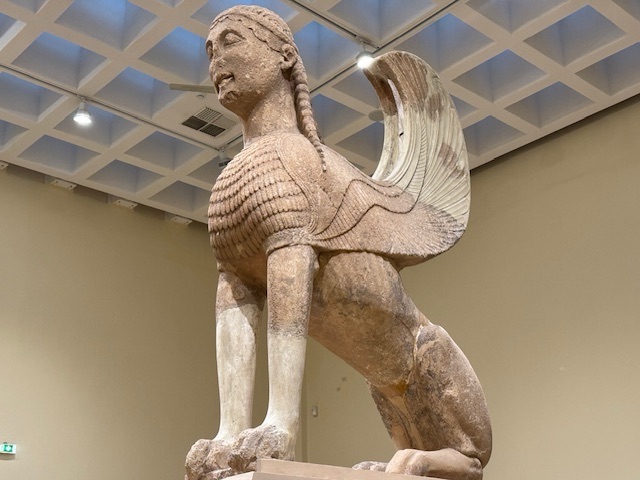
The Delphi Archaeological Museum houses the extraordinary artifacts uncovered from the site and is essential for understanding the sanctuary’s grandeur. Among its most celebrated pieces is the bronze Charioteer of Delphi, an exquisite example of early Classical sculpture that captures motion, restraint, and realism. Other highlights include the Sphinx of Naxos, the twin statues of the Argive brothers Cleobis and Biton, friezes from the Siphnian Treasury, and the intricate offerings that once adorned the temples. The museum provides not only artistic masterpieces but also a narrative of Delphi’s religious, political, and cultural influence across the ancient Greek world.
The Temple of Athena Pronaia is one of the most photographed and evocative sites at Delphi. Situated slightly below the main sanctuary, it once greeted visitors before they approached the Temple of Apollo. Today, it is closed for renovations and must be observed from above.
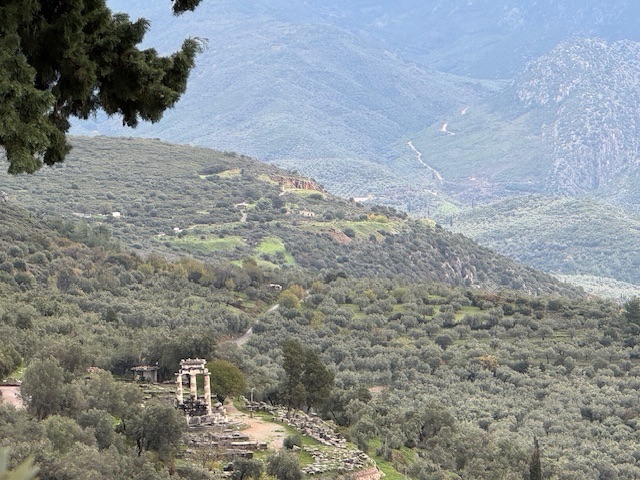
Its most striking feature is the circular tholos—a graceful structure of twenty Doric columns, three of which still stand—surrounded by the remains of rectangular temple buildings dedicated to Athena. The temple complex served both religious and protective roles, as Athena was seen as the guardian of the sacred precinct of Apollo.
The Temple of Apollo was the spiritual heart of Delphi and the seat of the famous Oracle. The ruins that survive today belong mainly to the 4th-century BCE reconstruction, built on earlier temples destroyed by earthquakes. Its location offers sweeping views of Mount Parnassus and the valley below.
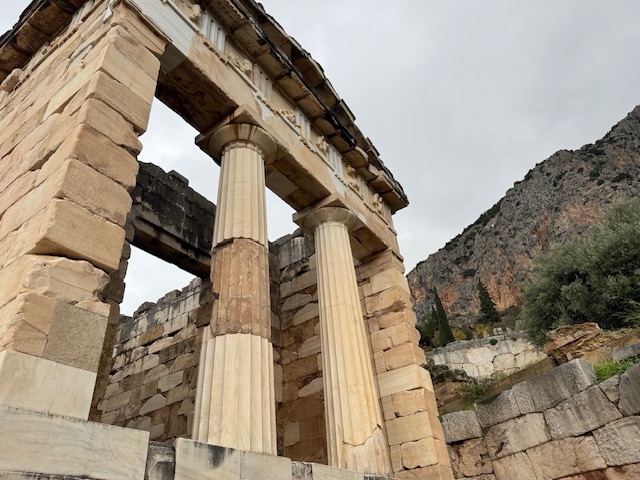
Temple of Apollo, Oracle’s home

Delphi archeological ruins
Visitors can still see the broad steps, column bases, and fragments of inscriptions, including those associated with the Delphic maxims like Know Thyself. This temple was where the Pythia, the priestess of Apollo, delivered prophecies inspired by divine vapors from beneath the earth. The setting—framed by the towering cliffs of the Phaedriades—amplifies the temple’s ancient aura, connecting nature, myth, and human aspiration in one special landscape.
Delphi Lodging
Our room for the night is at the V Hotel Delphi. The hotel sits at the V-intersection entering Delphi. Unfortunately, these are one-way streets. Unless we can spot an open parking space before the intersection, we must weave through the narrow streets, loop around and return down the other side. I was told the hotel had parking, but like most of Delphi, it sits on the narrow street. So, wherever there is a space, one parks. Fortunately, Delphi remains uncrowded and we zip into a space in front of the hotel.
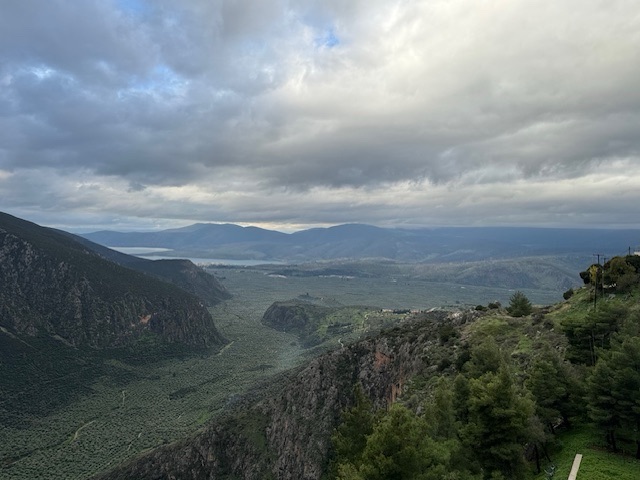
Gabrielle and I share a comfortable twin room with balcony with “sea view, Mountain View”. Mountains rise around us, a bay of the Gulf of Corinth lies about 7 miles to the south as the crow flies. The view, even with cloudy, wet skies and valley clouds, is spectacular.
We walk to a nearby restaurant (seems everything in Delphi is near) to enjoy a wonderful Greek dinner. Greece is an ancient wine-producing country known for its indigenous grape varieties and unique styles like the pine-resin flavored Retsina.
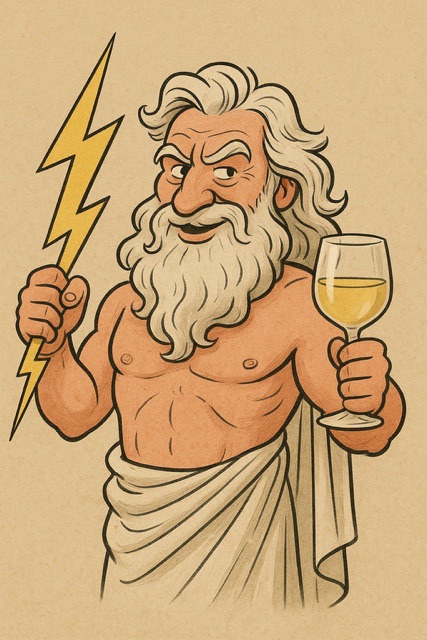
Retsina is a traditional Greek white (or rosé) wine mildly flavored with pine resin, giving it a distinct pine-like aroma and taste. This drink of the gods dates back at least 2000 years.
Enjoying my second chilled glass, sitting back, relaxing. I marvel at the view and think, in spite of our ongoing Saga, Gabrielle couldn’t have chosen a better country to travel this winter.

0 Comments