4 December 2025
We drive the 134 miles from Delphi to the city of Kalabaka, a place known mainly as the gateway to Meteora. Though Kalabaka sits only about 700 feet above sea level, it lies north, deep in the mountains. I expect the air to be cold and sharp. My early hope for the day’s drive was simple: just don’t snow!
Actually, snow is the least of our worries. Temperatures are mild. The threat of severe thunderstorms is very real. Part Two: Our Greek Saga continued. Read all about our adventurous drive to Meteora.
It is a relief as Kalabaka comes into view. One instantly recognizes the towering rock pinnacles.
Kalabaka is famous for its monasteries—six of them still active: Great Meteoron, Varlaam, Roussanou, Agios Stefanos, Holy Trinity, and St. Nicholas Anapafsas. Perched atop towering sandstone rock pillars, these monasteries are celebrated for their history, architecture, and spiritual significance, some standing for more than five centuries. Every world traveler has seen photographs of Meteora’s breathtaking cliffs and sacred retreats. Now it’s time to climb those very steps.
We awaken to our phones blasting an alert. Screaming a loud warning, we read with dismay that, today, the weather gods are angry. Zeus threatens thunderbolts and lots of rain.
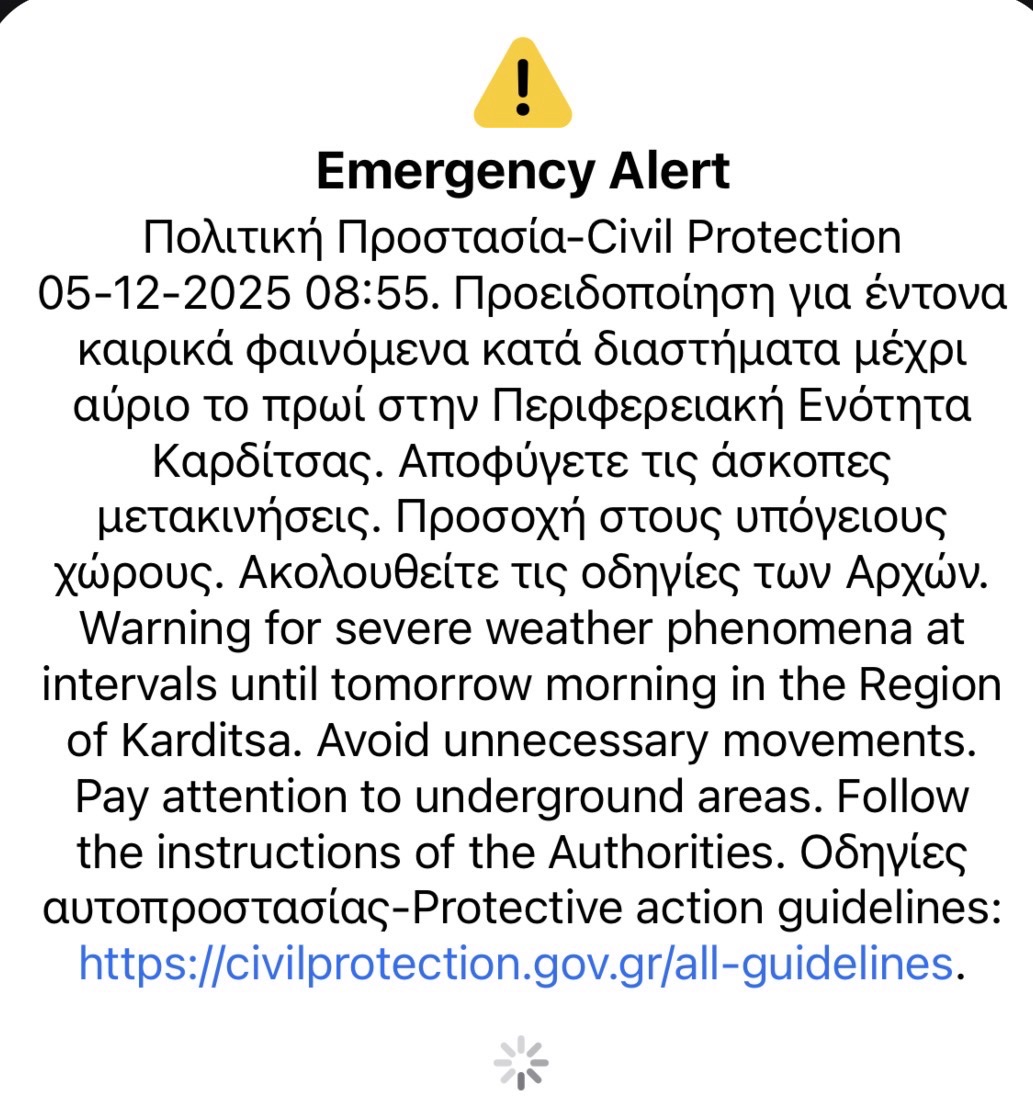
We decide, this is all part of our adventure. We did not come all this way to cower in front of the fireplace. In fact, I’m not sure which I dread more—the weather or the hundreds of stairs waiting ahead.
Options
The monasteries of Meteora are accessible by good roads, and most visitors either drive or join organized tours that shuttle among the sites. The distances between them are short, and parking areas are available tho limited near each site. Local buses and tour vans run regular routes along the same roads. The six active monasteries lie just a few miles apart. Thus, it’s entirely possible to visit several in a single day.
However, these are mountain roads, winding and narrow in places. The roads often hug the edge of steep cliffs with dramatic drops into the valley below. The scenery is spectacular but drivers better stay alert for sharp bends, blind corners, and the occasional bus or minivan squeezing past on the turns. Guardrails line most of the steeper sections, and the ascent is gradual rather than treacherous. However, the roads can be wet or icy in winter. Despite the twists, the drive is not intimidating.
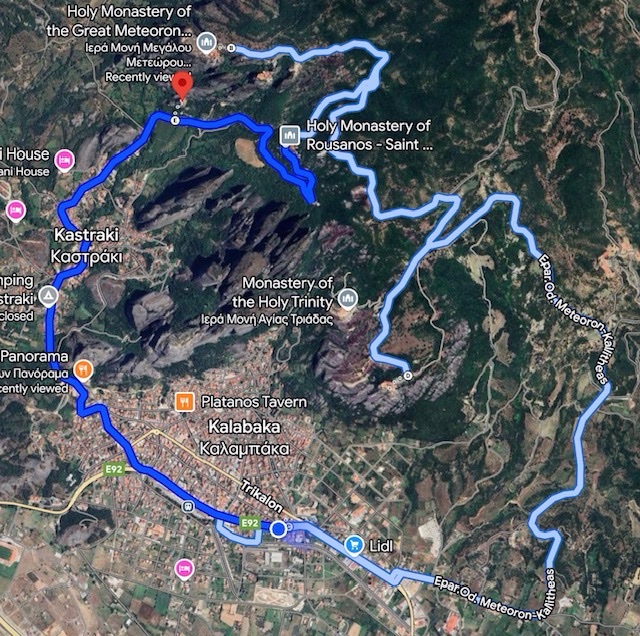
Another way to experience Meteora is by joining one of the many tour companies operating out of Kalabaka (or nearby Kastraki). These tours typically last about 5-6 hours and allow you to choose 2 or 3 monasteries you’d like to visit. (Keep in mind, the more people on a tour the longer each stop will take.)
Look at a map ahead of time and plan distances and travel time between monasteries. While they’re relatively close, mountain roads and viewpoints take time. Entrance fees usually €5 each stop. Each monastery also will provide a wrap around for women as dress code is strict: no bare arms or legs, or pants on women.
I think the number of monasteries one can visit on a tour really depends on individual stamina and how much time is taken to climb all those stairs. A loop around the area that includes two or three monasteries covers about 9 to 12 miles, with twisting roads that could easily test anyone’s mettle—definitely a ginger pill kind of drive. For us, the best plan was to drive.
Six Main Monasteries of Meteora
I could see in Google Maps that roads would be manageable. My question was: How do I get up the pillars? Answer: steps, steps and more steps. Oh, and one blessed bridge.
Perched high above the valley, the Great Meteoron Monastery reigns as the oldest and largest of the six active monasteries at Meteora, founded in the 14th century by Saint Athanasios the Meteorite. Reaching it requires around 300 stone steps carved into the rock cliff. In actuality, many steps go,down and an equal number go up.
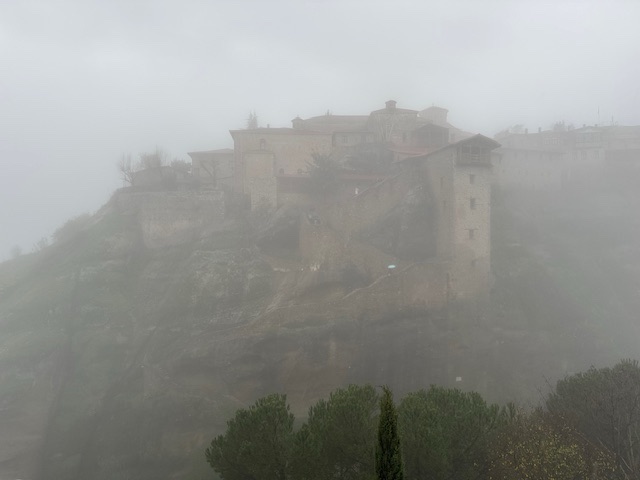
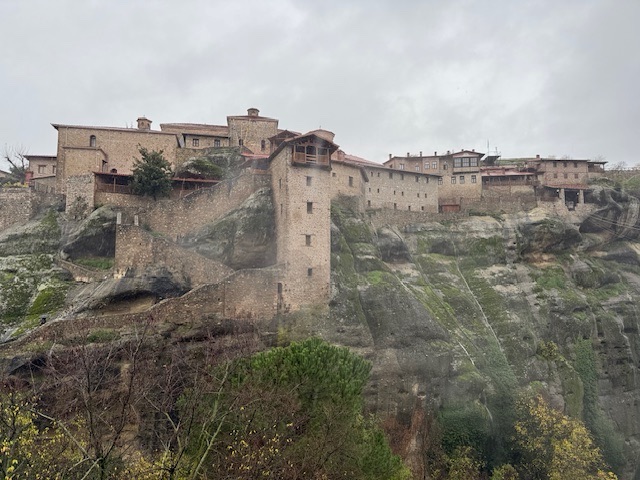
Briefly, clouds clear for views
At Meteoron, you’ll find richly decorated frescoes inside the katholikon (main church) dating to the 16th century and glimpse the monks’ refectory with original furniture. Step out onto terraces for sweeping views of the town of Kalabaka and the plains beyond, if weather is clear. For us, our heads were in the clouds.
The climb is demanding, but I found the climb easier than other sites. Here sits a blend of sacred space and dramatic landscape making it one of the defining experiences of Meteora. Winter hours are 9:30 to 2 pm. Closed Tuesday, Wednesday and Thursday.
Built on a tall rock pillar opposite the Great Meteoron, Varlaam Monastery offers a grand setting of stone, garden terraces and valley views. Established in the 14th century by hermit Varlaam, it later expanded into a full monastic community. Getting there involves climbing around 140-195 steps carved into the rock—a steady ascent but somewhat more moderate than the largest monasteries.

Inside is a museum of relics, the original winch tower still visible and in use, and a richly frescoed church. Outside the gardens and terraces provide expansive vantage points across Meteora’s legendary rock formations and the valley below. Winter hours are 9:00 to 3 pm. Closed Thursday and Friday.
The Roussanou Monastery (dedicated to St. Barbara) is a smaller, more intimate nunnery perched upon a narrow rock pillar. Its architecture seems to grow straight out of the stone.
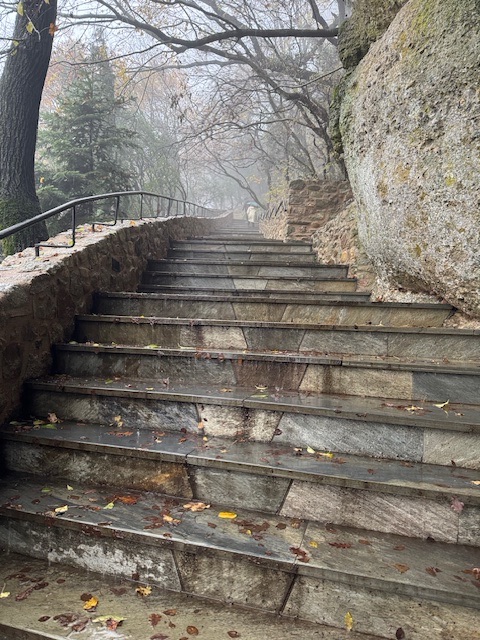
Although its elevation sits lower, the climb up involves roughly 140–200 steps and/or a steep cobbled path from the road. The steps are good but a challenge.
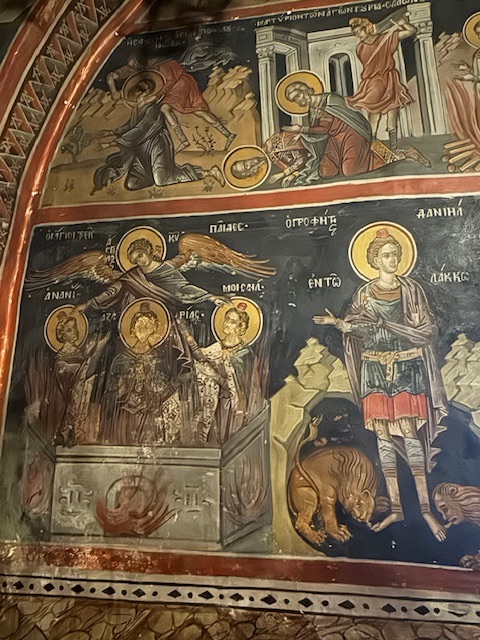
The chapel’s domed ceiling and walls are covered with 16th-century frescoes. Outside the balcony allows one of the finest panoramic views in Meteora. Fall colors provide dramatic views. Three of the monasteries perch can be seen if weather is clear. Its quieter atmosphere and breathtaking outlook offer both calm and scenic majesty. Winter hours are 9:30 to 2 pm. Closed Wednesday.
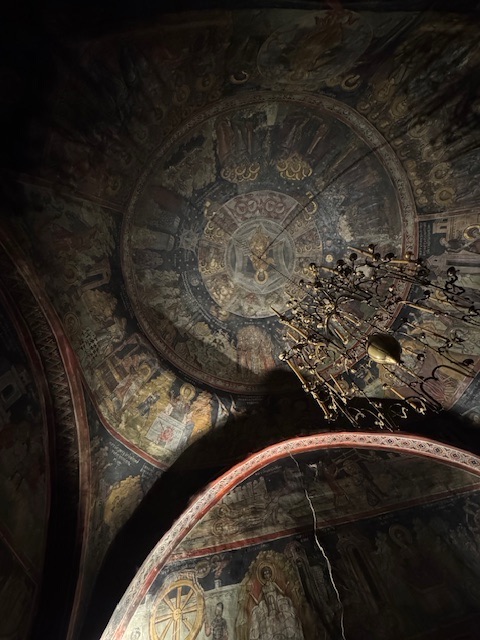
Roussanou allows photos
Holy Trinity Monastery occupies a dramatic vertical cliff face and gained fame as a location in the James Bond film For Your Eyes Only (1981). Access requires a walk down into a small ravine and then a relatively steep climb up 140–145 stone steps carved into the rock face. Once at the top, you’ll encounter a small church adorned with frescoes and a chapel carved into the rock. Perhaps most memorably, a balcony offers sweeping views over the plain of Thessaly, the town of Kalabaka far below, and the surrounding cliffs. This is perhaps the most difficult of monasteries to reach. However, the effort may be offset by the dramatic reward of solitude, history, and panorama. Winter hours are 10:00 to 4 pm. Closed Thursday. We decided to pass on this climb.
The Monastery of Agios Stefanos Holy Convent reigns as the most accessible of the active Meteora monasteries, reachable via a small footbridge from the parking area. No major staircase climb required. Originally built as a male monastery in the 15th century and now a nunnery. It contains beautiful chapel frescoes, a monastic museum and tranquil courtyards.
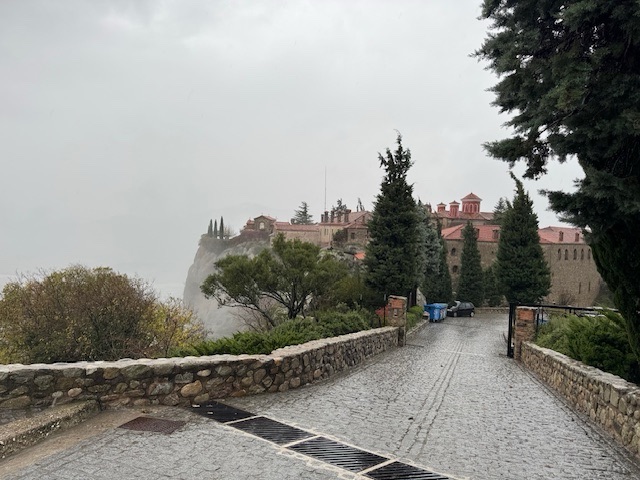
From its terraces you also get a splendid view of the valley, a forest of full colors, and surrounding rock formations—with far less physical exertion than some of the higher-perched monasteries.
It’s a first choice if you want to mix monastic atmosphere and scenic beauty with easier access. Winter hours are 9:30 to 1 pm and 3-5 pm. Closed Monday.
The Monastery of St. Nicholas Anapafsas is compact yet full of character. It stands on a narrow rock near the village of Kastraki and features striking 16th-century frescoes by the famed artist Theophanes the Cretan depicting Adam naming the animals. The climb up involves around 120–140 steps depending on the route taken. Though smaller than some of its peers, the views of rock pillars from the terrace are impressive. One can observe the rich geology of Meteora. The sense of scale and quiet intimacy make it a rewarding stop. Winter hours are 9:00 to 2 pm and Sundays 9:30-4 pm. Open every day.
Planning One’s Day
Because each monastery has its own entrance fee (typically €5, cash only) and closing days vary, pick two or three to visit based on your energy and time. The stair count can add up fast. And also keep in mind that summer temperatures bring exponentially hoards more visitors. Except for excessive rain, winter proved an ideal time to avoid crowded roads and spaces.
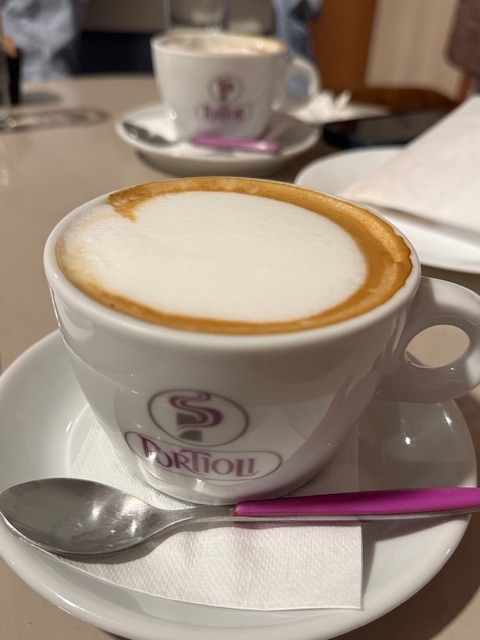

But as rain increased, water began to accumulate, roads became more treacherous – coffee called.
No Snow, Please—Climbing One Monastery at a Time
I look to the surrounding mountains, “No snow” I rejoice. Temperature feels warm and roads are clear but wet. Clouds are low, obscuring views and sometimes the road itself. Rain falls in sheets, thunderstorms threaten. One can do what one came here for or hide out in the lounge. For Gabrielle and I, it will just be Part Three of our Greek Saga. Is it turning from a tragedy to a comedy?
Because of the longer climbs, we choose to do the hardest monastery first – the Great Meteoron. Our second stop is at the not too distant from the first – Roussanou Monastery. (Varlaam is closed today.) there is time and energy, albeit wet socks and pants, for a visit toadies Stefanos.
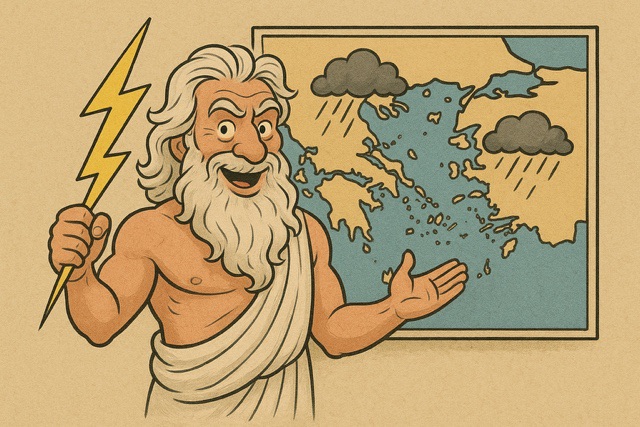
Tomorrow, as long as Zeus doesn’t go totally ballistic, we will visit a final two: Varlaam and St. Nicholas Anapafsas. I am told, if I managed to climb to Tiger’s Nest in Bhutan, I can practically trot to Holy Trinity. I choose to leave this final climb for others. My calculations tell me I have achieved my steps for these two days!
Dinner now, a little retsina, or a lot of retsina, and we restart our climbing tomorrow!

0 Comments