12-13 December 2025
So many ruins, so many rocks – the Ancient Agora and the lively area of Monastriaki Square lie below the north side of the Acropolis. More carved columns and ancient history. I think, I might be reaching my limit for columns and rock foundations. Perhaps we beseech Dionysus for some early relief.
Hadrian’s Library
Roman Emperor Hadrian, a great lover of Greek culture, built the library in 132 CE. He wanted to make Athens the cultural capital of his empire.
The complex was vast. It consists of a rectangular courtyard surrounded by colonnades, with a grand marble façade. The site also included a central pool and garden, and rooms that housed scrolls, lecture halls, and reading spaces. It served not only as a library but as a center of learning, debate, and philosophical discussion. It acted much like the ancient equivalent of a university campus.
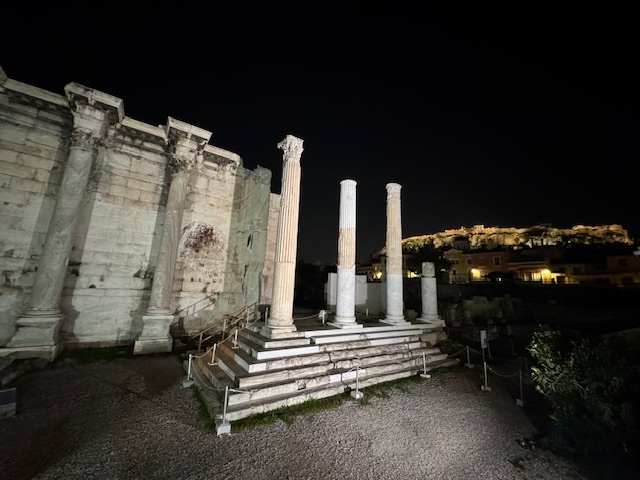
Today, the ruins of the marble columns and walls give a sense of the library’s grand scale. Remains of the original complex include the colonnaded courtyard and niches for storing scrolls. Later additions from the Byzantine and Ottoman periods included a church and some small dwellings built amid the ruins.
Just steps away sits the Roman Forum of Athens – the Roman Agora.
Roman Agora & Tower of the Winds
If one walks the streets of Athens, one sees a plethora or rocks, columns, archways, and unknown stone foundations. The city changed while under Roman rule. The Roman Agora and Tower of the Winds offer a glimpse of how Athens evolved from its classical past into a vibrant Roman-era city that thrived as a hub of commerce and learning.
The Roman Agora (not to confuse with the Ancient Agora) was built in the 1st century BCE, funded by Julius Caesar and Augustus. It functioned as a marketplace and civic space, filled with shops, storerooms, and administrative buildings. The complex was entered through an impressive gateway with four Ionic columns made of white marble. Portions still stand. Inside lie the remains of colonnades, paving stones, and the outlines of ancient shops.
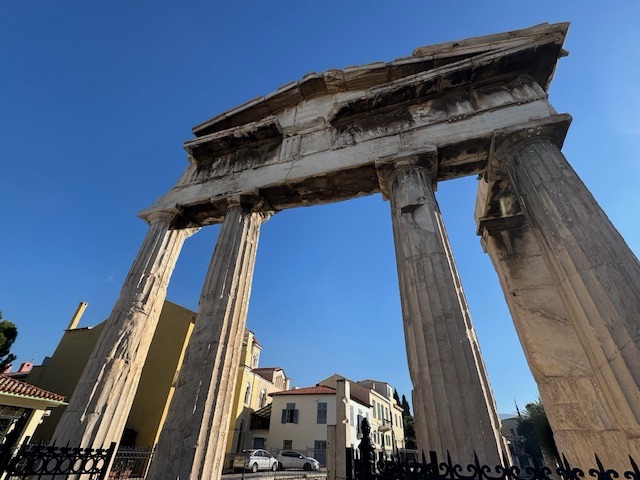
Gate of Athena Archegetis at Roman Agora
Later, during the Ottoman period, part of the Agora converted into a marketplace and even a mosque. Today, the Fethiye Mosque Museum (Mosque of the Conqueror) sits within the Roman Agora. It repressents one of the most visible reminders of the city’s Ottoman period. Its name, “Fethiye,” means “of the Conquest,” referring to the Ottoman capture of Athens in 1458 by Sultan Mehmed II (the Conqueror). Most of the original is gone and what is seen today was constructed in the 17th century. The building experienced repurposing many times over the centuries; it now acts as a museum and exhibition hall.
The most famous structure in the Roman Agora is the Tower of the Winds, an octagonal marble building from the 2nd century BCE designed by the astronomer Andronicus. It served as both a clock and a weather station, making it one of the world’s earliest known scientific buildings. Each of its eight sides is adorned with a relief representing a wind deity. Inside it once housed a water clock (clepsydra) powered by a spring from the Acropolis. Sundials carved on the exterior walls marked the time of day.
Ancient Agora
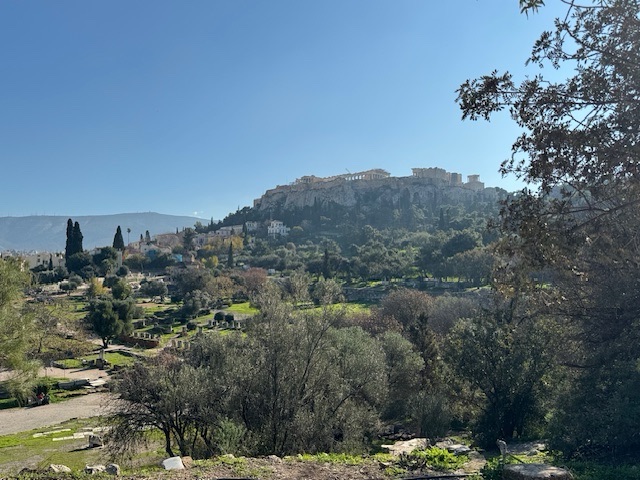
Just around the corner beneath the northwest slope of the Acropolis, sits the Ancient Agora. This marketplace acted as the heart of Athens. Scores of buildings and temples once covered this area. More rock foundations, more columns. But these ruins reflect a classical Greek life. And towering above it all sits the Acropolis and temples of the gods. If nothing else, imagine Socrates teaching under the colonnades and cypress trees; debates amid the menfolk about democracy. It all happened at the Agora.
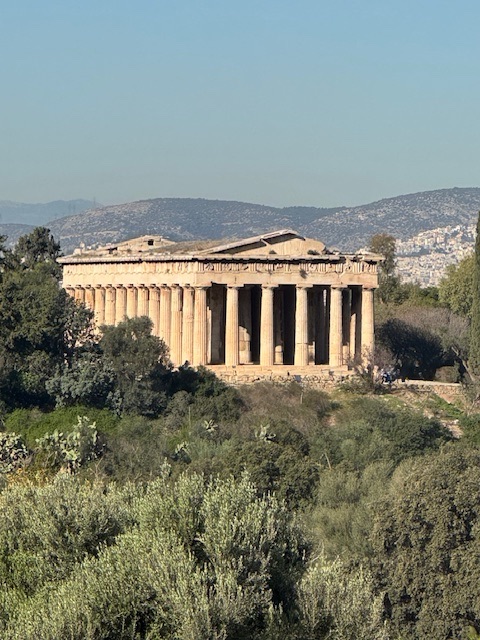
Temple of Hephaestus (Hephaisteion) – Represents the best-preserved ancient Greek temple in existence, dedicated to Hephaestus (god of craftsmanship and fire) and Athena Ergane (patron of artisans). Its graceful Doric columns and nearly intact roof give a powerful sense of what the Parthenon once looked like.
The temple is smaller but similar in design to the Parthenon. It measures about 45 by 1004 feet with 6 columns on the short sides and 13 on the long sides. Constructed mostly of Pentelic marble, it rests on a three-step platform and features a pronaos (front porch), cella (inner chamber), and opisthodomos (rear porch).
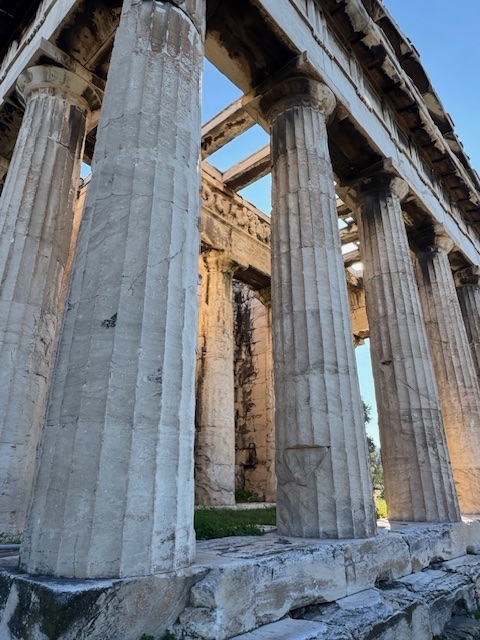
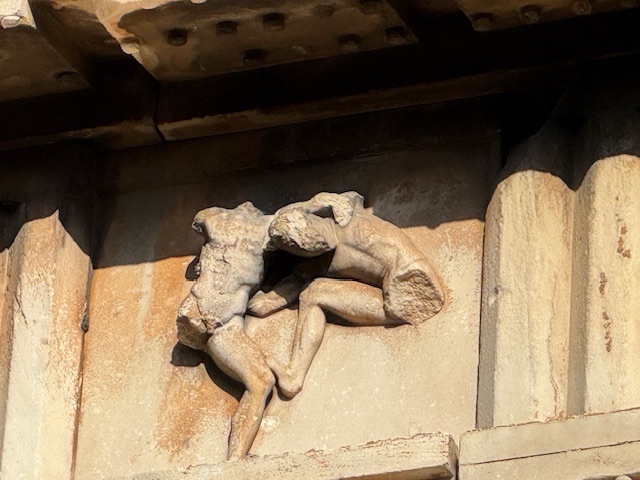
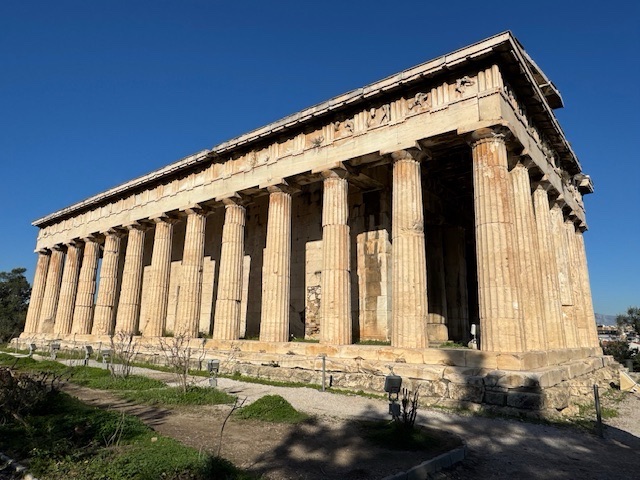
Inside, the temple once housed bronze statues of Athena and Hephaestus. The exterior was adorned with sculpted metopes depicting the Labors of Heracles and Theseus, symbolizing strength and civic virtue. Its remarkably intact roof and columns make it the best-preserved ancient temple in Athens. It offers an honest glimpse of what most of the Acropolis’ temples must have once looked like.
Stoa of Attalos – Originally built by and named after King Attalos II of Pergamon, who ruled between 159 and 138 BCE. Today, what is seen is a reconstruction of a Hellenistic shopping arcade, rebuilt by the American School of Classical Studies in the 1950s.
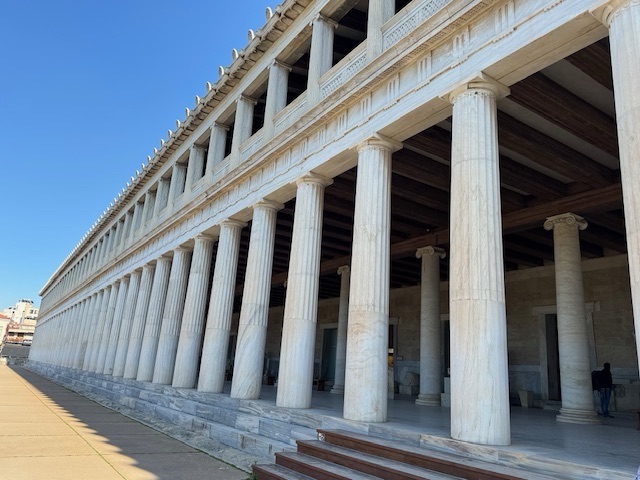
It houses the Museum of the Ancient Agora with artifacts from the site. This includes pottery, tools, coins, and voting tokens that tell the story of Athenian democracy.
Tholos and Bouleuterion – Foundations represent the council chambers where the city’s Council of 500 met to manage Athen’s civic affairs. The Tholos was where officials dined and slept during their term. It ensured government was always on call.”(Well, isn’t that an interesting idea?)
Altar of the Twelve Gods and Panathenaic Way – The main processional route through the Agora once ran here. It linked the city’s center with the Acropolis. Citizens would gather for festivals, processions, and debates.
Church of the Holy Apostles – A serene 10th-century Byzantine church that stands out amid the ruins, beautifully restored with delicate brickwork and domes.
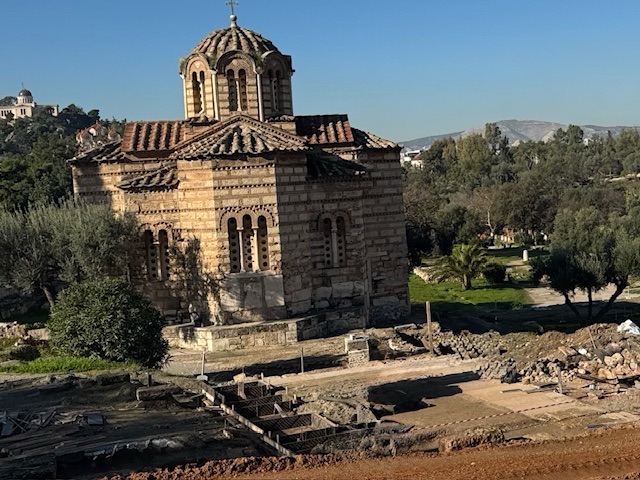
It represents one of the first churches in Athens constructed after the classical era and one of the few surviving intact from that period.
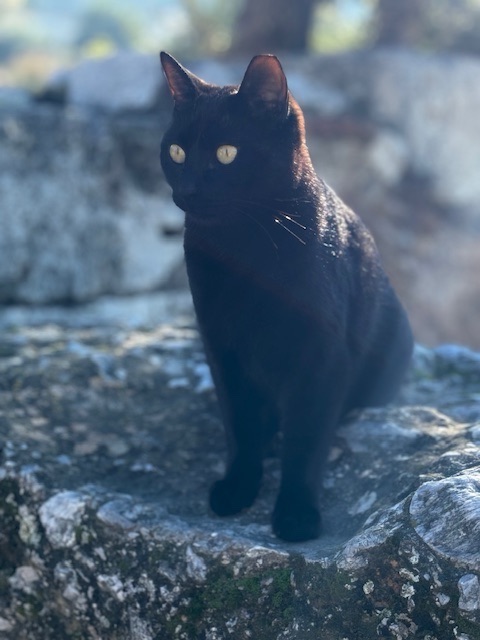
Odeion of Agrippa – The remains of a large Roman concert hall and meeting space, later replaced by statues of giants and tritons. Statues remain, not much else. Becomes a great gathering place for the friendly cats.
Walking along the paths, amid the rocks and broken columns lie several buildings, names but unrecognizable except for shape and size. But the Agora represents far more than just ruins of stone. It represented the very foundation of civic life — where democracy was born, philosophy took form, and everyday Athenians shaped the ideas that still guide our societies today.
Among these remnants of temples, stoas, and council halls lingers the spirit of debate, inquiry, and freedom of thought. The Agora is not merely an archaeological site; it is a reminder that civilization itself began with people gathering to speak, listen, and dream together.
Monastiraki Square
Beyond the reputation of Syntagma Square and the Plaka, there sits Monastiraki Square. In fact, this area is one of Athens’ liveliest and most colorful spots, buzzing with energy almost any time of day.
Framed by the Acropolis rising dramatically in the background, the square blends ancient ruins, Ottoman and neoclassical buildings, and modern street life into one vibrant, happening scene. On most days, you’ll find street musicians playing bouzouki tunes and a plethora of vendors.
Cafés, tavernas and rooftop bars line the square’s edge, their terraces perfect for people-watching with a frappe or glass of wine.
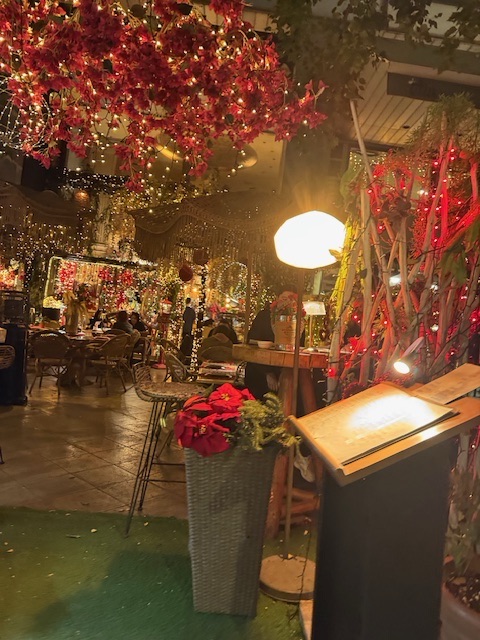
Everywhere, streets, shops, and restaurants are decked out for the holidays.
For an added kick of adrenaline, the Monastiraki Flea Market spills into the surrounding streets, offering antiques, leather goods, and quirky curiosities. On any given day, vendors stack their stalls high with antiques, vintage records, old coins, and books, then turn a corner and find handmade jewelry, leather sandals, and Greek souvenirs.
The market spills out from the square along Ifestou and Ermou streets, where tiny shops and open-air stands compete for attention under awnings and colorful signs.
The atmosphere is a blend of old-world bazaar and modern street market, with music from nearby cafés, drums in the square, and the smell of roasting nuts in the air. Not a rug seller in ear shot vying for my attention and just the right amount of chaos to make a stroll enjoyable.
Sunset, Ruins, and a Good Glass of Wine
As the sun sets and night falls, lights from shops and tavernas pop on, glowing against the stone walls. The air fills with delicious smells, sounds of conversations, and invitations to come sit.
We zigzagged our way through the chaos of Ermou Street and Monastiraki Square—dodging locals, street musicians, and the determined shopper—before finally claiming victory in the form of an empty table. Collapsing into our seats felt like a great achievement.
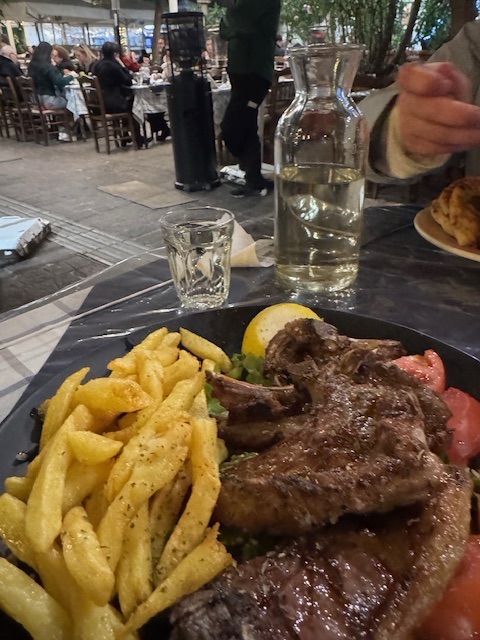
Reward followed quickly: tender lamb shanks, good white wine, and the deep satisfaction of having earned dinner the hard way. We watch the square pulse and swirl around us as night settled in.
Life is good.

0 Comments