19 March 2026
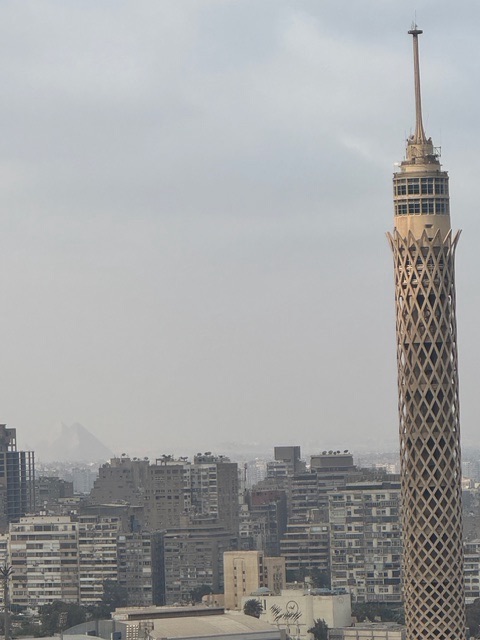
This morning, I see the pyramids from my balcony. This bodes well for cleaner air today. We join our guide, Galal, for a final day exploring some of Cairo’s most interesting museums.
I find it difficult to believe the GEM didn’t have it all. However, there exists several other sites around the city that warrant a visit.
Cacophony of the Streets
The past three days in Cairo and Alexandria may best be defined as visually cacophonous! Street life looked overwhelmingly busy and chaotic, like too many cars, donkeys, street sweepers, dogs and people competing at once for attention.
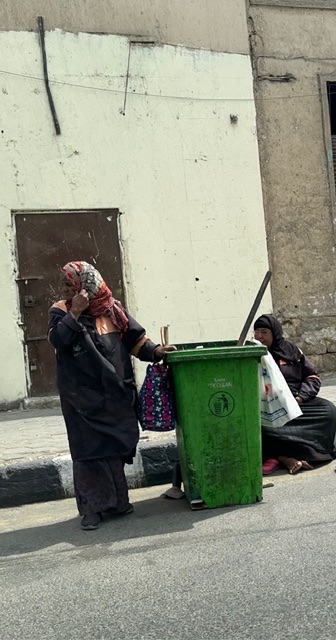
On comparison, today’s streets look almost deserted. The month of Ramadan ends at sunset. Perhaps people are home baking and preparing for tomorrow when Muslims celebrate Eid Al-Fitr. This day celebrates the end of the fasting month of Ramadan and is a time of joy, gratitude, and community.
People attend special prayers, share festive meals, give charity (zakat al-fitr) to those in need, and spend time visiting family and friends—often with new clothes, sweets, and a celebratory atmosphere that lasts for several days.
Whatever the reason for fewer cars, less noise and cleaner skies, I appreciate the break.
Egyptian Museum
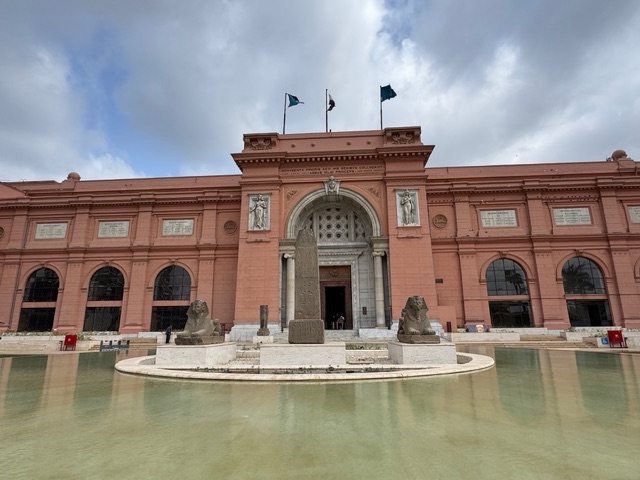
While many exhibits, including King Tut, picked up their skirts and moved across town to the GEM, far from everything is gone. The old museum still holds a surprising number of masterpieces, even after many headline pieces moved to the newer museums of the GEM and the Mummies to the Museum of Civilization.
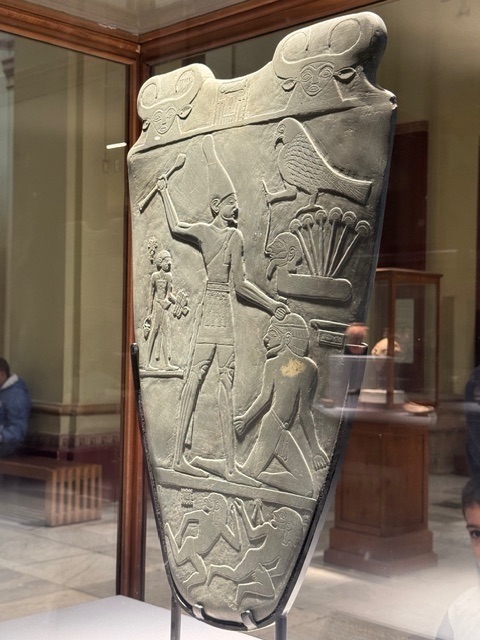
The Narmer Palette represents one of the most important finds, a carved stone slab that essentially depicts the birth of Egypt as a unified kingdom. Nearby are early royal works like the seated statue of Djoser, one of the oldest life-sized statues ever made.
A tiny statuette of Khufu is easy to miss, but don’t. It represents the only surviving three-dimensional image of the builder of the Great Pyramid.
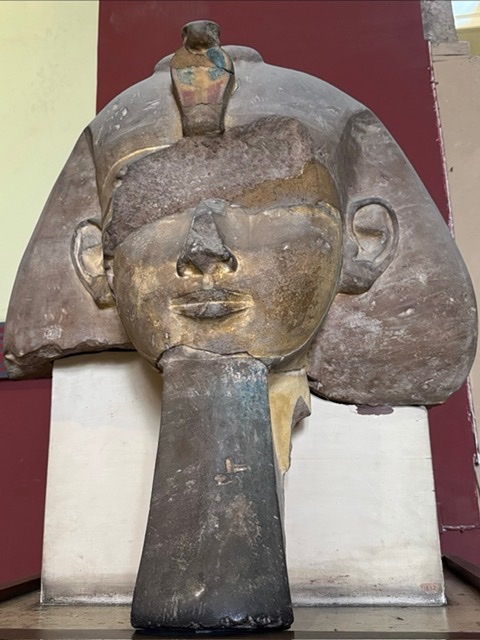
Queen Hatshepsut, the fifth pharaoh of the Eighteenth Dynasty, was highly regarded during her lifetime, overseeing a period of great peace and economic prosperity. She ran into stiff opposition when she expected to be regarded equally with her male counterparts.
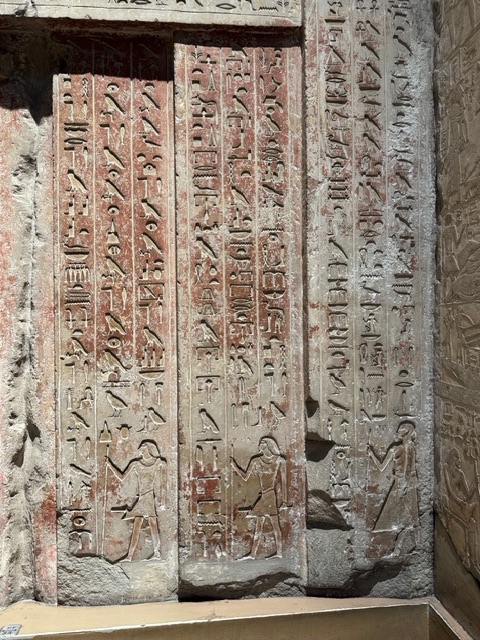
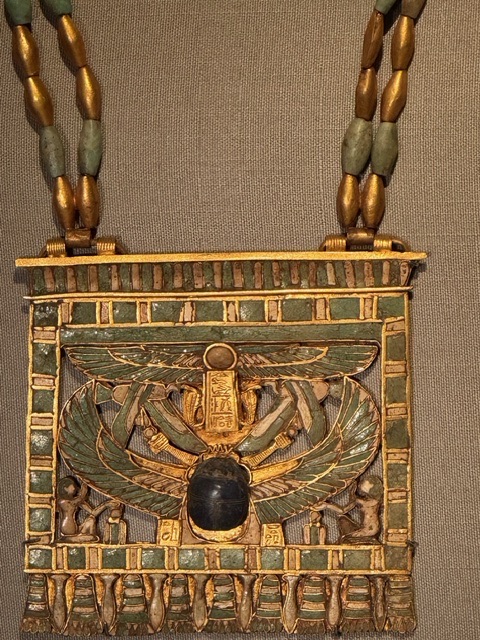
There are cases of vivid papyrus scrolls, everyday objects like mirrors and tools, and lesser-known treasures such as the statuette of Queen Neferefre which still retains traces of its original colors. Statues of all sizes represent a plethora of the Egyptian famous and infamous. After our visit to the pyramids and GEM, these kings and queens feel familiar.
The Great Pharaohs
The statue of Khafre is one of the most iconic pieces in the museum. Carved from dark diorite, it shows the king seated in perfect stillness, with the falcon god Horus wrapped protectively around the back of his head. The polished stone seems incredibly refined with a sense of his eternal authority. It captures the idea of the pharaoh not just as a ruler, but as a divine, timeless presence.
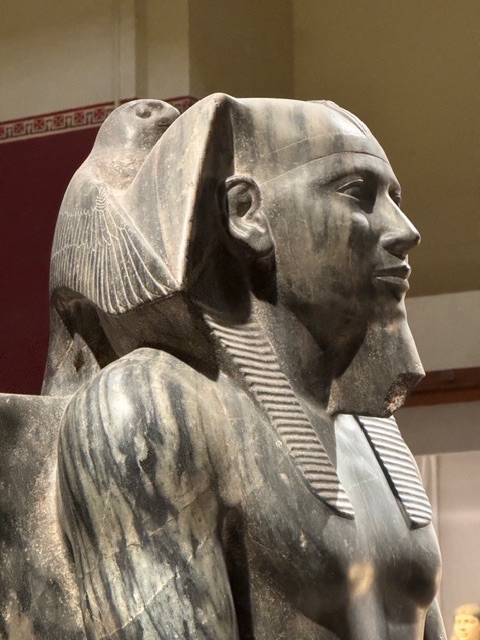
Khafre also represents the face of the Sphinx. I try different angles. Maybe, with imagination and effort, I see a bit of resemblance.
Nearby are statues of Menkaure. These show the king, whose pyramid and tomb we squeezed into, standing between the goddess Hathor and a regional deity representing a province of Egypt. These works give a glimpse into how Old Kingdom kings wanted to be seen: eternal, protected, and in harmony with the divine order.
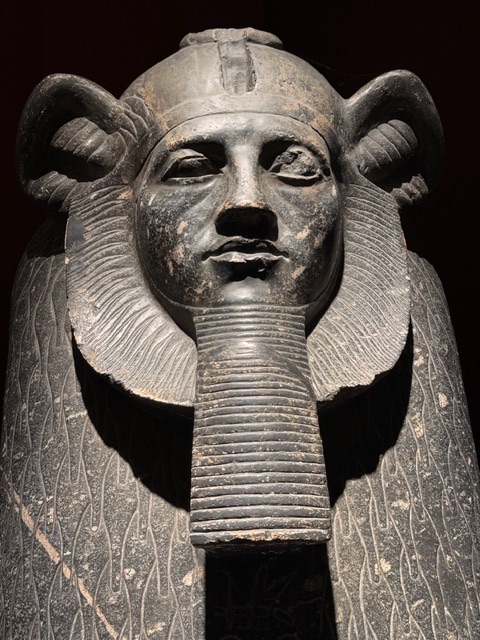
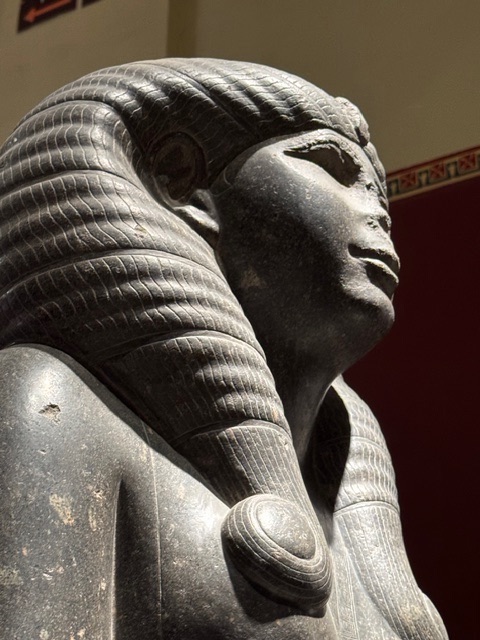
It becomes obvious, for the pharaohs, it was all about image. And, they believed they could take it with them. Unfortunately, the kings had underestimated the tenacity of tomb robbers.
The overall feel of the museum seems less like a single blockbuster collection but more like a very large and dusty attic where small, strange, and everyday objects await discovery. Where every artifact assists in increasing one’s understanding of the history, people and culture of the pharaohs and Egypt.
Coptic Cairo
This neighborhood thrives in a small section of Cairo where Egypt’s Jewish population thrived for centuries. Spending time wandering its streets can be the highlight of one’s day.
Coptic Cairo represents a small enclave within the larger sprawl of Cairo where narrow lanes and smooth stone walls enclose some of the oldest Christian sites in Egypt. The area centers on the remains of a Roman fortress around which churches, courtyards, and cemeteries cluster in a compact, walkable space. The atmosphere feels hushed compared to the city outside, with the scent of incense, the sound of bells, and shafts of light filtering into ancient sanctuaries.
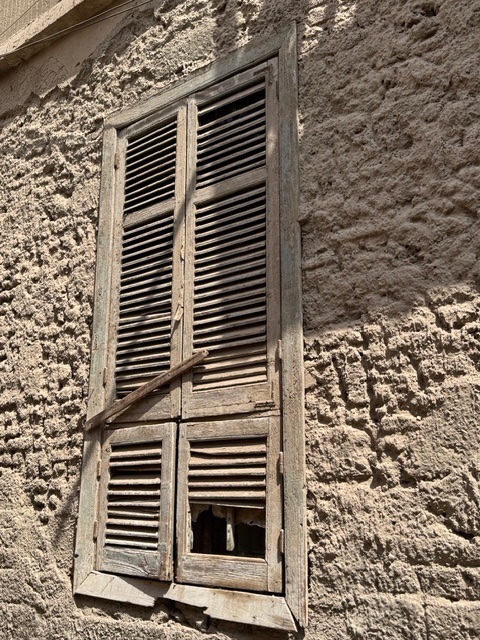
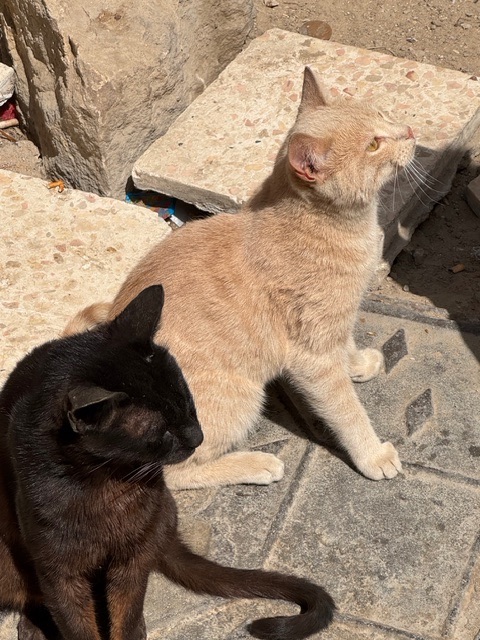
We walked down the narrow alley of Marj Gerges, passing through parts of the old bazaar. Racks of books and media line both sides of the alley. Cats hang out on the corner.
Saints Sergius and Bacchus
Tucked away along our route sits the small Saints Sergius and Bacchus Church, seemingly an oddly named combination.
Sergius and Bacchus were early Christian soldiers in the Roman army, traditionally said to have lived in the 4th century during the reign of Galerius. According to tradition, they were high-ranking officers who secretly practiced Christianity at a time when it was still persecuted. When their faith was discovered, they were publicly humiliated, stripped of rank and paraded in women’s clothing before being punished for refusing to renounce their beliefs.
Bacchus was reportedly executed first, while Sergius was forced to march in painful iron shoes studded with nails before also being killed. They became venerated as martyrs and military saints. Neither were connected to the Roman god of grapes.
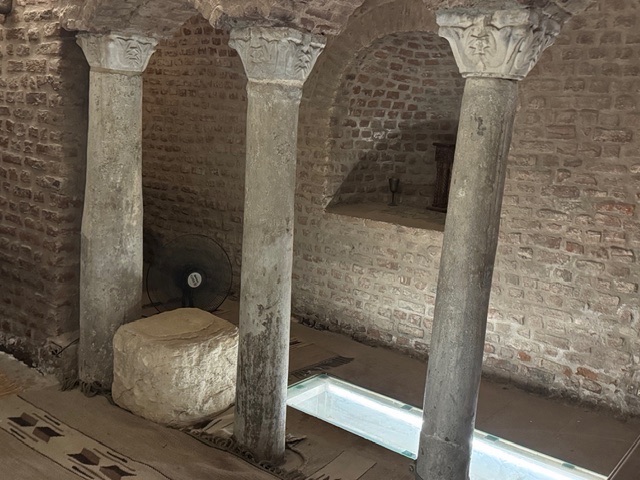
This fourth-century church claims that beneath its floors lies the spot where Joseph, Mary and baby Jesus once rested after fleeing to Egypt.
Holy family hid under the church in effort to avoid King Herod’s command to execute all male children in Bethlehem and its surrounding areas aged two and under. Thought to have been here several months if not 2-3 years.
Also in this neighborhood is Synagogue Ben Ezra, an ornately adorn place of worship which sits on the spot where baby Moses was found. Supposedly.
National Museum of Egyptian Civilization
We stop last at the Museum of Egyptian Civilization. Unlike a museum centered purely on royal tombs or monumental treasures, this one tells the tale of Egypt’s people from prehistoric times to the present day in a single, cohesive experience. Instead of focusing only on pharaonic tomb treasures, it frames civilization as an evolving, continuous human story. The exhibits blend archaeological discoveries with how everyday life, beliefs, and communities developed over millennia.
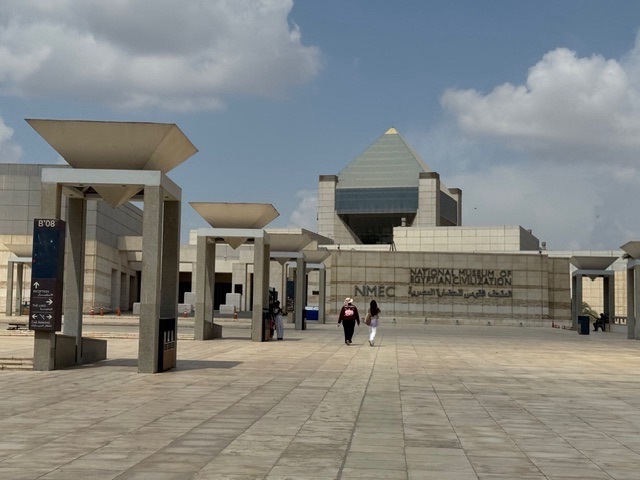
The museum consists of a chronological gallery that traces Egyptian history. You begin with early human presence along the Nile, including remains and tools from prehistoric communities. Then, exhibits proceed through the Pharaonic era, where statues, coffins, jewelry, and inscriptions reflect ancient beliefs, artistic mastery, and statecraft.
Among other items and highlights are rare human remains like the Nazlet Khater skeleton dating back some 35,000 years. Exquisite jewelry and everyday objects reveal craftsmanship across ages. Galleries of textiles display linen and garments that illustrate both ancient techniques and traditional folk costumes.
The timeline continues into Greco-Roman Egypt, with objects showing how local traditions blended with Mediterranean influences. Textiles, manuscripts, icons, and architectural fragments illuminate the spiritual and cultural life of the Coptic Christian and Islamic periods. Finally, displays on modern Egyptian culture, crafts, and folk traditions connect ancient legacy to contemporary identity.
This architecturally beautiful museum opened on 3 April 2021, with the moving of 22 mummies, including 18 kings and four queens, from the old Egyptian Museum. Called the Pharaoh’s Golden Parade, its reigning stars traveled in style. The resulting exhibition displays the mummies and their coffins along with a wonderful genealogy for each.
Mummies and Daddies
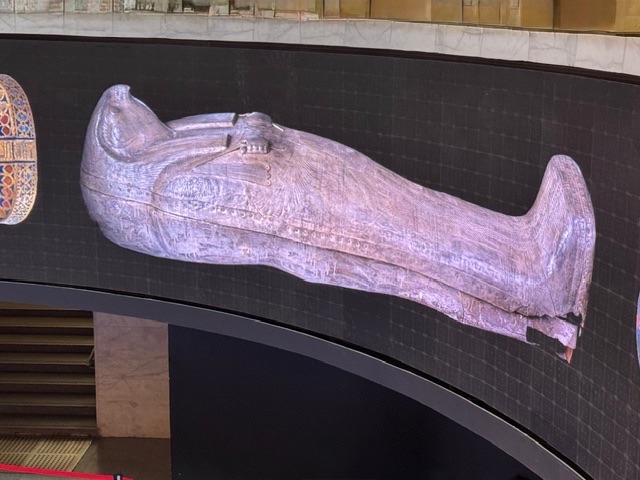
The Museum of Egyptian Civilization proves well organized and broadens one’s understanding of Egyptian history and culture. However, the museum’s most spectacular space is the Royal Mummies Hall.
Within a special underground gallery, lie the preserved bodies of around 22 ancient monarchs — including famous rulers such as Rameses II, Hatshepsut, and Seti I. Displays sit in elegant cases evoking the atmosphere of a tomb while offering context about embalming practices and royal history.
Especially well done are the brass plaques which list names, years of reign, accomplishments, and relationships. Within these walls, one meets the pharaohs and wives. Each are respectfully displayed and protected.
Cousin Ramses
Years ago, I tested my paternal DNA with the National Geographic Genome Project. Through this test, I met a distant male relative living in Bulgaria. His daughter has since become a friend. We consider ourselves cousins, even though our common relative must have lived at least 600 years ago.
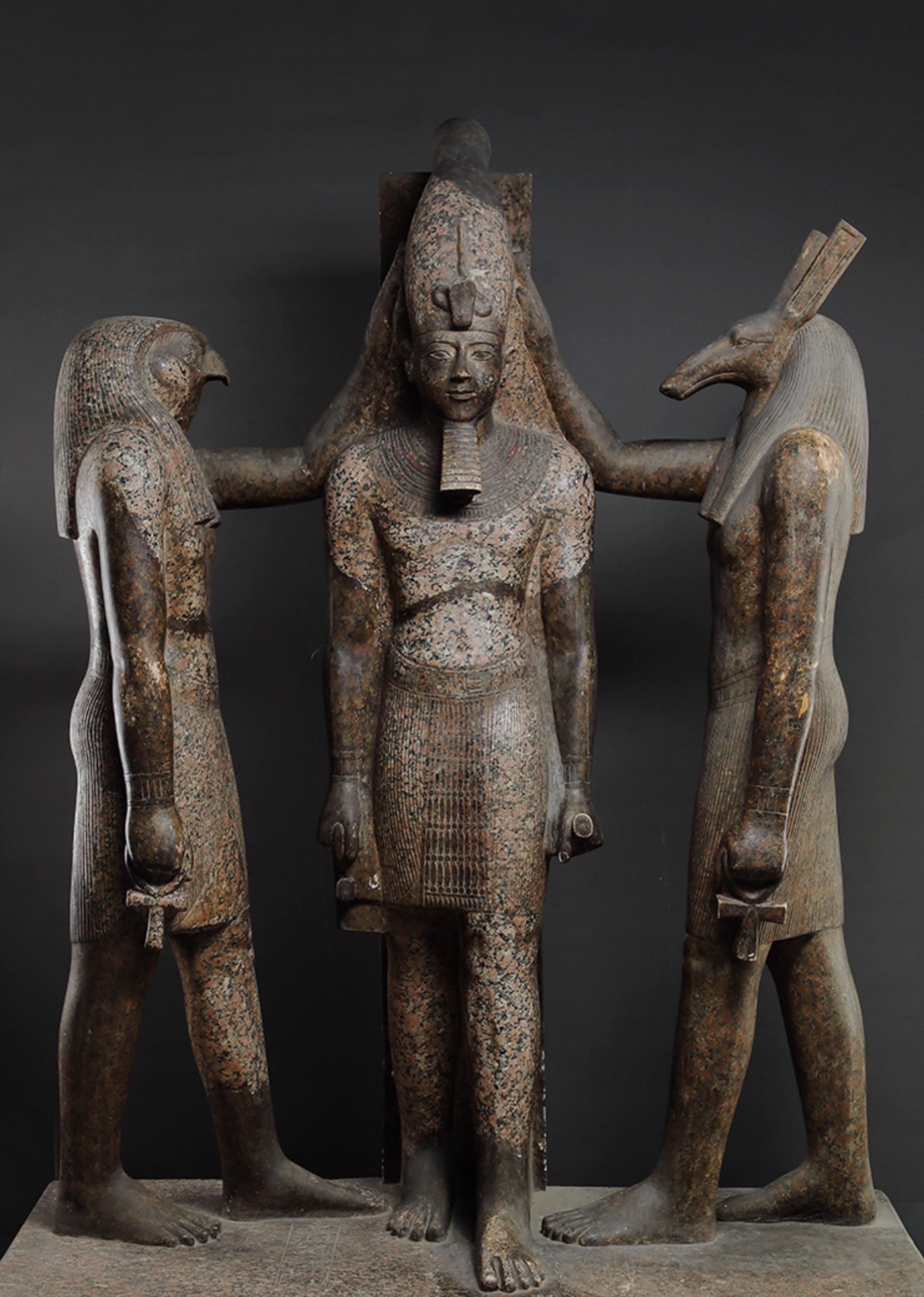
One’s Y-DNA can be traced back thousands of years. This means you can say, in a stretch of 1+1=2 theory, millions of relatives exist out there. My cousin fondly points out that one of our relatives is Ramses III.
Alas, this means we are related to the first King of Egypt (Ramses the I and II were generals, not royal). Ramses III, no relation to the previous two, begat several sons.
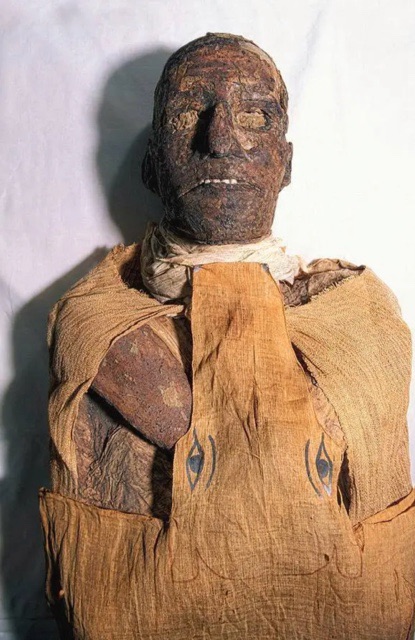
This Ramses ruled Egypt during the 20th Dynasty which lasted from 1189 BCE to 1077 BCE. This was the last dynasty of the New Kingdom of Egypt which included Ramses III thru Ramses XI, a great great grandson.
Gabrielle and I spent a few moments with our distant cousins. In her opinion, there seems to be some family resemblance.
Other Sites of Cairo
There exists many more sites of interest around Cairo. However, time does not allow more exploration at this time.
At end of day, Gabrielle and I arrange our transportation back to the Cairo International Airport. Afternoon traffic remained light, our trip taking about 35 minutes.
We lodge at the Le Meridian Airport. As we have an early morning flight and the hotel provides easy walkway access into the airport, dinner and lodging here seems a convenient choice.
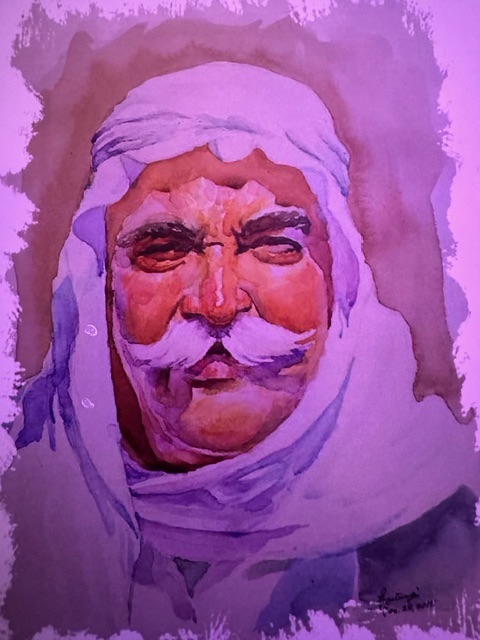

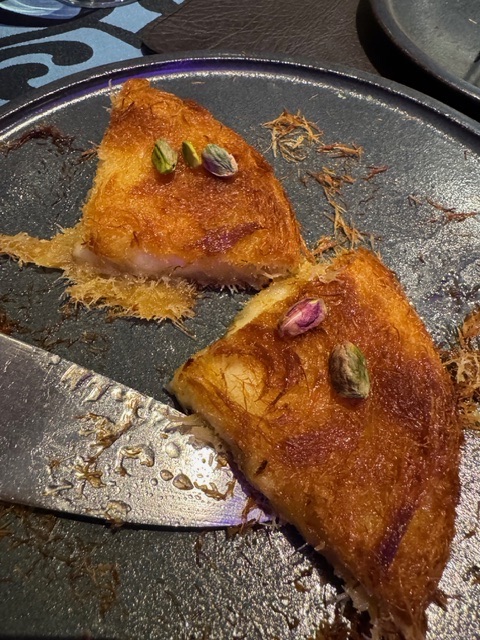
We dine at Mezzeh, which offers an appetizing fare of Lebanese cuisine. Gabrielle expertly selects two small dishes, or mezze, and two main dishes to share. Everything tasted great and offered a variety of flavors. We finished with delicious Kunafa.
The staff throughout the hotel were friendly and helpful. They went out of their way to be gracious. Only complaint I can express is the service, in general, moves slowly. My bad, but eventually after a busy day, I lean toward cranky having to spend 20 minutes to check in or wait 30 minutes to pay a bill.
However, it takes no time for the graciousness of the Egyptian people to reestablish good vibes.
And, tomorrow, our adventure continues.

0 Comments