26 March 2026
Tunisia’s Tataouine Governorate feels like stepping beyond Earth’s familiar into a landscape sculpted by wind, silence, and time. The horizon stretches endlessly, carved into rippling desert plains, honey-colored ksour rising like ancient fortresses, and villages seemingly grown from the rock itself.
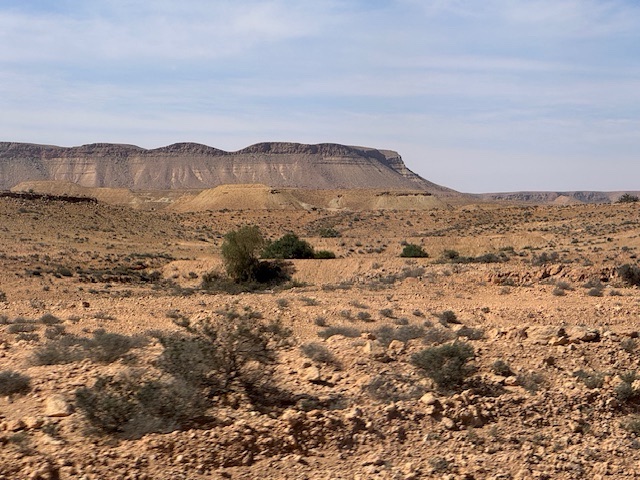
The air carries a stillness that amplifies every footstep, every shifting grain of sand, every whisper of history. It’s hidden granaries perched on cliffs, labyrinthine alleys shaded by earthen walls, and vast open spaces that invite adventure. Its Berber heritage adds texture far beyond what photos capture.
Expect awe, a touch of timeless mystery, and the feeling that you’ve traveled far beyond an ordinary galaxy. It’s easy to understand why filmmakers saw another world here — the terrain feels cinematic, surreal, and quietly powerful, as though the desert itself is telling stories millions of years old. In fact, George Lucas modeled his fictional planet Tatooine after this region.
I admit, I love Tataouine Governorate.
Galaxy of Tatooine
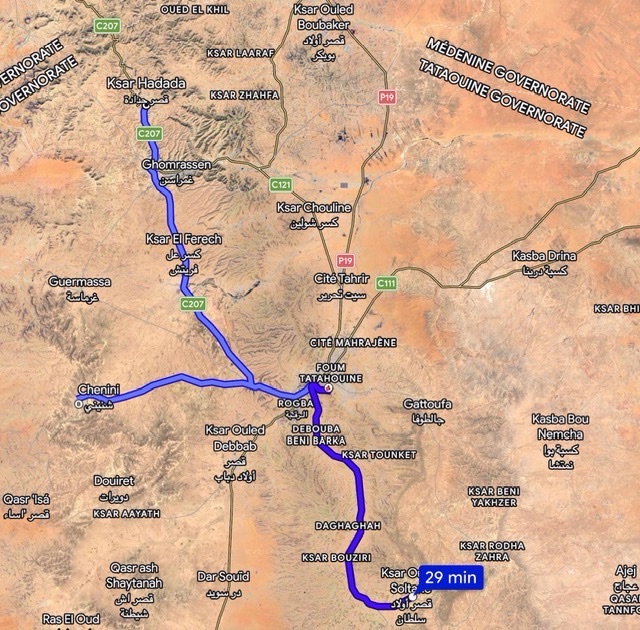
Ksar Ouled Soltane
This ksar feels less like a structure and more like a vision from another planet — a sculpted fortress rising from the desert in layers of curved earthen chambers. Its stacked ghorfas form a beautiful pattern of shadow and symmetry.
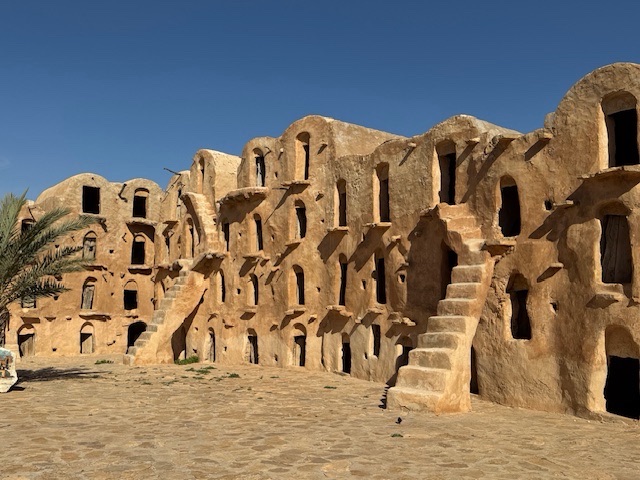
A ghorfas are the individual vaulted storage chambers that make up the honeycomb-like structure of the ksar. Each ghorfa was traditionally used by families to store grain, olive oil, or valuables, helping protect supplies from heat, humidity, and raids. Their stacked form is what gives the ksar its striking, almost “out of our galaxy” appearance.
Wandering through its quiet courtyards, one senses centuries of resilience preserved in clay, where architecture was shaped not just for beauty, but for survival. The silence is broken only by the wind which is strong and constant.
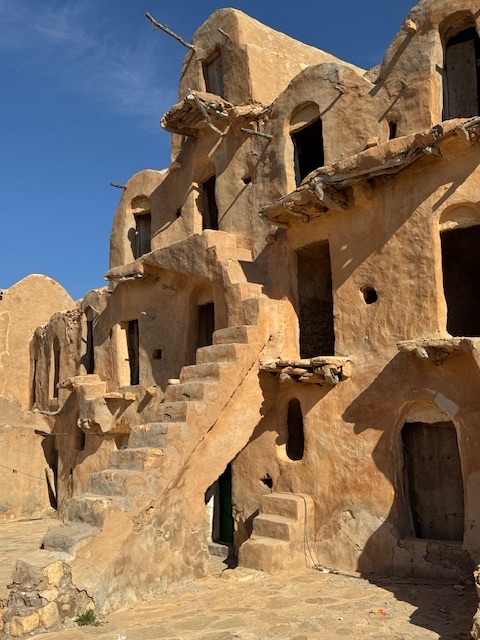
Exploring Ksar Ouled Soltane feels cinematic in the purest sense — a place where imagination effortlessly bridges past and future, all timeless and extraordinary.
The repeating arches and narrow stairways create shifting perspectives that feel almost otherworldly, which is why it famously inspired scenes from the Star Wars universe. It represents community, adaptation, and the quiet perseverance of desert life.
Expect a sense of awe that lingers long after you leave, as if you briefly stepped beyond Earth’s familiar landscapes into something timeless and extraordinary.
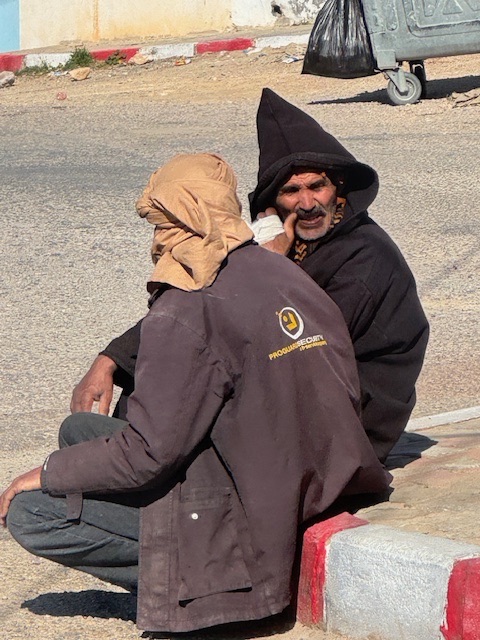
Ksar Ouled Chenini
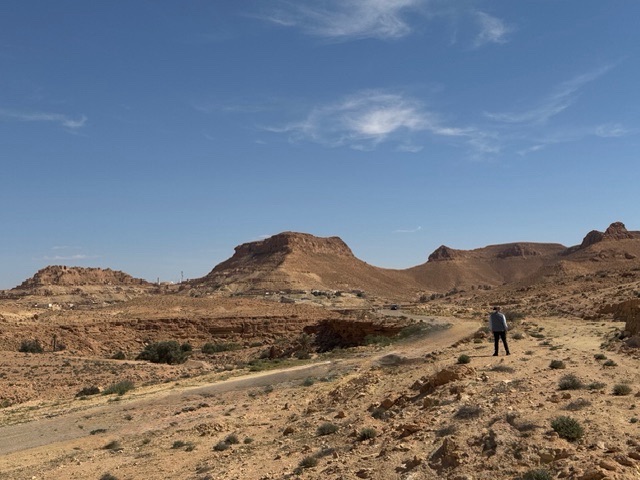
Perched high in the Dahar mountains, Chenini must be one of the most beautiful old Berber settlements in North Africa. Its origins date back to at least the 12th century, when Amazigh families built fortified ksour and carved homes directly into the rock to protect themselves from raids and harsh desert climate.
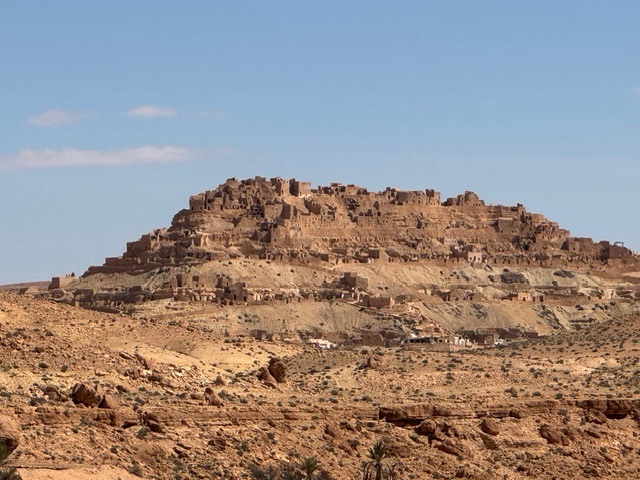
The hilltop location was strategic: from above, approaching threats could be seen from miles away, while precious harvests of wheat, olives, and dates could be safely stored in ghorfas carved into the mountain itself.
Over time, as regional conflicts diminished and modern life became more accessible, many residents gradually moved down into “New Chenini,” built after Tunisia’s independence in 1956 with electricity, roads, and running water.
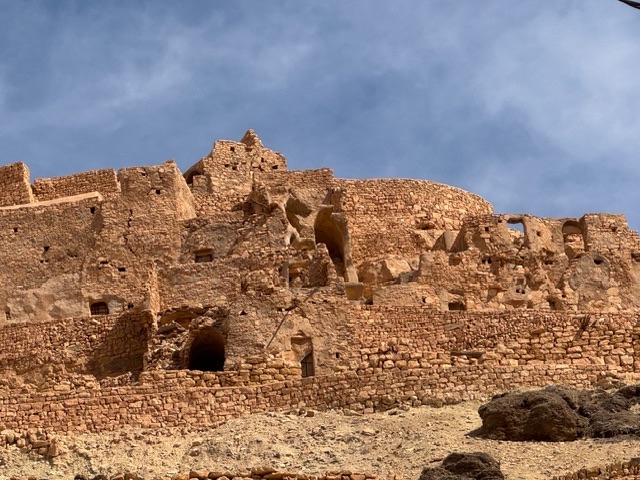
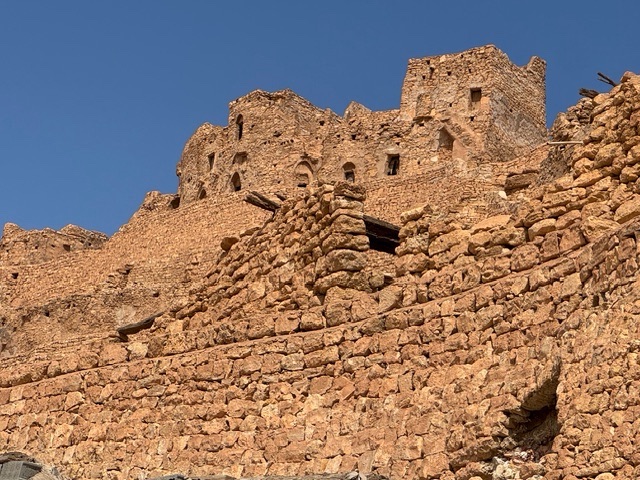
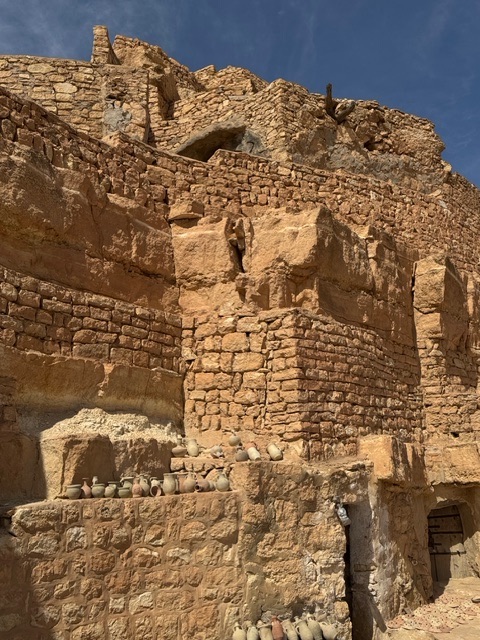
Today, parts of the original village remain inhabited, but much of the upper settlement feels suspended in time — not suddenly abandoned, but gently left behind as the progress of life shifted toward the valley.
What makes Chenini so spectacular is its presence high above the surrounding desert floor. Blending into the rock seamlessly, easy to overlook as just another rocky outcropping. Until one arrives and climbs its path to the old city. Donkeys line the path.
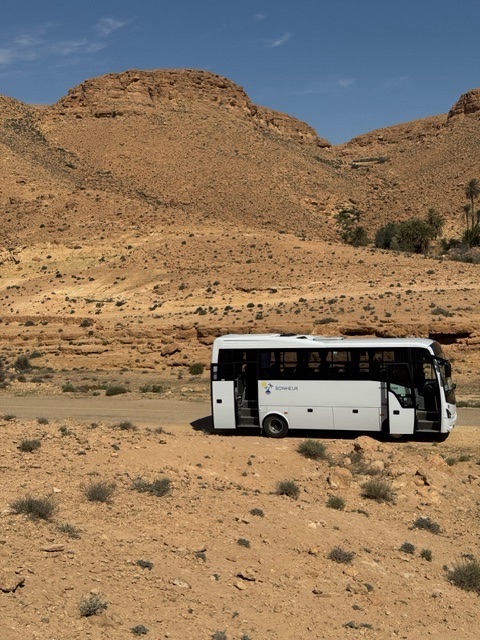
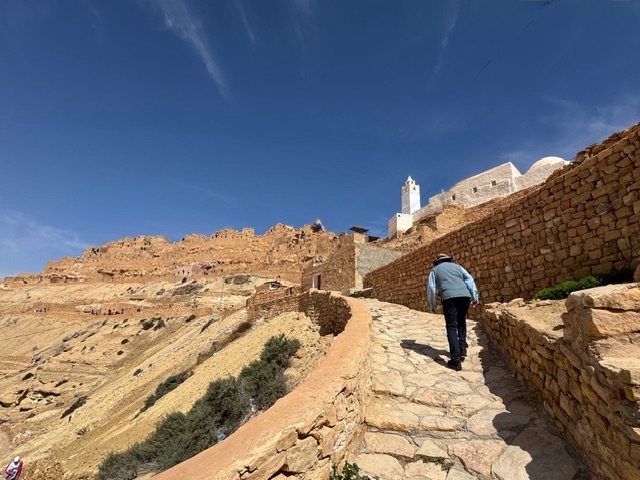
The wind blows as a constant companion, reminding me that Mother Nature was here, carving rock long before Man arrived.
The white mosque, often called the Mosque of the Seven Sleepers, sits like a brilliant beacon among brown stone dwellings that seem to grow out of the mountain itself.
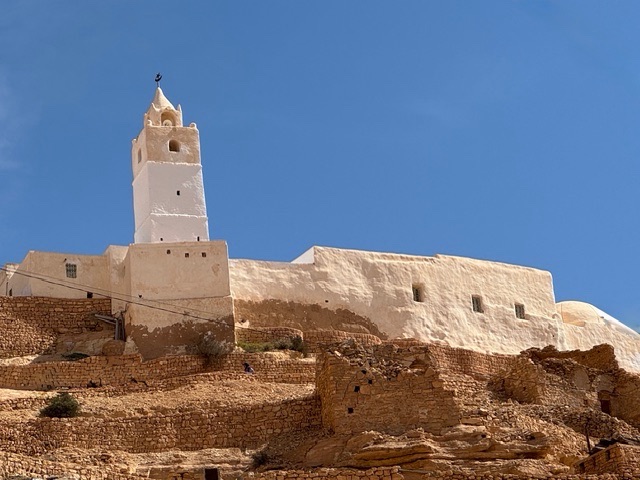
From the summit, the landscape unfolds in vast silence, an endless sweep of desert plains that appear almost extraterrestrial in scale and color.
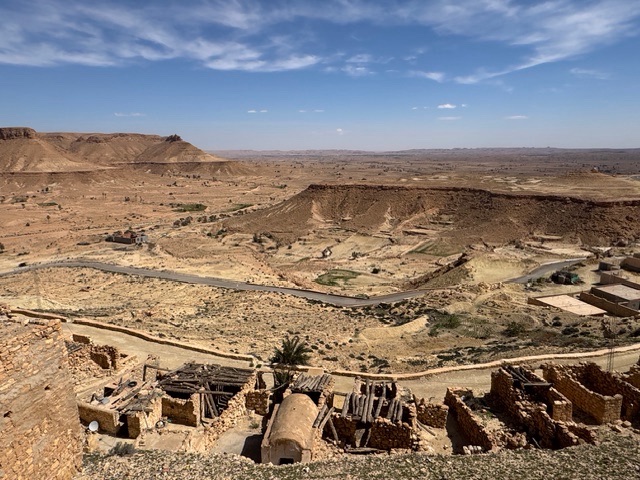
Standing there, the modern world disappears, replaced by the sensation of looking out over another planet — one shaped not by machines, but by centuries of adaptation, faith, and resilience. The elevation, the wind-carved ridges, and the layered earth tones create a panorama that feels both ancient and infinite. This represents a landscape that has endured for millennia.
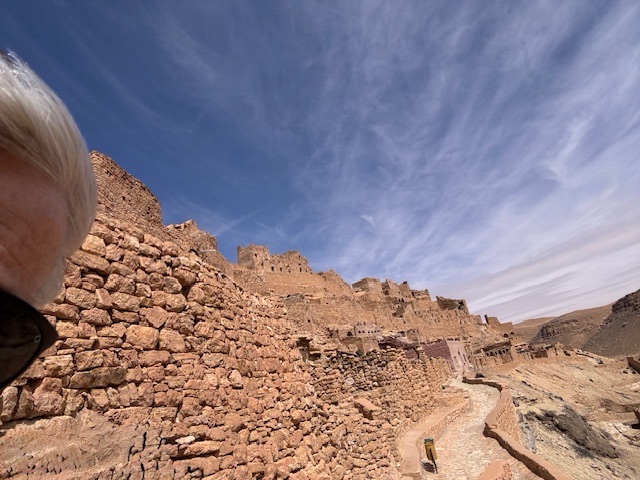
Ksar Haddad – Looking for Yoda
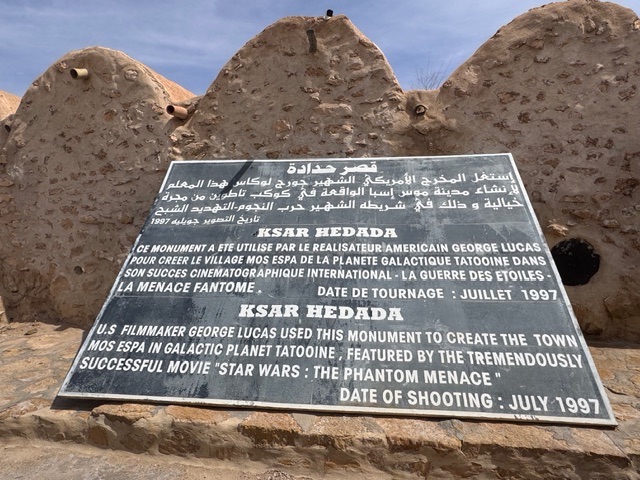
Again, a location for Star Wars – this time with food. Ksar Haddad represents one of the best-preserved Berber ksars in southern Tunisia, a community that survived and traded within this harsh landscape.
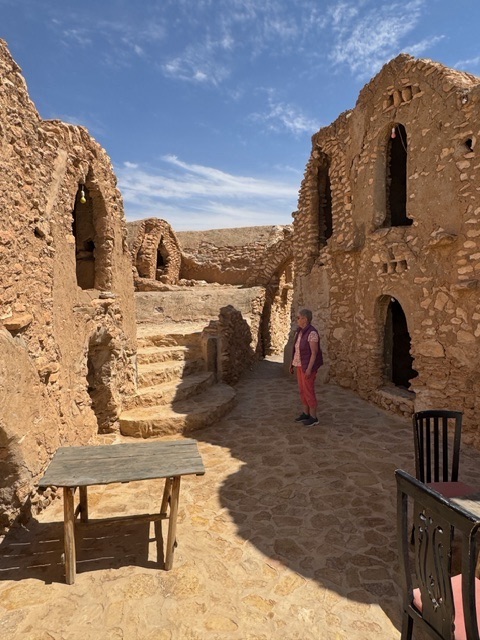
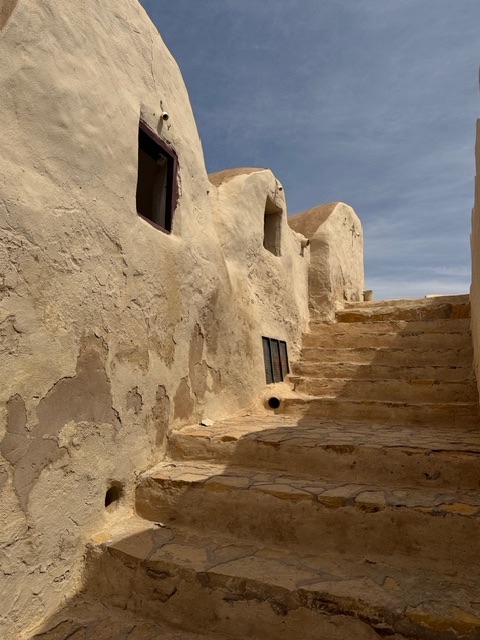
Built mainly in the 19th century, the ksar functioned as a fortified communal granary. Here, semi-nomadic Berber tribes stored grain, olive oil, dates, and valuables in stacked, barrel-vaulted rooms called ghorfas. It’s thick walls and compact design protected both food and people from raids, extreme heat, and the unpredictability of desert life.
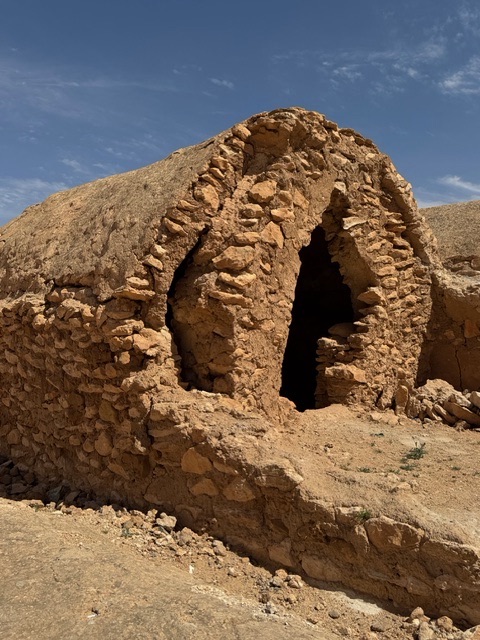
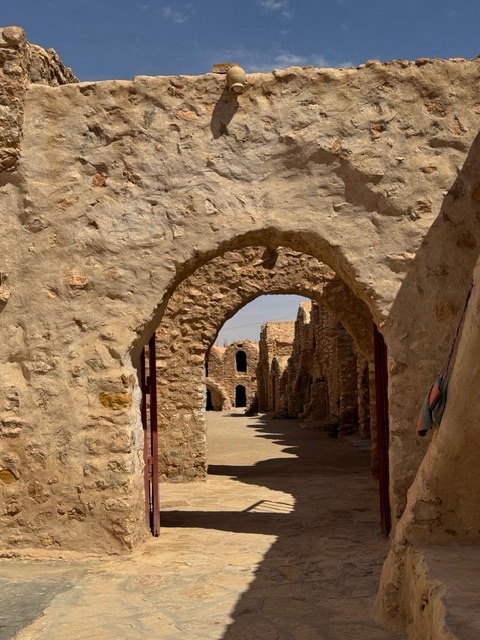
Today, Ksar Hadada continues to be impressive for travelers. Rows of honey-colored ghorfas rise in tiers around small courtyards, their simple doors and rough stone surfaces glowing in the desert light. Parts of the ksar were used as a filming location for Star Wars: Episode I – The Phantom Menace, standing in for slave quarters on Tatooine.
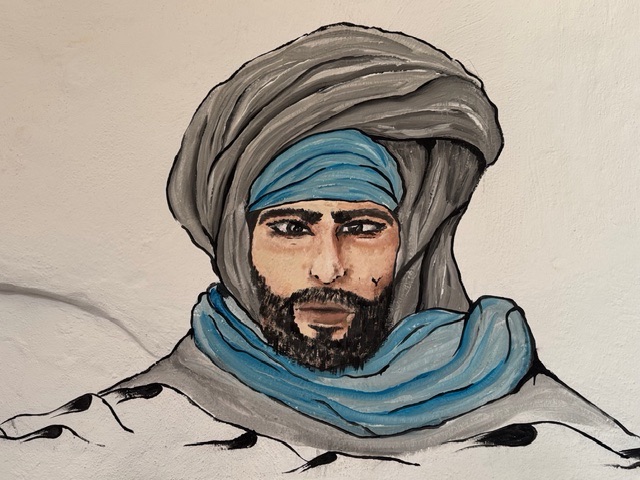
Walking through it now, you sense how its architecture was never decorative. This served as communal, defensive, and deeply practical, shaped entirely by the demands of life on the edge of the Sahara.
Invisible Security Network of the Desert
Travel in the Sahara is often imagined as remote, yet the reality reveals a watchful but covert network of coordination designed to keep visitors safe. In southern Tunisia, particularly within the Tataouine region and areas approaching the frontiers of Algeria and Libya, local authorities remain attentive to the movement of travelers.
Guides like ours commonly stay in regular contact with regional officials, sharing itineraries and confirming that guests are accounted for and comfortable. This communication may feel surprising at first, yet it reflects a longstanding system intended to provide support in landscapes where distances are vast and services sparse.
Along the roads, occasional checkpoints and patrols serve as subtle reminders that while the Sahara feels boundless, your presence is neither unknown nor unsupported.
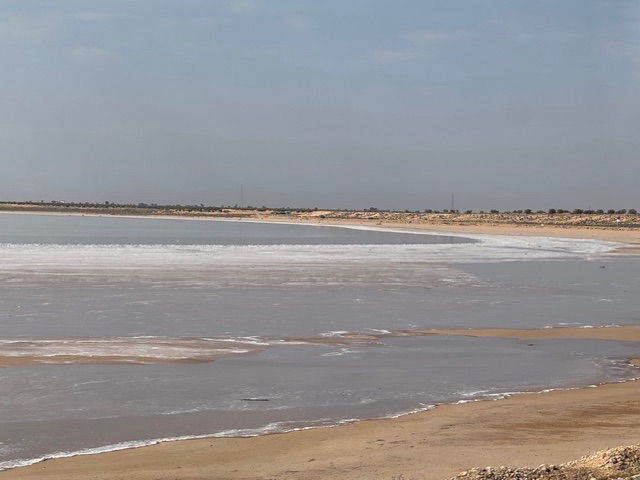
Salty bay, desolation, ever-watchful security for visitors
The sense of security becomes even more understandable when one realizes how close these journeys can come to international borders, with road signs sometimes pointing toward Tripoli or remote crossings into Algeria.
Foreign advisories designate areas within approximately ten miles of these border zones as higher caution regions. In fact, the US State Department ranks this area as the highest Level 4. Thus, guides and local authorities often maintain awareness of travel routes and, in some cases, arrange escorts when itineraries approach sensitive corridors.
So, that explains some of those cell phone calls to my guide.
Overnight in Djerba
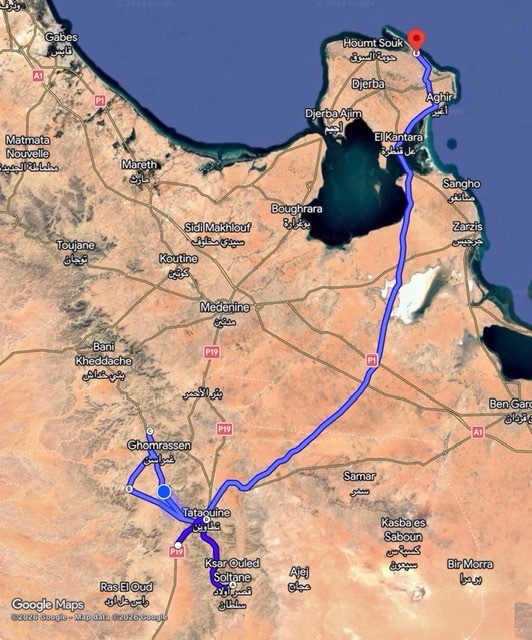
We drive through more open desert, signs to Tripoli pointing to my right, the border less than 50 miles south.
Different border, different time zone, different attitude.
We lodge for the night at the Ulysse Djerba Thalasso & Spa. One knows immediately what to expect with our hotel, or I should say spa. It is always fun to look up the tour’s lodging to get an idea of amenities. I love it when amenities include “bathroom toilet paper.”
Not only does the Ulysse offer a spa but an indoor swimming pool, outdoor pool and terrace, beautiful gardens, and private beach. It overlooks the sparkling blue Mediterranean just a few feet away. However, the wind is cold and fierce so we pass on the beach.
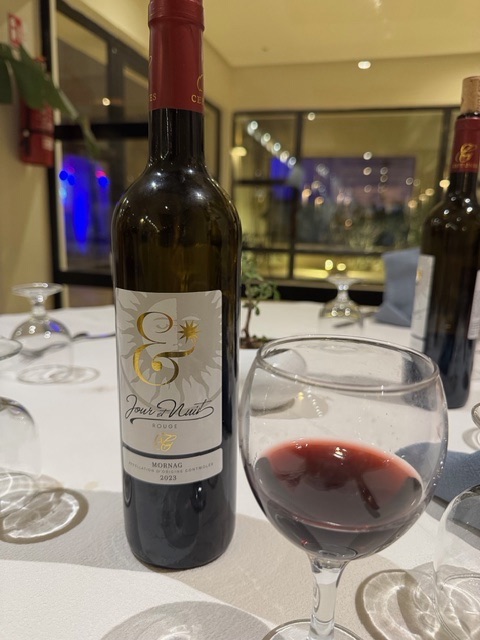
It also has a bar with real alcoholic drinks!
The white wine, color of camel urine, was undrinkable; the Day and Night red fairly good.
Strangely, we are not considered resort material so to get wine we must purchase an entire bottle. Well, okay. Perhaps, if I have a good enough imagination, or too much alcohol, I will see Malta in the distance.
