29 March 2026
One needs time in a country to truly begin to appreciate its history, culture, diversity and idiosyncrasies or peccadillos. I did not have the time or exposure during my brief visits to Tunis in 1982 and 2010.
But, 10 days touring Tunisia, I can feel a true appreciation for its history and culture. Although I can drive thru just so much desert before empathizing with the camels, there is beauty even in those endless sands and scrub grasses.
I like Tunisia.
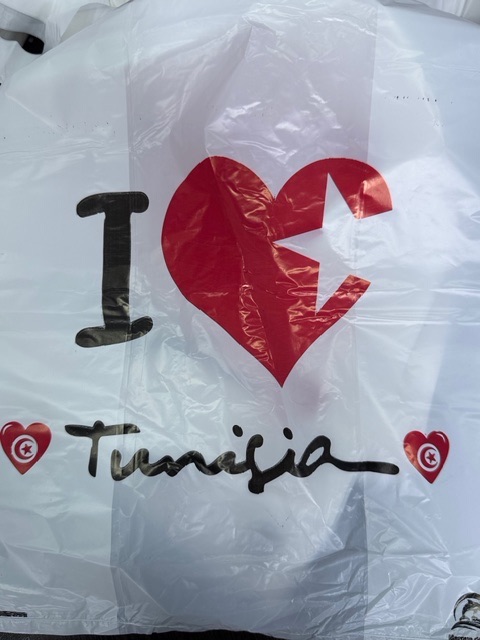
Here, I will add some interesting information that I learned during my visit to this land of Carthage and jasmine.
Looking for Yoda
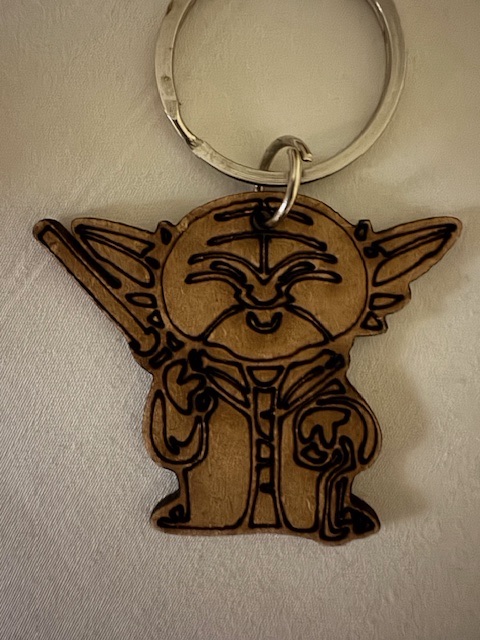
I admit, I was surprised by all the movie locations around Tunisia. Not only Monty Python and Indiana Jones, but countless locations for Star Wars. This isn’t just coincidence.
Filmmakers often choose Tunisia because it offers diverse landscapes—deserts, ancient cities, Mediterranean coasts—that can double for multiple countries. Production costs are relatively low, weather is reliable, and government permits are often straightforward. Tunisia also has experienced local crews and film infrastructure developed since major productions like Star Wars. Directors value its visual authenticity, accessibility, and ability to convincingly portray historical or fictional settings.
History and Democracy
As our guide, Kamel, talks of Tunisian independence and progress, I cannot help but think how it all sounds so familiar. As historian, author and filmmaker Ken Burns said:
History doesn’t repeat itself, but it does rhyme.
Tunisia’s recent history rings as a familiar refrain:
Loss of middle class, growth of the wealthy few, movement of money out of the country, low paying jobs if a job at all, 10-12% inflation, youth and professionals immigrating to Canada.
Kamel talked often about Habib Bourguiba.
Who is Habib Bourguiba?
My guide loves Habib Bourguiba and explains how the man earned the title of Supreme Combatant. Bourguiba is widely honored in Tunisia because he is considered the father of the modern Tunisian state. He led the movement that ended French colonial rule and guided the country to independence in 1956. As Tunisia’s first president, serving from 1957 to 1987, Bourguiba focused on building a secular, education-centered society and establishing national unity after decades of foreign control.
One of the main reasons many Tunisians respect him is his progressive social reforms, especially regarding women’s rights. Shortly after independence, he introduced the Code of Personal Status, which banned polygamy, improved women’s legal rights, and expanded access to education for girls. These reforms were very advanced for the region at the time and helped shape Tunisia’s reputation as one of the more socially progressive countries in North Africa.
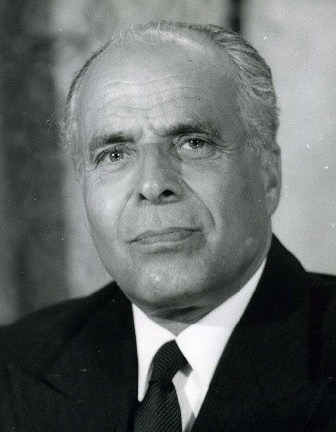
Bourguiba also prioritized public education, healthcare, and economic modernization. He believed that literacy and education were essential for national independence and dignity. His leadership helped create a strong national identity and a sense of pride among Tunisians who saw themselves moving toward a modern future.
My guide views him as the leader who laid the foundation of the country’s institutions, promoted social progress, and helped Tunisia stand apart in the Arab world. Streets, schools, and even the main avenue in Tunis are named after him, reflecting the deep respect many citizens continue to hold for his legacy.
BB or Before Bourguiba, Tunisia, politically and religiously, seemed so familiar to what is happening in the US today. The tragedy is the erosion of our norms, processes, and institutions that underpinned a remarkable period of peace, progress and prosperity. The foundations of our democracy have need undermined. The US has morphed into a revisionist power, and disruptor of national stability.
I harbor deep respect for the progress and peace Tunisia has achieved. It remains my hope that in my lifetime, I will witness the same for the US.
My Canadian Friends
There is too much division and diversion happening. I was saddened to hear the two dear Canadians on our trip express their initial hesitation about joining Americans on this trip. The image that America projects to others is shameful. The long standing joke has been how Canadians are too kind and polite. For them to worry about Americans showing hostility towards them is beyond embarrassing.

Good grief, to treat a Canadian poorly is like slapping around Ryan Reynolds, Ryan Gosling, Keanu Reeves, Jim Carrey, or Michael J. Fox. How can one insult the likes of Alex P. Keaton or Marty McFly?
After the prerequisite time of caution, we are able to talk honestly about the political situation. I cannot apologize enough for my government’s insulting and disrespectful behavior towards our friends and allies. The world feels this.
As an American, I feel welcome everywhere. But, it is clear, it is obvious to all travelers and should be to all Americans (but sadly it is not), that the US is failing its allies and can no longer be trusted.
Breads, Bowls & Bold Spices
Tunisian cuisine is deeply shaped by its vibrant use of spices, which bring warmth and balance rather than overwhelming heat. Staples such as cumin, coriander, caraway, turmeric, and paprika create layered flavors in soups, salads, and stews.
The chili paste harissa adds a kick which I am happy to avoid, while cinnamon and allspice subtly enrich savory dishes. Fresh herbs, olive oil, lemon, and garlic appear generously, making even simple salads taste wonderful. The breads are excellent for soaking up fragrant broths, and fish and camel are often seasoned just enough to highlight their natural taste.
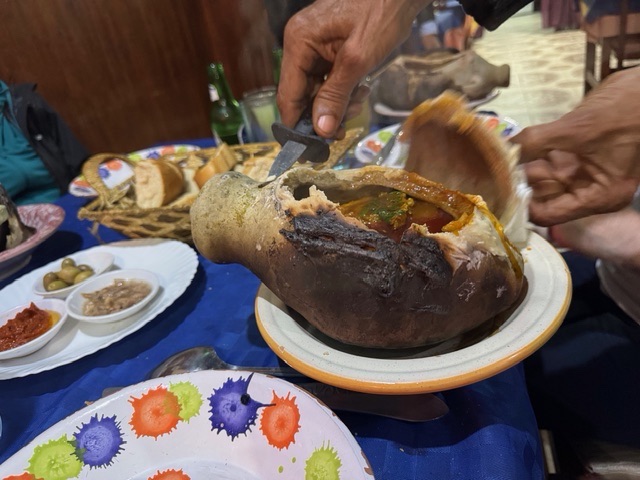
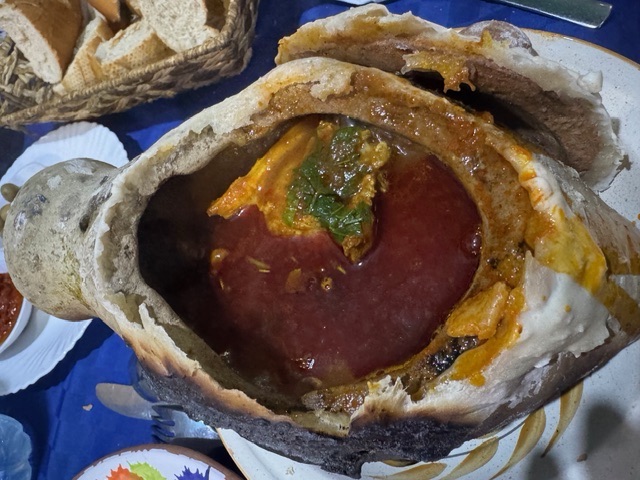
Despite the bold seasoning in many dishes, the food can sometimes feel under-salted, leading diners to reach instinctively for the salt shaker — which, unfortunately, may not always cooperate. Coffee culture leans heavily toward sweetened espresso or ubiquitous Nescafé packets, often lacking any accompanying cream packet that I need to drink Nescafé. Yet the generosity of portions, the comforting soups, and the thoughtful layering of spices reflect a cuisine designed for sharing, abundance, and long, leisurely meals.
Alas, few meals served more than water or soda drinks. Deserts were usually cakes or cookies – always delicious. Buffets served a plethora of selections, especially desserts. However, it was the smaller restaurants or family homes that seemed to serve the best meals.
I did miss the evening cocktail. It was a real treat when we were able to gather for a drink. Most local reds or whites were enjoyable.
Solo Women Travelers
I am a woman – traveling solo. I am doing so in a Muslim country, surrounded by centuries of tradition, one in which women are not out and about unchaperoned. And certainly, not hanging out in a bar. I often wonder how locals feel about us Westerners who display this behavior.
What most locals actually feel, though, seems far less dramatic than the weight of history I carry in my head. For many, a solo foreign woman registers as unusual but not threatening, and increasingly, not even surprising. Tunisia in particular has a long history of tourism, education, and relatively strong women’s public presence compared to many neighboring countries. Therefore, the sight of a woman moving independently doesn’t automatically trigger disapproval.
More often than not, reactions fall into three quiet categories: curiosity, indifference, or mild protectiveness. Some people may assume I’m married and a husband sits “around somewhere.” Others know instinctively I am a visitor passing through their daily routines. I’m not measured against local norms for women so much as placed outside them—foreigners live by different rules, and that’s widely understood.
Cafes still skew male (and may look askance that I sit), but my presence usually reads as cultural difference rather than defiance. In short, I am told, locals rarely judge me as a woman breaking tradition. They mostly just live their lives while I pass through—observed, perhaps, but rarely condemned.
Saḥḥtek
To your health
