Between Warm Welcome and Wary Watchfulness
Notes from a a Land of Generosity That Never Quite Looks Away
Lessons learned by travelers: one needs time in any country to understand and appreciate its history, culture, diversity and idiosyncrasies or peccadillos. I admit, I knew practically nothing about Algeria before my arrival. After 15 days, I feel I have scratched its surface.
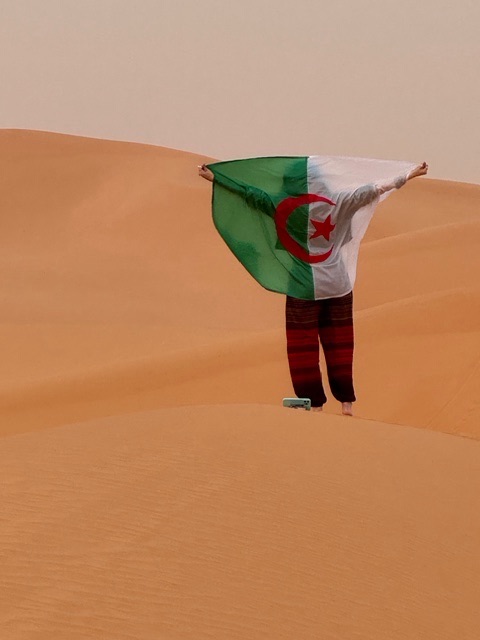
Thanks to excellent local guides, Kamel and Sumaya, I learned so much about Algeria. And locals did not hesitate to speak to us almost as if hungry for contact.
I liked what I saw and heard. It becomes impossible to describe each daily event, especially when busy with long days of exploration. But there are a few things worth summarizing:
- Clearly, Algeria is just beginning to develop their tourist infrastructure, especially when one enters the Sahara.
- Algeria has the best dates in the world. Enough said.
- Cats cats cats – too many and Algeria could do better. There is a need for an organized neutering program.
- Often grouped together in Northern Africa are Morocco, Tunisia and Algeria. Algeria has developed as more conservative than Tunisia and Morocco but less than Saudi Arabia. They emphasize Muslim not the same as Arab people. Algerian conservatism seen in the dress, lack of alcohol, and strict observance of Ramadan and holy days.
- Algers particularly has an effective infrastructure that seems lacking in the cities of Cairo and Tunis.
- Tailgating is an art here.
- Algerians are very friendly and welcoming. Waves from the streets. Many greet us with smile and hello. Cars will actually stop to say their welcome and hello.
- As one leaves the bigger city, dining has a long way to develop. Sometimes plates and utensils are nowhere to be had, salad seems a communal activity. Algerian wine tastes pretty awful. Coffee pours as a dark sledge that makes Nescafé taste exquisite. Sometimes milk is available. Red meat means sheep, lamb, goat, camel or cow (of which I’ve seen very few). Then there is chicken. And you see very creative uses of eggs. All soup is called vegetable as a catch-all phrase be it squash, carrot, lentil or other. Many restaurants have outside grills: now if the cook could just learn to not grill the meat to death.
- One tires even of the best of cuisine. Our hosts may be slow in serving but not in portions. It is shocking the amounts and thus the waste. Hopefully, the cats get leftovers.
- Tea, you better like it because there is not much else. Little milk, lots of sugar.
- When you read alcohol may be in restaurants and four star hotels, understand this is an exaggeration.
- Lots of squat toilets.
- Heard more than once about the Corruption Period and Agriculture Mafia. Not sure it has ended.
- State builds apt but have to wait, sometimes years to get one. Cost about 170-Euros a month which goes toward eventually owning the property. Multitudes of unfinished buildings.
Portrait of Presence, Protection, and Perception
The U.S. State Department advises increased caution in Algeria due to terrorism and kidnapping risks. While major cities like Oran are more secure, authorities often require escorts to prevent incidents, particularly for foreign tourists in certain areas. They spot our pasty faces and immediately become alert.
Local authorities or police may assign escorts to ensure safety during your stay? The escort, which may include armed guards or police vehicles, assures safety and manages high-visibility travel, allowing tourists to visit sites safely without being in immediate danger.
Or…
Ask the question and one learns Algeria’s political structure is classified as a civilian dictatorship. Some political analysts describe the government as dysfunctional, sometimes referred to as a failing state. This classification suggests that power is concentrated and not considered a democracy.
Life at the bottom…
Algeria ranks as the biggest and richest country in all Africa with solid reserves of oil, gas, uranium, and rare earth elements. It is the military who jealously guard these riches, with a growing chasm between the rich at the top and the multitudes of poor at the bottom.
As others encourage tourism, will it change Algeria? As I heard directly from more than one gentleman, the Military is in control. And the military does not need tourism and probably doesn’t want it. An increase in tourism equals change and the global exposure which comes with it. Possibly not what a dictator or military would desire as a best case scenario.
Feels Like a Prison
The people are friendly and welcoming. Experiences with locals reinforced openness, warmth, curiosity and respect. They seemed, in general, to lack much knowledge about events outside their local region. Presence of police and military taken for granted. Sources here said this reflects the desire to keep the populace ignorant and compliant.
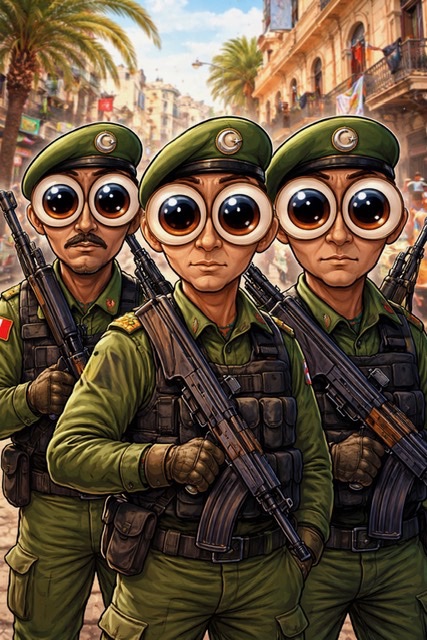
The policemen, or men in blue, were always polite and friendly. Military, the men in green, represent the National Gendarmerie, a branch of the armed forces that functions as a specialized police force under the Ministry of National Defense. They are not so much utilizing the smile factor.

We are always being monitored. Security and scanners everywhere, bags checked, possibly Passport and Visa confirmed. We were always within sight of police, sometimes dressed in uniform sometimes street dress.
But one did not venture off or walk outside the hotel on one’s own. Even if with an Algerian, it will be suggested the American/foreigner remain behind. It becomes less a matter of security and more a feeling of control.
Someone during the tour expressed that the security results from as agreement between the US and Algeria. Keep our people safe, guard them while in your country. I say bull hockey. Once here for a time, realize this is nonsense and distraction. The military and its government seemingly protects their own ass sets – beyond what was referred to as the Bouteflika Corruption Period which ended in 2019.
(And not to get reader’s hackles up: when conversations allowed, Algerians learned the US seems little different and possibly on the same downward spiral. In general, Algerians knew little about the US.)
A Quiet Yes – Come See for Yourself
Yes—come to Algeria. Come for the vast, cinematic landscapes, the layered history, and the generosity that appears without ceremony but leaves a lasting mark. You may notice the watchfulness, the quiet presence of security, the sense of being observed—but it sits alongside an equally real warmth: invitations to tea, conversations among friends, and a pride in place that’s deeply felt.
Algeria isn’t polished for tourists, and that’s precisely its appeal. It asks a little more of you—patience, curiosity, openness—and in return offers something rarer: the feeling of discovering a country that hasn’t been packaged, where the welcome is genuine and the experience entirely your own.
