4 April 2026
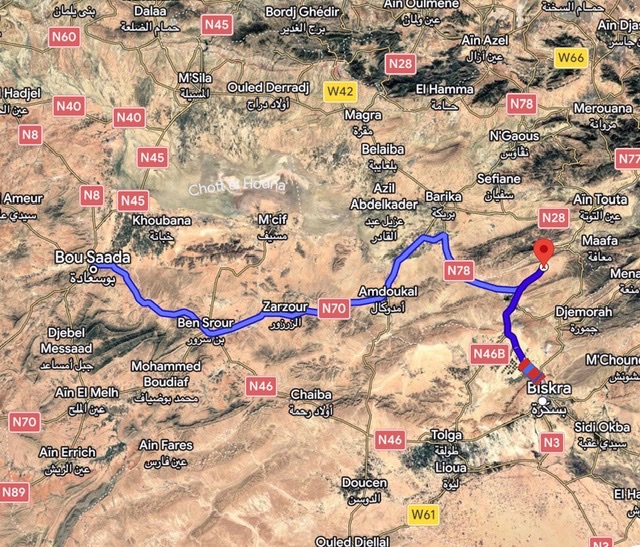
We continue our Sahara journey to Bou Saâda. The national road N3 heads northerly to the small oasis of El Kantara before turning in a northwesterly direction onto N70/N78. Not much changes during our 145-mile drive.
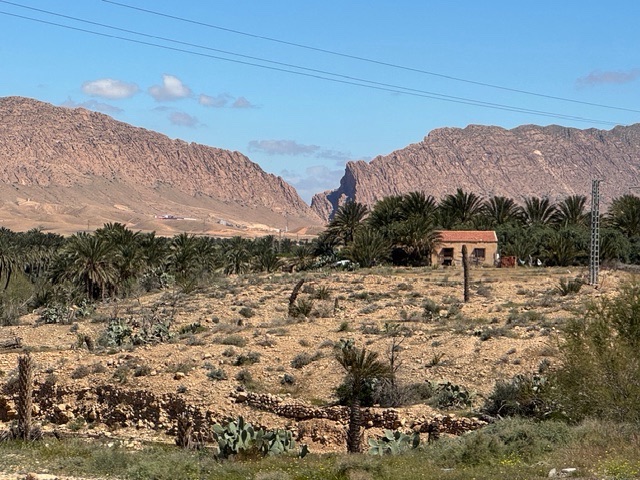
Lots of flat desert, rocks, occasional hills and some green where humans and animals might survive. I’m thinking Arizona and New Mexico deserts on steroids.
Roadside Shopping
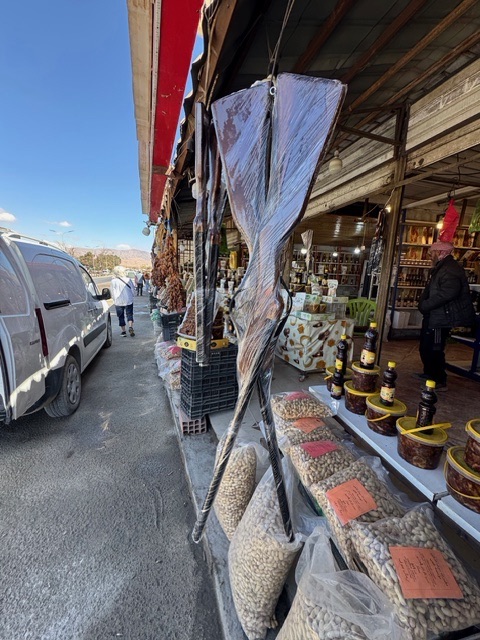
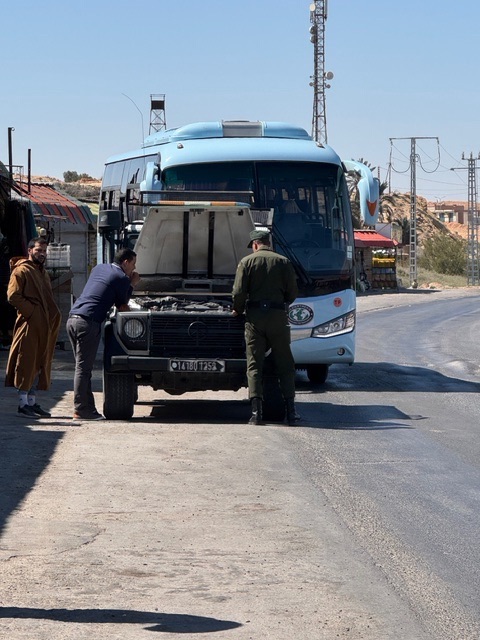
We make a pit stop to check the local wares. Here, peanuts seem to be the big sale item. Huge bags of them. Or possibly the toy rifles. Also, the ubiquitous dates hang in bunches, plus everything imaginable made from dates. Algerian dates have to be best in the world. Snack shopping occurs then we board the bus. However, our Green Guard escort can’t start their Mercedes.
Hood up, everyone tinkers. Nothing, not a putter. We cannot proceed without an escort so we wait. Shortly, another car arrives. We motor on as our long drive will be broken up with a brief stop at El Kantara. Here, the scenery undergoes dramatic changes.
El Kantara
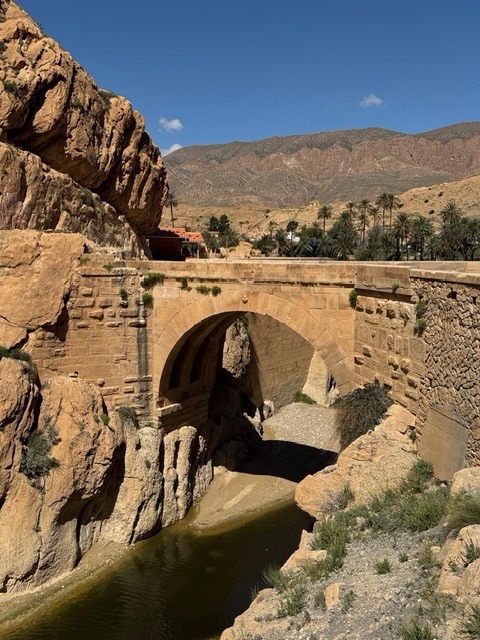
We enter this Gateway to the Sahara. Makes me question why this particular location is a gateway to what I have been traveling for days and hours. Answer: “This natural limestone bridge and scenic oasis mark the entrance to the vast desert beyond, offering stunning views and a chance to stretch your legs before continuing the journey.” An ominous warning for the miles of travel to follow.
The Roman bridge at El Kantara stands in a dramatic narrow gorge often called the Gateway to the Sahara or the Mouth of the Desert. The site was strategically important because it formed a natural passage between the fertile northern regions of Algeria and the desert interior.
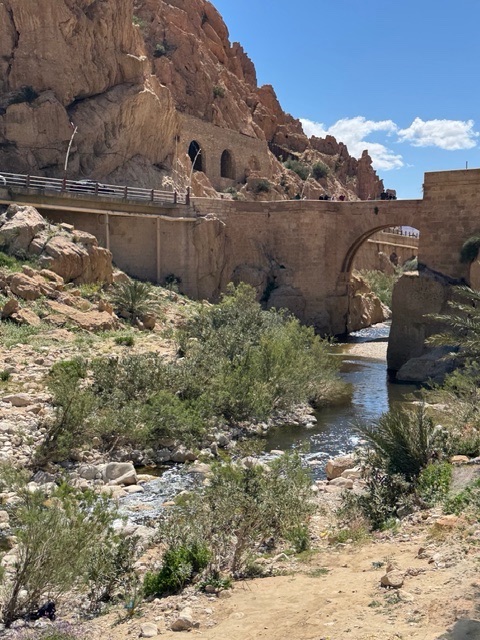
The Romans arrived in the 1st century AD and built this arched stone bridge across the Oued el-Haï to support military movement and caravan trade routes linking key settlements such as Timgad and Tobna. Roman soldiers of the Third Augustan Legion named the gorge Calceus Herculis (Hercules’ Kick), reflecting both the dramatic landscape and the importance of the crossing.
The bridge helped transform El Kantara into an important caravan stop and military post, guarded in the 2nd century by Syrian archers who are believed to have introduced early date palm cultivation in the area.
Although modified and repaired over centuries, including restoration in the 19th century, the remains of the Roman structure still testify to the importance of this narrow passage as a vital link between Mediterranean North Africa and the Sahara.
Today, the road is filled with traffic and railroad (above on the opposite side of the road) follows the same route as the ancient Roman road, demonstrating the enduring geographic importance of this historic crossing.
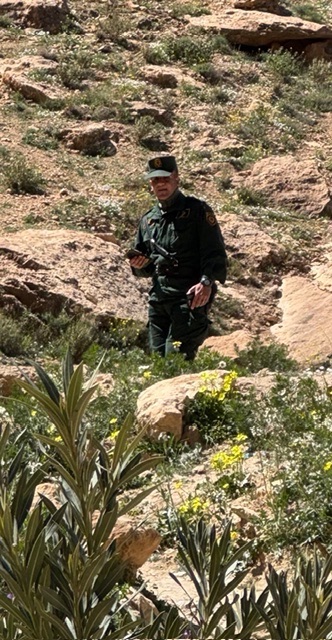
Our ever-present guard patiently watches and waits for these tourists to snap their photos before returning to Biskra.
Our guards surreptitiously walk with us as we visit Algeria. This, I hear, produces some very real advantages. In case we are held up in traffic, they will clear the way. Late for our domestic flight? The guard will call the airport and the flight will be held for us.
Sure wish they had been that accommodating when we were entering Algeria and getting those visas!
Return to Biskra for Lunch
We turn around and return to Biskra for lunch. Driving through this countryside I understand why as there is little in the way of towns or amenities. I see a camel farm, for eating I am told. Lots and lots of semis travel this road.
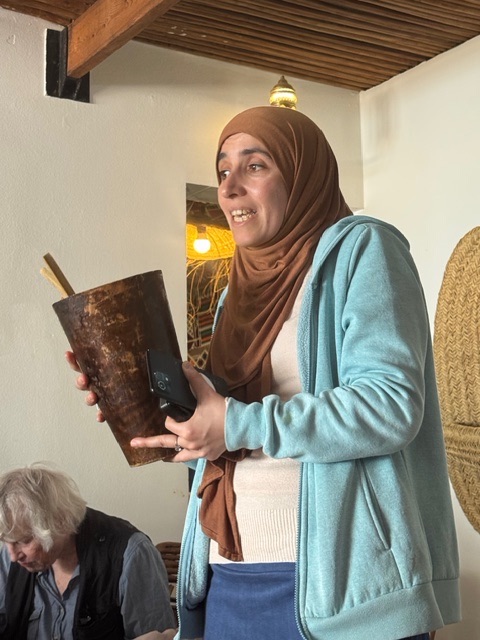
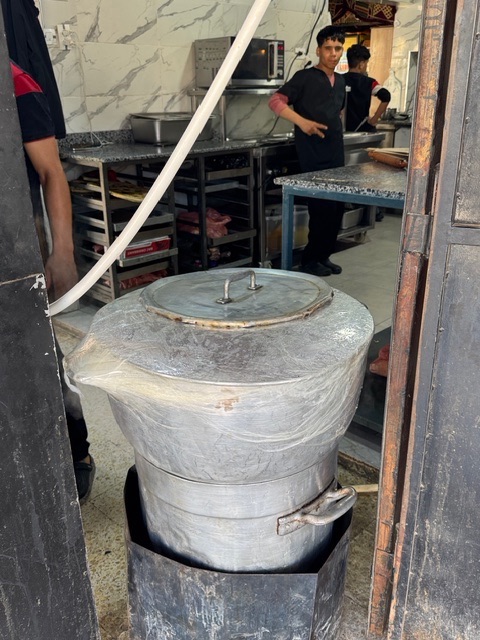
Lunch is in a small Biskra restaurant. Perhaps some explanation becomes lost in translation, but all red meat seems to be called beef. This covers meat from cattle (seen very few), goats, sheep and camel. All soup is called vegetable and one must ask the type, be it squash, lentil, carrot or other.
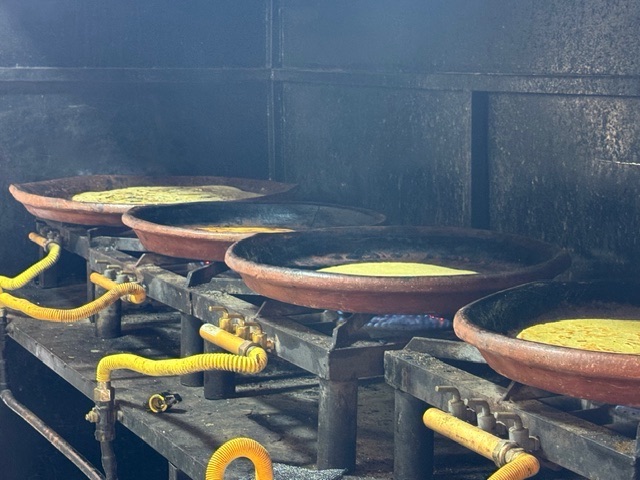
Bread is always a staple of the table, for all meals. Here, bread in stages of frying.
Today’s lunch is salad, which is another oddity. One large plate of lettuce, cucumbers, tomatoes and olives. But no individual plates are given. Often, we must ask for a plate. Always the wine glass on the table. Sadly, it acts as a water glass. Our lunch of salad, vegetable soup, steamed and spicy rice and beef is very tasty.
After lunch, we change directions and begin to drive northwesterly. Nothing much changes in landscape or views. Color seems rationed. Architecture blended in so perfectly that I had to squint to tell where the village ended and the desert resumed its natural state of indifference. A couple villages, hills, sand, cactus and scrub, low rocky cliffs. Topping a final cliff, Bou Saâda lies below: large, green and promising.
Bou Saâda
Bou Saâda, often called the City of Happiness, sits on the edge of the northern Sahara. Historically, it acted as a caravan hub and trading post, linking the northern cities to the desert interior. It retains a sense of crossroads between cultures and landscapes.
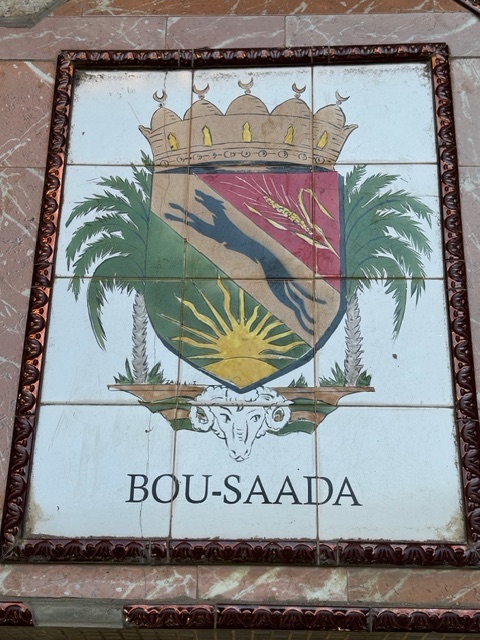
Bou Saâda feels like the Sahara’s laid-back cousin when equated to bustling coastal cities. Compared with Algiers or Oran, with its traffic jams, rivers of people along its boulevards, and constant hum of commerce and construction, Bou Saâda’s streets are quiet and sunbaked. There’s no honking, no crowded cafés spilling onto sidewalks, and definitely no mad scramble to get anywhere.
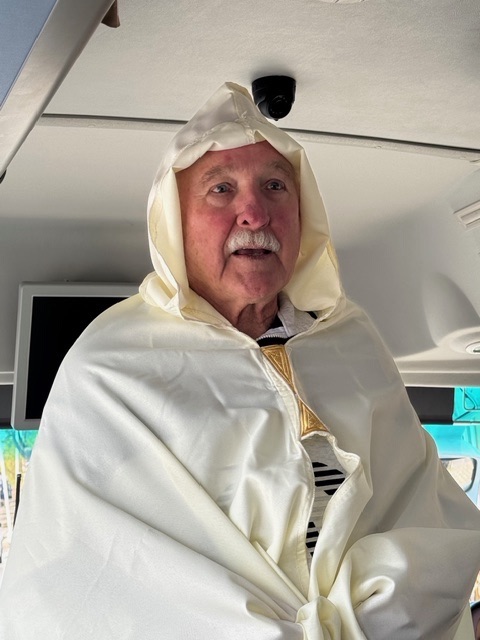
Not a merchant but our Loren wearing the commonly seen dress for men in these locals. Temperatures are much warmer, finally, so a lighter garb is needed to protect from sand and sun.
Merchants slowly shuffle through the souk. Palm fronds gently sway in the breeze. Sunsets color the surrounding hills with ochre and gold. All this more than makes up for the crazy energy of Algiers or Oran. Bou Saâda seems the kind of town where your fastest pace might be a camel walking through a palm grove.
Yet, the town is known for its vibrant souks, where merchants sell dates, carpets, pottery, and silver jewelry, along with colorful textiles and traditional crafts from the Saharan and Berber regions. The medina, though smaller and less crowded than those in Algiers or Oran, feels authentic, with narrow alleys and bustling marketplaces.
Bou Saâda is also known as a center for artists and painters, drawn to the desert light, ochre-colored landscapes, and striking horizons. Cafés and small hotels cater to travelers seeking both comfort and a taste of desert life, often with views of the surrounding palm groves and hills. The pace remains unhurried, giving visitors a genuine oasis experience. Bou Saâda represents a wonderful mix of history, culture, and the quiet, expansive beauty of the Sahara.
Nasir al-Din Dini National Public Museum
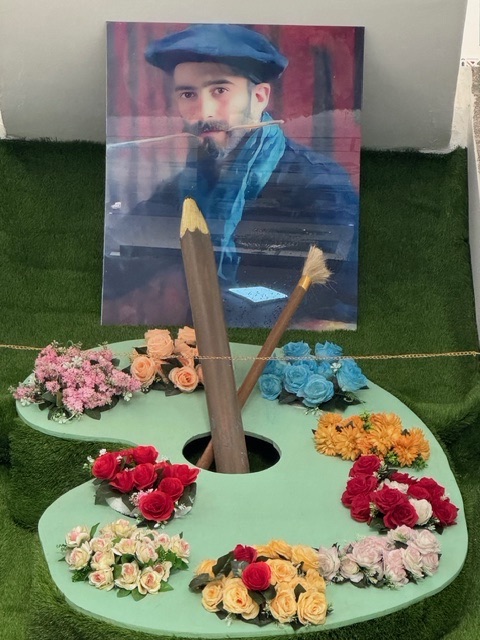
This museum sits in the historic part of Bou Saâda and showcases the life, art, and cultural context of the French painter Étienne Dinet. Dinet lived many years in the region and embraced Algerian culture under the name Nasr Eddine.
The museum was established in 1993 to preserve and present his works. The city named the street after Dinet. His memorial and tomb rests in the nearby Ouled H’mida Cemetery.
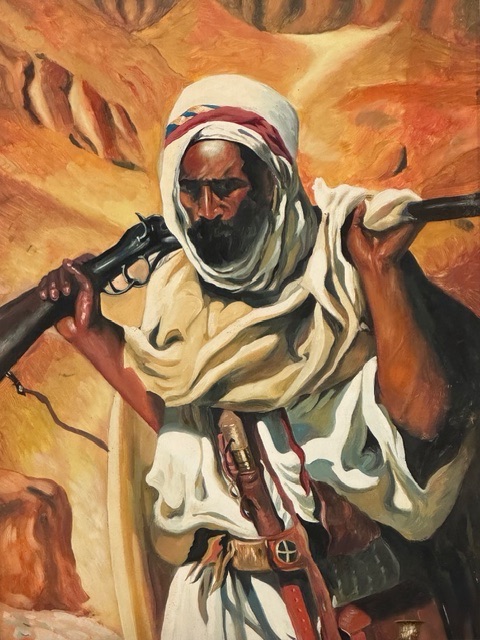
Inside, presentations include paintings and drawings by Dinet, as well as documents, photographs, and objects tied to his life. This includes his Légion d’honneur, France’s highest order of merit.
Dinet’s paintings depict Algerian life and peoples.
Overnight in Bou Saâda
We stay for the night at the Kerdada Hotel. It opened in 1913 as Le Petit Sahara. The original owner was a descendant of the family of Frenchman Jean Bailly (1736-1793), recognized as a great astronomer and politician. Our balcony overlooks the lush gardens, their peacocks crying out for attention.
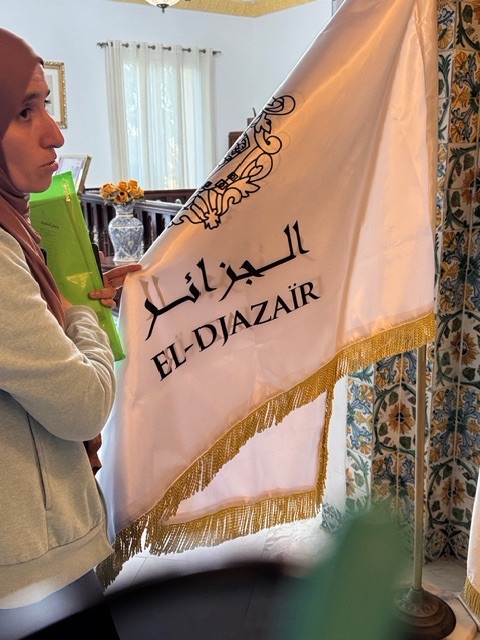
We say Algeria, Algerian’s say El-Djazaïr. Same great country.
For dinner, we individually ordered our salads and main course, a mushroom and cream sauce on tagliatelle. Salads are usually very tasty. The pasta rather tasteless. Dessert, for me, was a wonderful crème caramel.
And, of course, from our arrival greeting through breakfast, lunch, and dinner, we are offered mint tea. Like the Australian koala who pouted about Qantas, I .hate .mint. tea. Thankfully, beer or wine can be ordered with dinner.
Oh là là
The pool is sparkles, the architecture blends colonial‑era charm with Sahara‑town character. Meanwhile, the interiors and décor lean more toward the classic and old‑fashioned rather than ultra‑modern. Certainly, the Kerdada’s beautiful garden terrace steals the show. As does the sweet John Cazale/Fredo in Godfather lookalike bartender who happily delivered local beers – Becks. I’ll take what I can get, having learned Algerian wine needs lots of development.
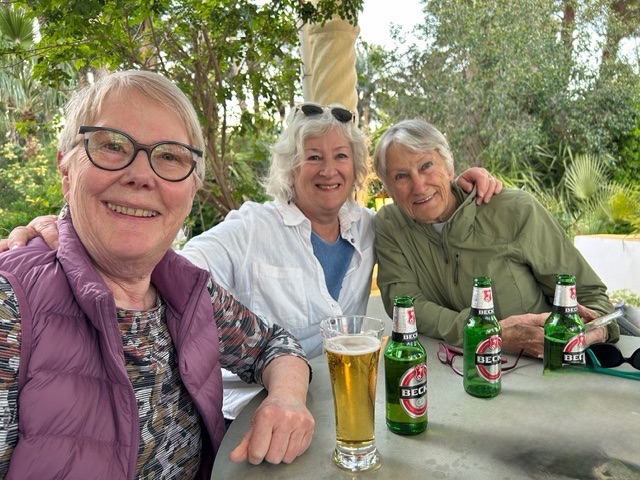
My Canadian aimes meet on the terrace for laughs and a Becks. Celebrating warmer weather, a cold beer, and forever allies.
À votre santé

0 Comments