8 April 2026
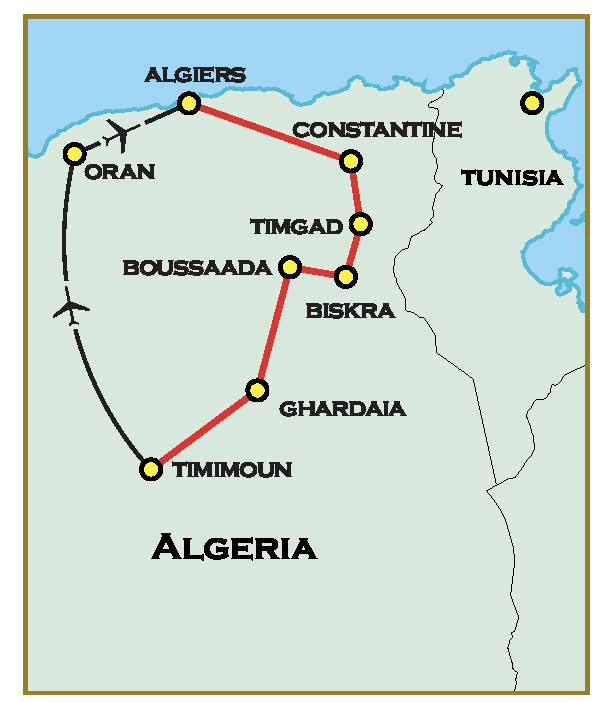
Today is what I call a kickback day. Nothing like sitting in a bus for hours. How can I enjoy 8 hours thru desert? Because my guide takes care of all the arrangements. And he promised an “enchanting oasis town” at the end of our drive.
Also, our itinerary says “surrounded by endless desert vistas and charming settlements, showing the timeless beauty and serenity.”
I just have coffee in my room. Gabrielle and I hop in the bus. In the memorable words of Stanley Tucci’s character Nigel, “Alright everyone, gird your loins!”
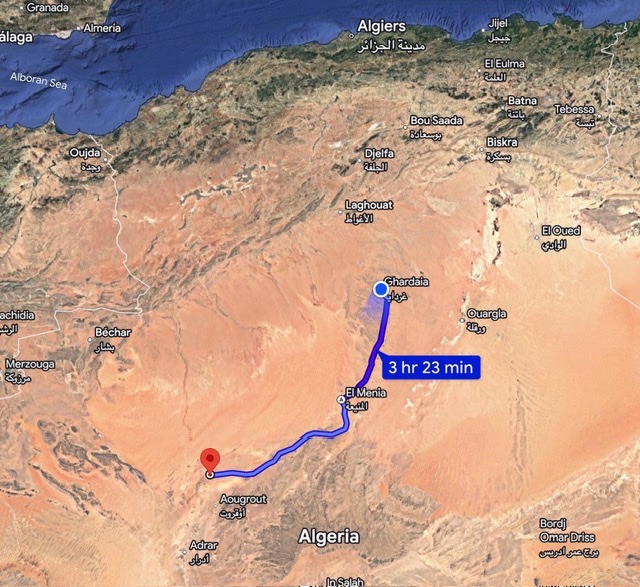
Hopefully, for the ubiquitous weak bladders, there exists some bathrooms other than rocks over our 400-mile route. According to Google Maps, the landscape appears to be an overwhelming brown color.
Couldn’t we fly? Technically, yes. However, flights between the M’Zab Valley’s Ghardaïa Airport and Timimoun Airport fail to operate on a direct, daily basis. Al Algeria requires connecting in Algiers rather than flying nonstop. Overland travel seems to be our time-saving alternative.
Checkpoints and Other Mirages – 400 Miles Of Hurry and Halt

Our nearly 400-mile odyssey south to Timimoun begins with optimism. We are allowed to leave town on our own, only to pull over near the airport to wait for our escort to catch up, presumably after a strong tea.
This brief independence does give me a chance to observe our driver. Without police accompaniment, our driver politely yields in traffic circles; with escort, he becomes a Formula One contender, secure in the knowledge that any desire for a U-turn will be met by officers materializing to halt the oncoming. Or, he just pulls in front and dares others to hit us.

We drive maybe an hour, then pause at a police station to demonstrate our compliance skills. Jack Nicholson demands: we follow orders or people die. Is that clear? Crystal.
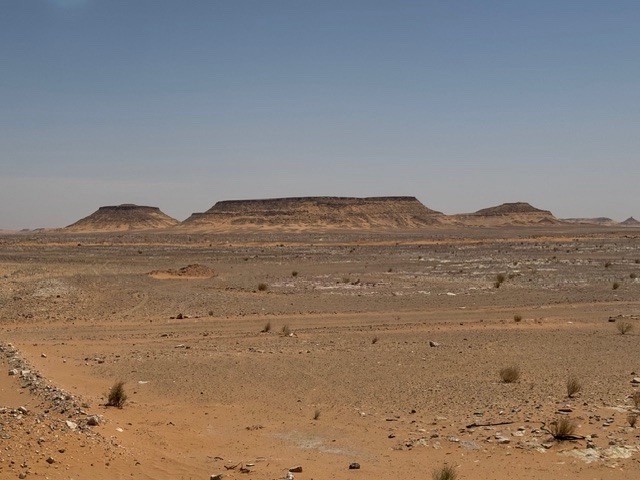
The landscape shifts from mesas to scattered sand dunes, back to flat dirt stretching far ahead, utility poles marching heroically into the horizon. Sudden bursts of purple wildflowers attempt to cheer us on. The snack brigade tries distracting us with deployments of dates, nuts, wafers, chips, chocolate and bananas. It helps.
However, bus morale dips low during a 40-minute truck stop pause while we await for our next escort vehicle, which apparently must be summoned from another dimension. That last escort led us maybe 50 miles before requiring a handoff. Counting 50 miles per escort, countless road barriers, and several invisible borders, this will be a looooong day. And we have 350 miles to go before we sleep.
Soon, we stop in the middle of nowhere like an invisible sign blinks STOP HERE. We wait for another driver coming from Nowhere, Algeria. Then we speed on.
Look to the right! Civilization? This is El Minia. Date palms, buildings, water, people. Our hope is lunch.

We experience a long wait at the police station and watch idle police – three in blue uniforms, two in green, one man in black. Finally, our escort arrives.
However, lunch continues to prove elusive. Our first inn is unprepared. So, we retrace our miles back to El Ménia and hastily dine at Hotel El Boustene for speedy service under an hour.
El Ménia
The small oasis town of El Ménia, once known as El Goléa, sits surrounded by tall sandy/rocky cliffs and what seems to be endless sand. The narrow band of palm trees compliment the nearby Hassi El Gara Lake. The lake is part of the Sebkha el Melah, (salt flat) which serves as a habitat for numerous migratory birds. Common migratory visitors include greater flamingos, herons, ducks, sandpipers and those hawks and buzzards who feed on them.
Like many shallow lakes in the Sahara, the lake is primarily fed by groundwater from local aquifers and, to a much lesser extent, occasional seasonal rainfall. In this region, surface water becomes extremely rare, so the lake exists where the water table rises close enough to the desert surface to create a permanent or semi-permanent body of water.
Thus, provide a source of water, palms grow and settlers come. Next, we the tourists show up.
200 to Bedtime
I exercise elementary math. We have been 6 hours on the road, add 1 hour for lunch. A stop at a church? Add another hour. Then, 4+ hours at least plus 1 hour for inept police. It is already 3pm! It does not look good for daylight arrival.
Our guides also do the math. They suggest we skip the afternoon stop at historic Saint Joseph Church and grave of Charles de Foucauld, a French soldier-turned-explorer and later a Catholic priest and hermit. Cheers from the crowd!
Mad Max Meets Escort Service, Desert Edition
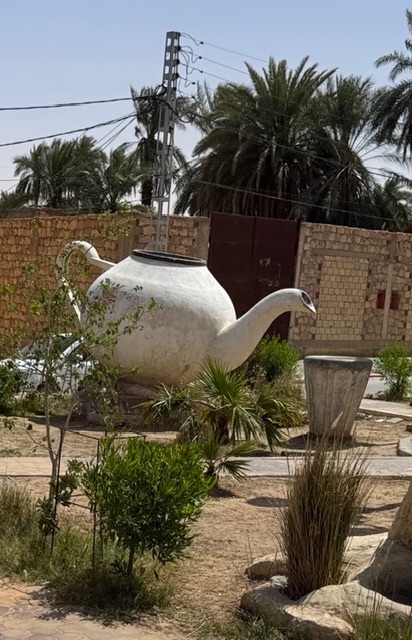
We pass the same teapot monument for the fourth time on our escorted way out of town, an unintentional homage to circular travel planning.
Turning southwesterly from the N1 onto the N51, the terrain becomes a vast, flat expanse of dark earth under a pale sky, so empty one wonders if lunar training exercises occur here. It’s after 5 pm.

The land is flat, earth dark brown, random rocks, a lustreless grey sky as far as I can see. It looks like a giant flood rolled over the land leaving this barren surface. A straight narrow ribbon of asphalt leads southwest.
I feel like Mad Max motoring into the unknown.
Distraction 2 – Dirt
We are given a lesson on dirt, perhaps to break the monotony.
Algeria’s landscapes are often described locally in terms of three visible “earth types,” each reflecting climate and geology across this vast country. In the north and some high plateaus, darker soils — sometimes called “black earth” — contain more organic matter and support agriculture such as grains, olives, and figs.
Moving south into the Sahara, travelers encounter the “shesh,” the rolling dunes of fine golden sand shaped constantly by wind into waves that migrate slowly across the desert. A third type is the reddish earth, colored by iron that has oxidized over thousands of years, producing warm rust tones seen in rocky plains and desert hills.
Algeria is also known to contain deposits of rare earth minerals and other valuable resources in remote regions. These geological differences help explain variations in vegetation, settlement patterns, and traditional building materials across the country.
Timimoun or Bust
We drive through a world of rocks, sand, heat, and the occasional lonely tree. No animals, humped or otherwise. I see four lone men walking through the desert. My Algerian guide explained the “dark chocolate” people from Niger migrate for opportunity. I wonder what surprises me most, their desperate life-risking attempt to find work and a better life, or the guide’s description of the men.
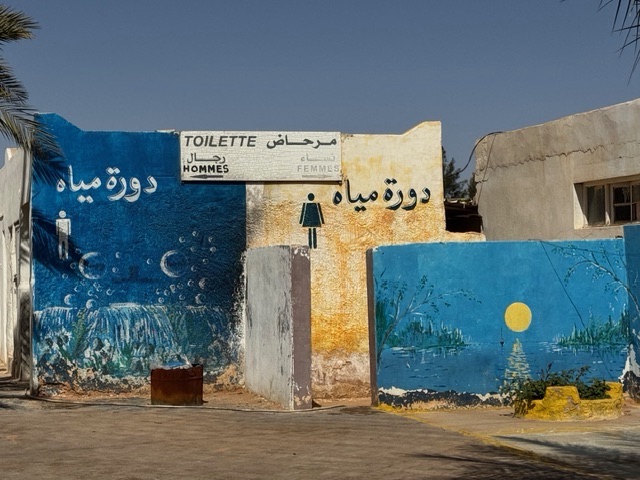
Another restroom stop inspires appreciation for rocks as a privacy tool.
A multilingual officer cheerfully greets us, in English one of his five languages, in the middle of Nowhere, proving the Sahara has better language programs than most universities.
As we drive the horizon disappears in haze. Outlines of mesas fade to white then nothingness. We continue to burn the miles with occasional trucks flashing by. Don’t see our escort. But then, I don’t see much at all out here. We cross another provincial border and keep the pedal down. It appears our escort has bailed on us. Even they would rather be home. It’s 6:30pm, the map says we have maybe an hour and a half to go.

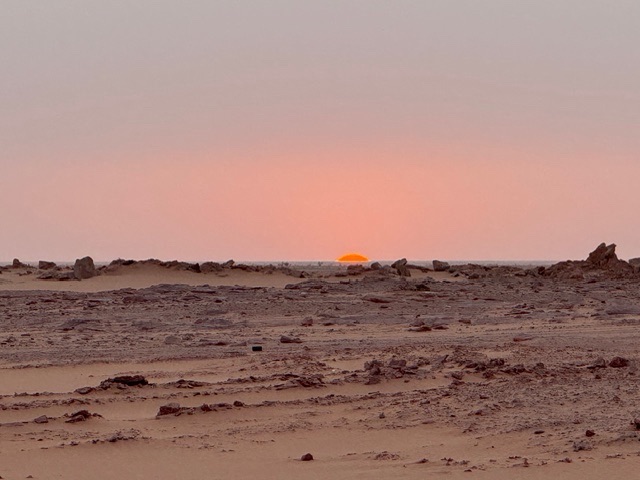
We very briefly pause for a desert sunset and a camel crossing sign. Stars appear and headlights shimmer ahead with trucks speeding past into dark oblivion.
Around 8:30pm we approach Timimoun, tired, dusty, and quietly provoking this traveler’s question: why did we drive 400 miles to get here?
The answer, presumably, will arrive tomorrow.
Timimoun Lodging
We stay at the Gourara Hotel. This large complex offers pool, garden, and restaurant. However, little food left in spite of a long menu. And the beer and wine is “sold out” but more coming. Perhaps by camel or police escort. ETA unknown.

Up a dark flight of stairs, our room has a broken shower and, sadly discovered too late, a waterless toilet. Mosquitoes come free of charge. Too late to enjoy the balcony or terrace.
Things can only improve: Tomorrow, tomorrow! I love ya tomorrow! You’re always a day away!

0 Comments