12 November 2026
Roadside Hijab and Kofias
Zanzibar has a long history of Islamic influence, shaped by centuries of trade across the Indian Ocean with Arabia, Persia and the wider Swahili coast.
This strong Swahili and Islamic heritage is visible as we drive through small communities.
In fact, the main religion in Zanzibar is Islam, with an estimated 99% of the population identifying as Muslim, according to U.S. government estimates. Most are Sunni Muslims. The hijab, long dresses and flowing garments, and men’s embroidered kofia all add a beautiful layer of color to market life. Modest dress is asked outside the resorts.
Where History Meets the Indian Ocean

In 1698, Zanzibar came under control of Saif bin Sultan, the Imam of Oman, who defeated the Portuguese. In 1840 the Omani ruler Said bin Sultan moved his royal court and capital to Stone Town in Zanzibar, turning the island into the center of a wealthy maritime and spice-trading empire.
After Said bin Sultan died, a power struggle between his sons led to a split in 1856. Zanzibar and Oman became two separate realms: one son became the Sultan of Muscat and Oman, and another became the first Sultan of Zanzibar.
Because it was a good thing, it was inevitable that the Imperial British East Africa Company, then the German East Africa Company got involved in 1888. It wasn’t until 1964 that the Republic of Tanganyika and Zanzibar was born.

From Socialism to Sunseekers
Zanzibar has had quite a journey. Following the 1964 revolution, which overthrew the Sultan and ended centuries of Arab rule, the islands became part of the United Republic of Tanzania. The new government embraced a socialist model, influenced by Soviet and Chinese ideas, with extensive state control, nationalization and centralized economic planning.
The experiment proved difficult economically. By the 1970s and into the 1980s, production was struggling, government enterprises were inefficient, and the once-lucrative clove trade was declining. Zanzibar’s economy along with the wider Tanzanian economy collapsed.
By the mid-1980s, Tanzania began opening its economy, with encouragement and financial support from the IMF and World Bank. Private investment was welcomed and tourism began to emerge as an important opportunity.
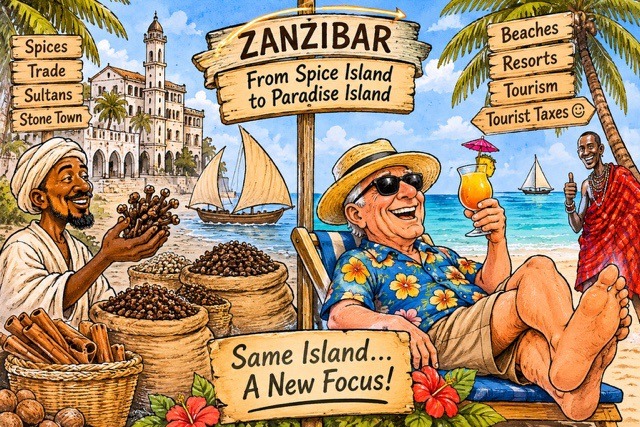
Through the 1990s, hotels, resorts and tourist services began appearing along the island’s beautiful coastline. What was once a relatively quiet Indian Ocean archipelago became an increasingly popular destination for international visitors, drawn by its white-sand beaches, turquoise waters, historic Stone Town and fascinating blend of African, Arab, Indian and European influences.
Today, tourism is big business. Hotels, beach resorts, restaurants, excursions and spice tours are everywhere, and the government has become increasingly adept at collecting its share through tourism levies, infrastructure charges and other visitor fees. Zanzibar has discovered that paradise can be profitable.
Finally, the Indian Ocean
Nungwi Beach and our lodging at the Zanzibar Queen give me a very different experience from the past safari lodges. This spot reflects a tropical, Indian Ocean Zanzibar: white sand, turquoise water, palm trees, and a much more relaxed rhythm. Problem is: even though I live on the Pacific Ocean, I am just not a beach person.

Nungwi is at the northern tip of Zanzibar and supposedly known as one of the island’s best-known beaches, although I have never heard of it. The sand is very white and fine and the water shines the brilliant blue-green you probably picture when you think of Zanzibar. One advantage of the northern coast is that the tides are less dramatic than on many parts of Zanzibar, so there is generally more opportunity to swim – surfers go elsewhere.
The beach seems more than just a beautiful postcard.
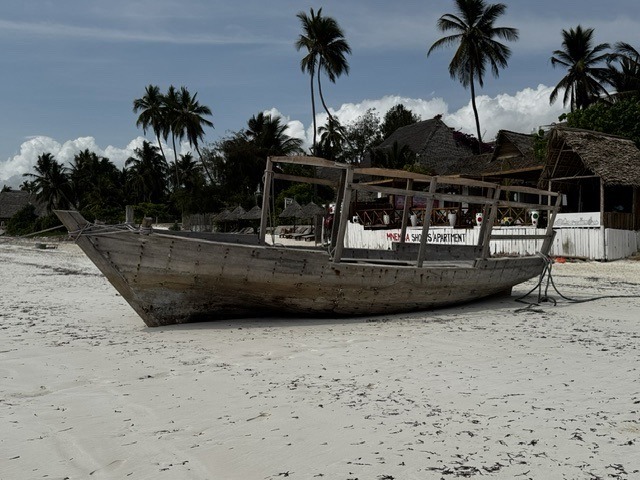
Traditional wooden dhows are built and repaired along the coast. The fishermen sail out to sea, and I see many boats sailing across the horizon.
Men stand in the shallow waters fishing and looking for crabs. At sunset, the dhows with their triangular sails make a particularly beautiful sight. My itinerary says I will have an opportunity to sail one later.
Nungwi itself is lively. There are beach hotels and restaurants, small shops, local businesses and people selling crafts and excursions. Quite a few Maasai people work in the tourist area, along with local fishermen and beach vendors. The atmosphere and activity provide a bit of distraction from just lying around on the sand.
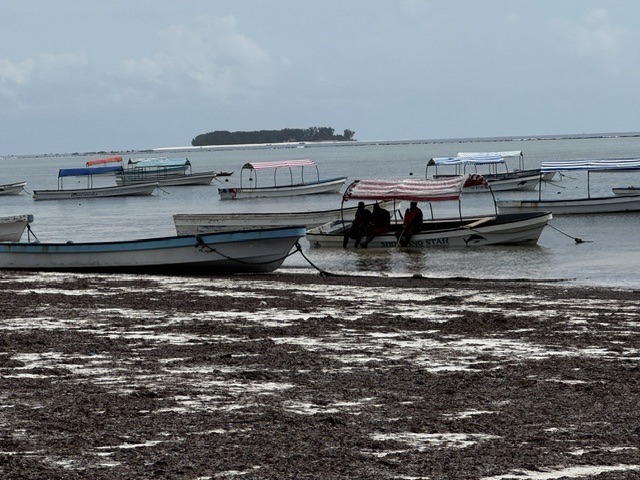
But, all is relative. While the tide is out, high tides are a different story. A morning walk finds the beach strewn with red kelp.
I enjoy the walk but the sun is already hot, 85°, and the humidity is very high, 72%. So it feels like a blistering 94° on the beach!
Tomorrow’s Assignment: Relax and Do Nothing

My itinerary says: “A day to relax…do nothing but enjoy.” This could be a problem. I live on the Pacific Ocean, but I have never been what you would call a beach person. Still, I am willing to give this assignment my best effort.
I’ll dip a toe into the Indian Ocean, check the temperature. The water is very warm, probably around 85°! I take a beach walk to earn my steps. Check a map and try to comprehend exactly where I am in the world. Take a cold shower then I’ll find a cold beer, sit somewhere in the shade and stare at the water.
For once, there is no predictor to avoid (unless I consider the beach Maasai, no road to navigate, no schedule to keep and no place I have to be. Just water. Endless, beautiful water. Perhaps this is what they mean by “relax.” I’ll give it a try. But don’t expect me to become a beach bum overnight.
Zigzagging with the Beach Working Class
A walk along the beach comes with its own cast of characters: the well-dressed, colorfully adorned Maasai men who seem to have divided the shoreline into assigned territories. Each appears to have his own quarter section of sand to patrol, and each has perfected the art of intercepting passing tourists. I suspect there is a scheduling arrangement, although I have yet to discover who handles the assignments.
The greeting is remarkably consistent. “Jambo! How are you? Are you okay? Where you from?” Occasionally, there is a little variety: a name, a question I don’t quite understand, or some new attempt to distinguish himself from the fellow I met fifty yards earlier. The encounter invariably requires a fist bump, a handshake, a few more questions and, eventually, the realization that I really should keep walking. No sooner have I escaped one conversation than the next greeter appears.
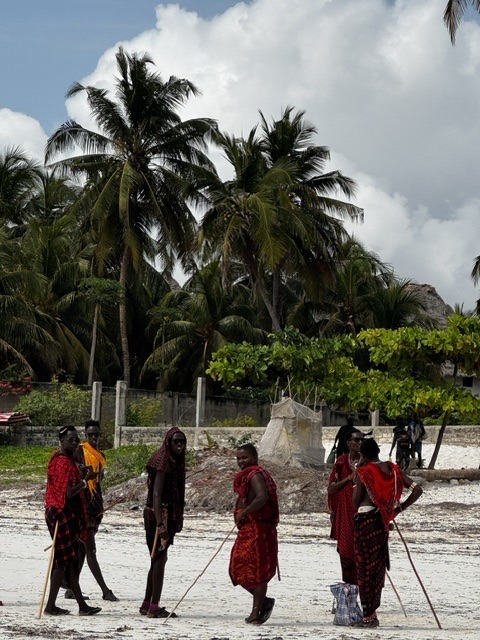
After a while, it becomes a bit of a mind game. I begin zigzagging along the shoreline, changing direction and trying to make them work for the encounter. If they are going to turn my peaceful beach walk into a social obligation, I might as well make it a little exercise for them, too.
Then I decide that turnabout is fair play. I start asking them the same questions. “Jambo! How are you? Are you okay? Where are you from?” I offer the fist bump and wait for their answers. Unfortunately, my strategy backfires. Rather than shortening the encounter, it seems to encourage them. Now we have a proper conversation, and I have extended my time in their territory considerably.
So much for outsmarting the system. What began as a leisurely walk beside the Indian Ocean has become a rolling series of introductions, handshakes and diplomatic exchanges. Today, I honestly earned my steps.
Zanzibar Queen Hotel
I lodge for two nights at the Zanzibar Queen. Sounds really exotic. Almost African Queenish but luxury without the wit of a Katherine Hepburn. Rather than feeling like a huge resort, it features a smaller, more personal atmosphere, with rooms and open public spaces designed around its tropical setting. The hotel has a pool, restaurant and bar, and the beach starts steps away. The architecture and décor have a distinctly Zanzibar/Indian Ocean feel, with lots of natural materials with an emphasis on the surrounding tropical landscape. (Only the use of lots of trees gives this feeling as the entire beach is one long stretch of hotels semi-hidden behind palm trees.)
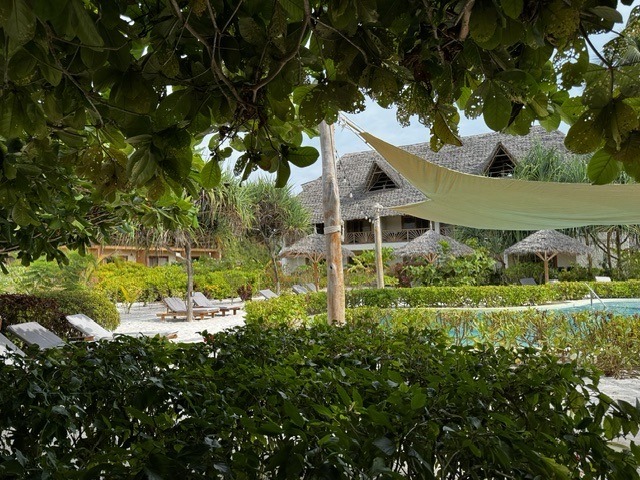
My room features large windows and a balcony with views of the garden. After days of game drives, dusty roads, elephants and baobabs, there is something nice about having my biggest decision being whether to sit on my balcony or walk down to the beach. Biggest challenge is finding a spot that is shaded and as comfortable as my air-conditioned room.

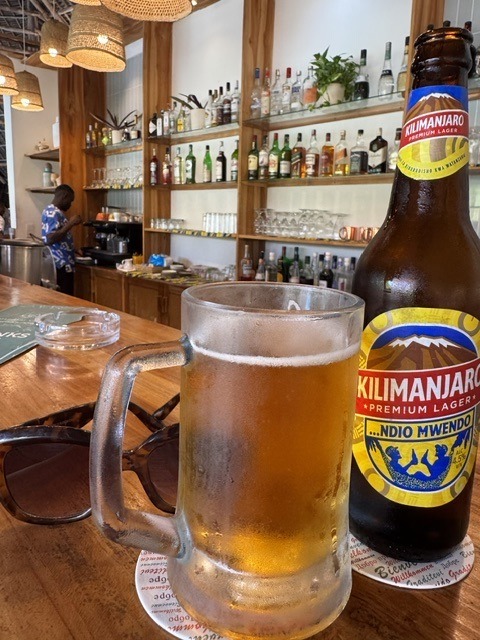
Kilimanjaro, kama huwezi kuupanda, unywe!
At night, the sounds of ocean are soothing. The waves are not roaring ashore like they do at home on my section of the Pacific. But then the water is about 85°F compared to the 62°F Pacific waters at home. Don’t need a wetsuit here. The maid pulled the mosquito netting around the bed, or is it just for looks? I think I fear buzzing, biting mosquitos more than waking up in a canvas tent wondering what animal might be grunting outside.
Trading Elephants for Ocean Waves
We have traded the African bush for the Indian Ocean. After days of watching elephants, giraffes and other wildlife, suddenly the scenery becomes one of white sand, turquoise water and palm trees. Nungwi feels lively and tropical, with fishing boats, beach vendors, dhows and tourists all sharing the same stretch of coastline. At the Zanzibar Queen, the ocean is practically my front yard. I can’t imagine a greater change of scenery.
A little elephant philosophy: why rush around the Serengeti when you can put your feet up in Zanzibar?
