Cairo seems beyond belief. Then again, any city that tattoos minorities, leaves thousands to bed down on the streets, dresses in nightshirts and unzipped trousers, brews tea from canals, and is thick with tricksters, disbelief becomes the only reasonable Western response.
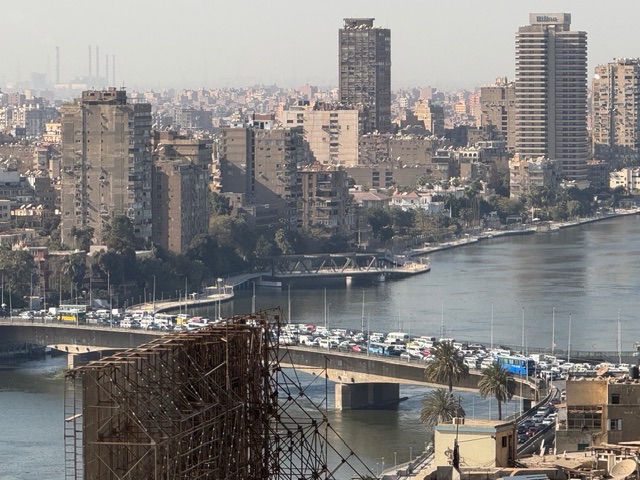
With minimum hassle, I traveled solo to Egyptian Museum and Cairo Tower. Egyptian Museum was vast, amazing artifacts of wood that have lasted 45 centuries, sculptures and tombs. King Tut’s tomb of gold spectacular and just in a little room with no one else about but me. Guard offered to show me mummies for a tip but didn’t think I would enter a dark room alone with him. Cairo covered with smog and dust but can see pyramids in distant haze.
Not much has changed in past 45 years, just a lot more cars!
Returned by taxi whose driver tried to get more $ but I refused, told him to call police and left cab. Heard when the old die they just seal them into their home. What do they do with the taxi drivers? Met youngish English couple who came Tuesday for a month and already has ticket out for Sunday because she can’t stand the hassling. TV is hilarious with hourly religious breaks. At least, commercials run all at once.
2026
We have hired our own guide and driver, Galal, for our stay in Egypt. Thus, we planned what we want to visit each day. No shopping, I stipulated. Galal greeted us at our hotel this am and our driver expertly weaved thru dense traffic to the new Grand Egyptian Museum, GEM.
Not only do I look forward to seeing the new building and its contents, including King Tut, but I heard the GEM has its own 4-legged greeter, Mimi the hound.
GRAND EGYPTIAN MUSEUM
When the modern, glass and marble Grand Egyptian Museum opened in November 2025, the news spread like wildfire among the travel community. It represented a day long-awaited. Like many events around the world, Covid had delayed its opening by a couple years.
One could spend an entire day wandering the5.4 million sq ft GEM. As the largest archaeological museum in the world, it houses not only the complete collection of Tutankhamun, but about 100,000 other artifacts telling the story of this amazing country. The GEM collected exhibits from all over Egypt, relocating them here. Luxor’s or Alexandria’s loss were the GEM’s gain.
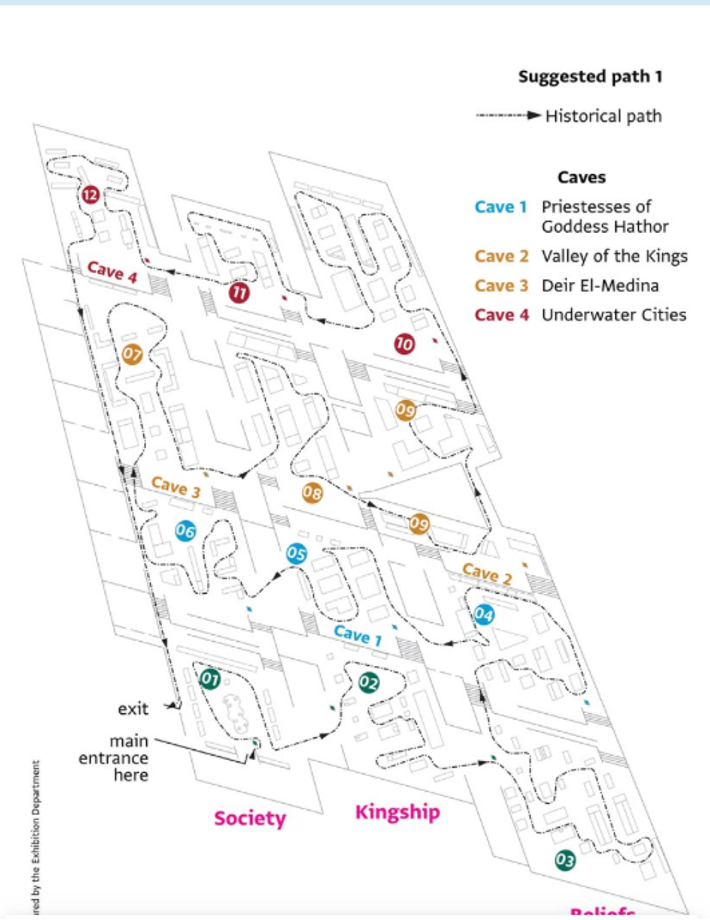
The Grand Staircase serves as a gallery of massive statues which leads to 12 main exhibition halls arranged by time period (c. 3100 BCE – 400 CE). The numerous interactive displays bring history alive. The terrace allows for magnificent views over the landscape, Great Pyramid of Khufu and the Menkaure Pyramid.
There are also four caves, subterranean galleries, situated between rooms. Caves highlight the Priestesses of Hathor, the Valley of the Kings, a village where the royal tomb builders lived, and another focuses on the Amduat Slabs and a journey to the underworld. The museum provides excellent recommended paths for exploration.
Ramses II
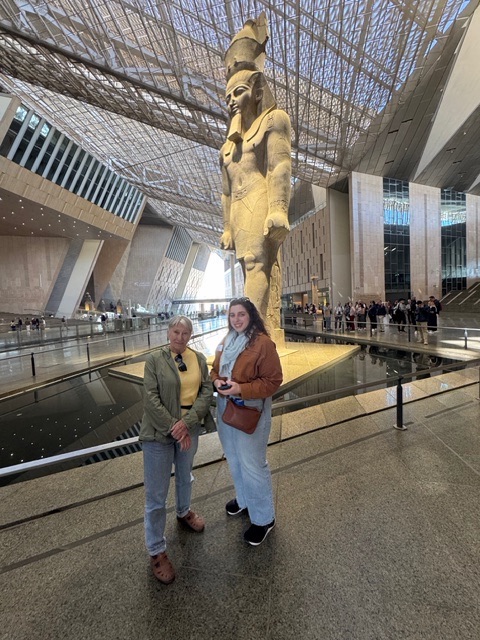
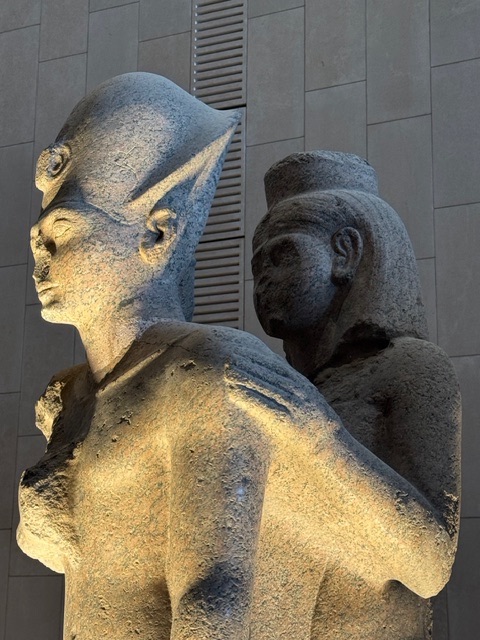
When in Memphis in 1981, I visited the statue of Ramses II. He laid in a reclining position and I walked around this immense 3200 years-old representation to appreciate its detail and size. His twin, which previously stood in front of the old Egyptian Museum in El-Tahrir Square, stands in the GEM. Ramses now welcomes all, majestically towering 30’ above us. He is just one of many, many statues from throughout Egypt’s history, but certainly the most impressive.
We rode an escalator up beside the Grand Staircase and began to snake our way among the rooms and through the caves. It is impossible to see and read it all. Words hardly exist which can clearly describe the beauty, history and impact these artifacts have.
Like the Vatican where visitors ignore so much so they can arrive at the Sistine Chapel, here the big draw is the King Tutankhamun rooms and especially his mask.
King Tutankhamun
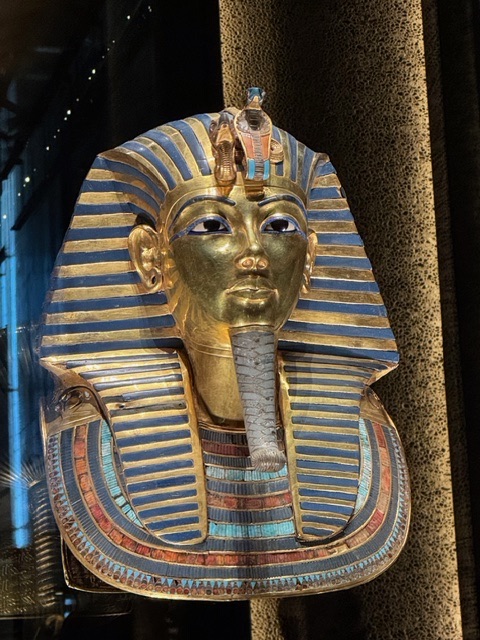
Two of the 12 halls, located off Hall 7, are dedicated exclusively to the display of 5,398 artifacts belonging to King Tut, the pharaoh of the 18th Dynasty who ruled from about 1332 to 1323 BCE. Born in about 1341 BCE, he was but 18 years old when he died. Few Egyptian pharaohs command such a presence. This represents the first time Tut’s entire collection displays in one place, unlike the partial display I observed in 1981 at the Egyptian Museum in Tahrir Square. Just these two halls cover 75,000 square feet.
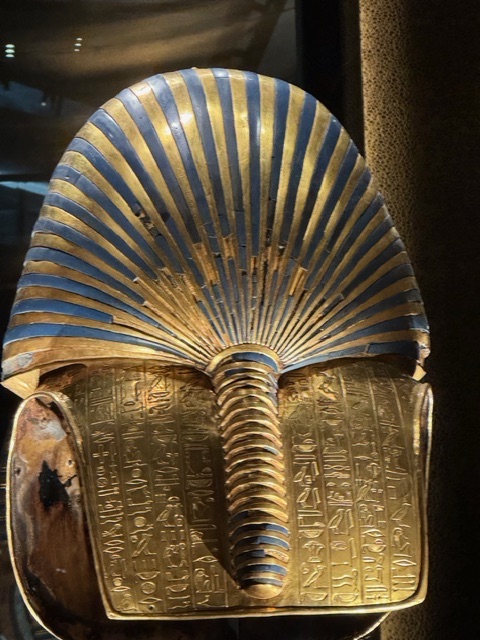
Of course, the most popular item is Tut’s Golden Mask. On display are three coffins, one made of gold and two of gold-plated wood. The Golden Throne, a chair covered in gold and silver, illustrates scenes of Tutankhamun and his wife. Artifacts include statues, furniture, amulets, jewelry and weapons. However, Tutankhamun’s mummy remains in the Valley of the Kings and will not be moved.
Khufu Ships Museum
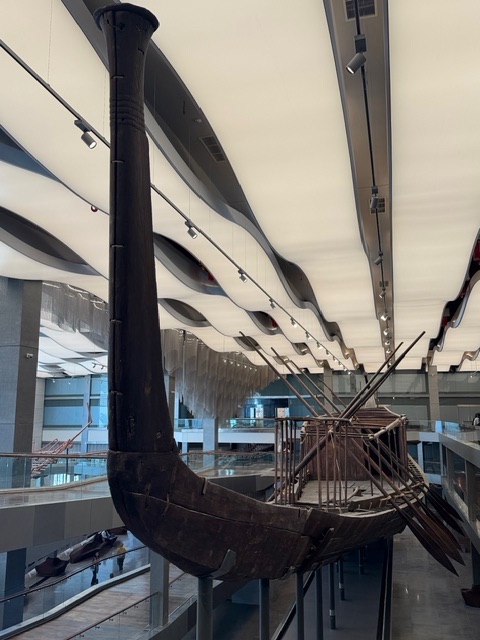
The Khufu Ships Museum is a separate hall dedicated to displaying the two solar boats of King Khufu (the builder of the Great Pyramid).
These rank among the oldest wooden ships ever discovered, dating to approximately 4,600 years ago. An entire section of the GEM was built to display the two ships and other artifacts related to their history.
Terrace
For views and refreshments, one can stop at the terrace. It overlooks the Great Pyramid about one mile distant. In more than three hours, the museum felt like a slow-moving river of time. We drifted for over three hours from colossal statues to intimate jewelry, past reliefs still sharp with chisel marks.
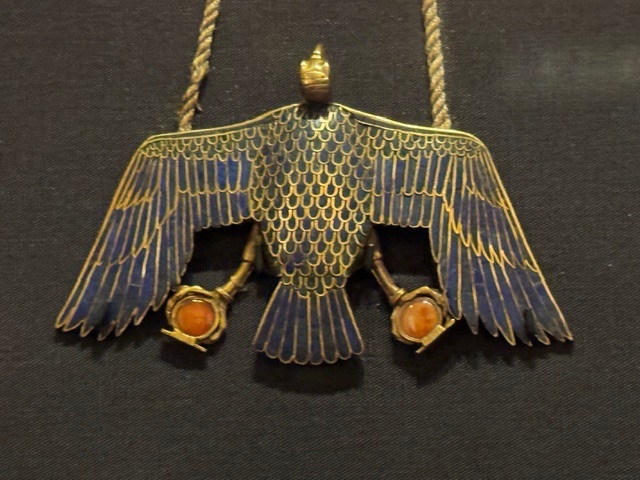
Rooms unfold chronologically. Tutankhamun’s gold dazzles, but quieter objects linger—a scribal palette, intricate and bejeweled jewelry, a worn sandal, Ramses II towering 30’ presence. You leave knowing you’ve only skimmed Egypt’s story, yet somehow experienced its history and greatness.
And, no I didn’t meet Mimi. Perhaps she blended in too well with the multitudes of stray dogs in the area. Perhaps she has moved on with the Pharaohs.
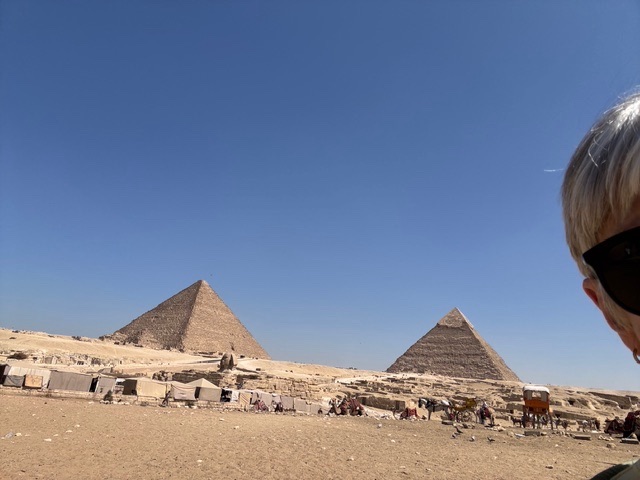
Great Pyramid of Khufu
Great Pyramid of Khufu on right.
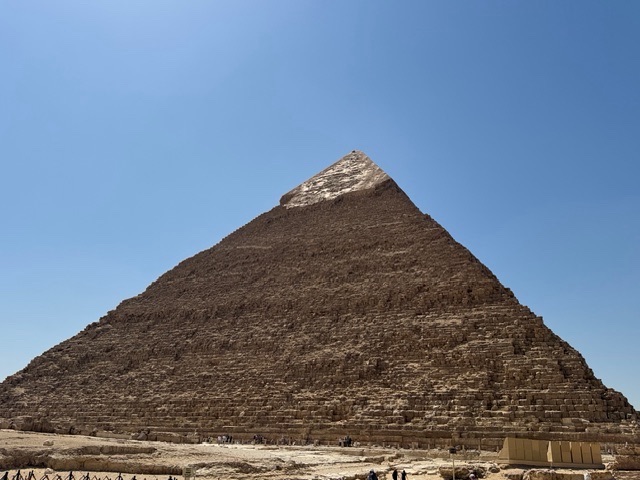
The Great Pyramid of King Khufu (Cheops) (named for the builder) is big. Originally rising some 481 feet above the desert, deteroration and loss of stones have shrunk it to 455 feet. However, it still holds a commanding position over the other pyramids which dot the landscape. The base is approximately 756’ on each side. With a slope of over 51 degrees, it seems nuts that there continue to be people that attempt to climb it even though illegal.
Each side of the base aligns almost perfectly with the cardinal directions, deviating by only a fraction of a degree—an accuracy that remains astonishing even by modern engineering standards.
Each immense limestone block, which on average weighs between 3 and 15 tons, stacks into a form of precision. The granite beams within the chambers weigh 70-80 tons! Consisting of over 2.3 million blocks of stone, that is a lot of chipping, lifting, and situating. Most of these stones were quarried from the nearby limestone quarries on the Giza Plateau. Estimates say that it took over 20,000 people over 20 years to accomplish this marvel. And the best part: it was accomplished by paid Egyptians.
Giza Plateau
Originally covered in polished white Tura limestone, it must have appeared almost luminous under the hot, Egyptian sun. Before the smog arrived, that is. One may choose to duck through a low opening, shuffle up a very narrow passageway to the King’s Chamber. We chose to enter one of the smaller, less crowded pyramids later.
Did the King outlive all the chipping and grinding of construction to see his future tomb? Most likely, though we can’t be absolutely certain. Khufu reigned about 23–26 years (ca. 2589–2566 BCE), and the Great Pyramid seems to have been built entirely during his reign. The scale of organization suggests construction was far advanced well before his death; the core structure would have been standing for years.
Khufu almost certainly saw the pyramid rise to its full height or close to it, although he may not have seen all the finishing touches. Pharaohs attended to their mortuary projects and visited sites and planned rituals. His pyramid wasn’t a surprise waiting for him in death; it would have been a visible, dominating presence during the last years of his life.
Great Sphinx and Other Temples
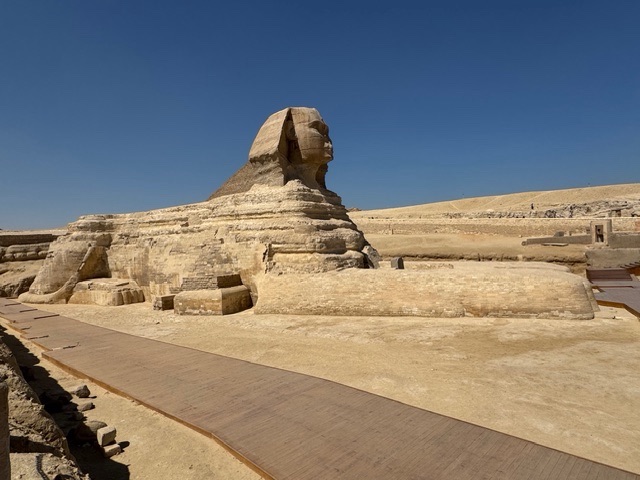
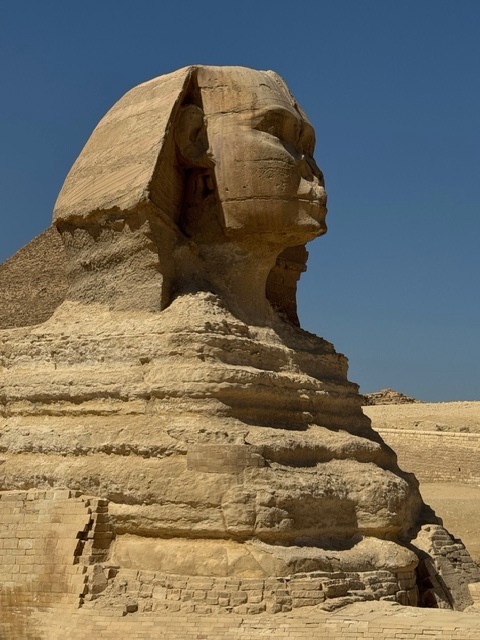
The Great Sphinx of Giza is one of the oldest and most recognizable monumental sculptures in the world. Most Egyptologists agree it was built during the reign of Pharaoh Khafre (c. 2558–2532 BCE) of the 4th Dynasty, the same ruler associated with the second pyramid at Giza.
The Sphinx sits directly aligned with Khafre’s pyramid complex, and its widely believed its face represents him. Measuring 240’ with a width of 13’, it sits 66’ above the desert floor. Its massive body stretches low and horizontal, weathered and calm, while the face gazes east in perpetual silence.
The Sphinx likely served as a guardian figure, symbolically protecting the Giza necropolis. Carved directly from the natural limestone bedrock, the Sphinx has the body of a lion and the head of a human king wearing a royal headdress. In ancient Egyptian belief, sphinxes represented strength, kingship, and divine protection. Later Egyptians revered it as a solar deity called Horemakhet (“Horus of the Horizon”). Originally, brightly painted with reds on the face and body, blues and yellows on the headdress.
Its famous missing nose vanished by the medieval period; contrary to popular myth, Napoleon’s troops did not destroy the nose. Erosion, intentional damage, and centuries of sand storms all contributed to its weathered appearance. For much of its existence, the Sphinx lay buried up to its neck in sand and repeatedly excavated. One famous restoration comes from Pharaoh Thutmose IV, who erected the Dream Stele between its paws. He claimed the Sphinx promised him kingship if he cleared it of sand.
Giza Plateau
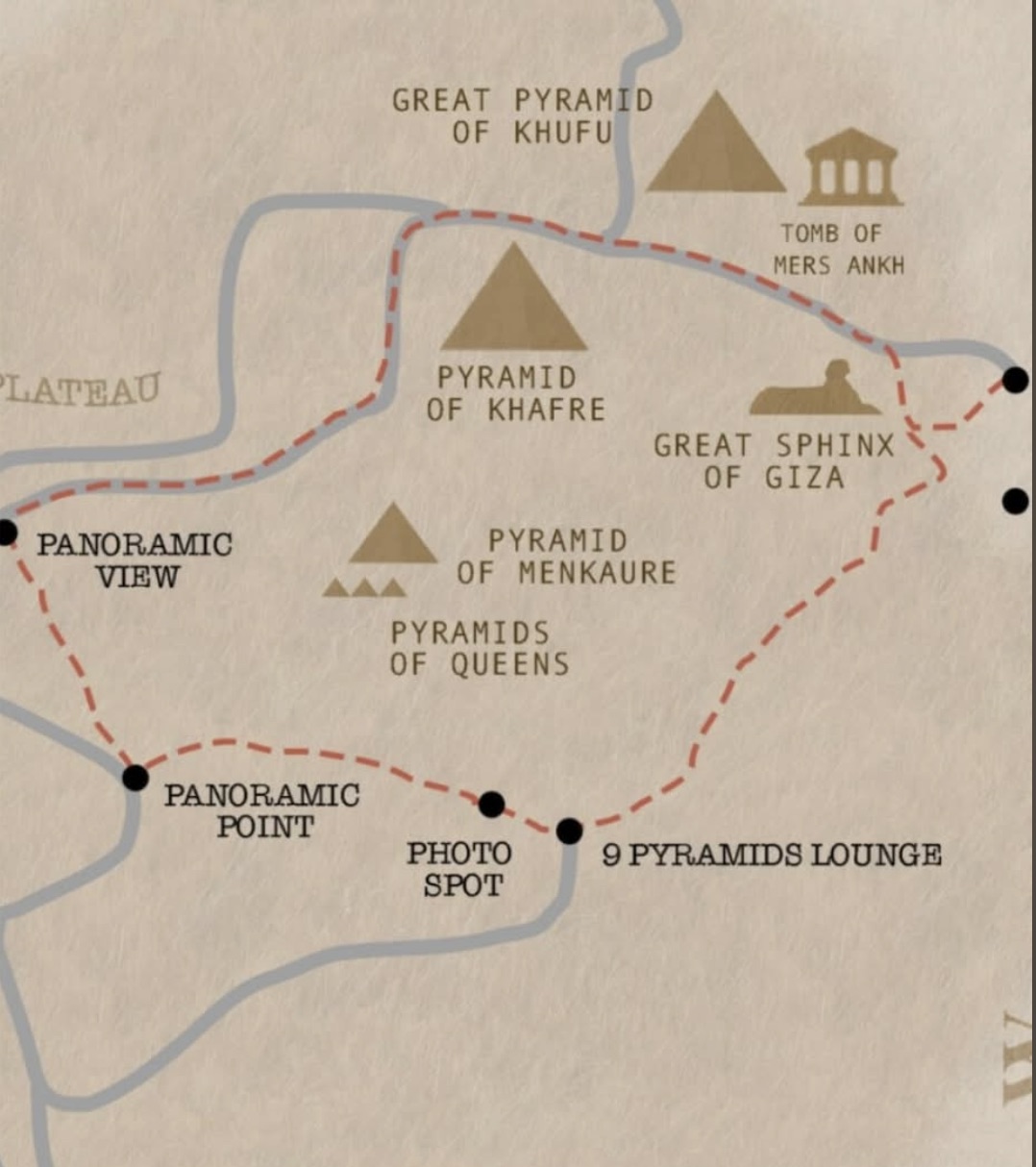
One can walk the paths or utilize a free shuttle service around the area. From the Sphinx, paths lead past the Valley Temple of Khafre, where enormous granite blocks rise about 40’.
Though nearly square measuring 148×148 feet, its walls consist of huge limestone blocks faced with polished red Aswan granite. Its interior is also open for visitors.
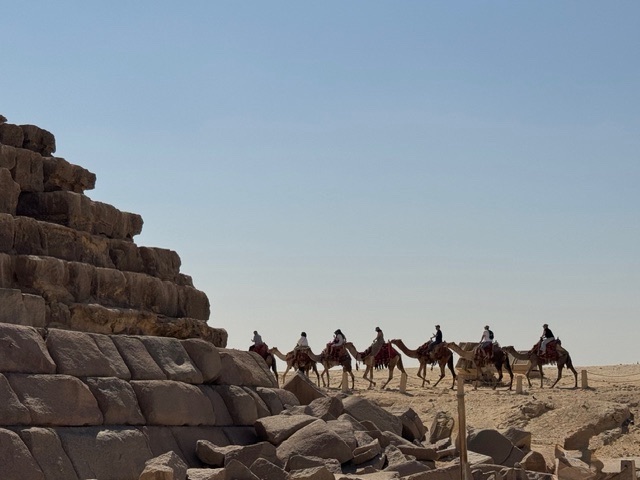
Farther south, the Menkaure complex feels quieter, more human in scale, its pyramid smaller but elegant, fragments of casing stone still clinging to its base. The remains of Menkaure’s temple are more fragmentary.
Together with Khafre’s temple, these represent just two of many monuments scattered across the plateau, each one close enough to walk to, yet separated by centuries of ambition, belief, and stone. And lots and chipping, lifting, and grinding.
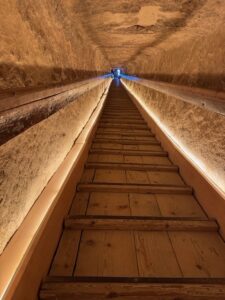
We chose to ignore the camel and horse rides for the experience of scrambling into the very narrow, and steep, passage which descends to the King’s burial tomb.
The ceiling is low, the boardwalk angled down between walls of undecorated rock. Not for the claustrophobic. But then, one also meets those who are coming up for fresh air. The path clearly was not meant for two-way traffic.
July 1981
Left Lido for my reservation at the Mena House’s paradise and opulence surrounded by spectacular poverty. Went horseback riding for different view of pyramids and desert. Nasser prattled constantly for more money, finally out-talked him. A wonderful way to see the area and village. Afterwards, I met up with the tour. Met Hassem who after dinner took me in his Trans am to his cousin’s home in Sahara City, site of neon and camels. Guard made tea on open burner. Walked a bit and the same old line “if you don’t want to” which I didn’t. Then drove around desert for views of lit Pyramids, noisy cafes and bars, before returning through camels, horses, and men lounging around the desert sands – and no there doesn’t seem to be anything under those galabiyas.
2026
Today, plenty of photo opportunities exist. The Giza Plateau area, especially along Pyramids Road, had a surprisingly lively social scene in 1981. There were nightclubs and caféswhere visitors could drink, listen to music, and look out toward the pyramids or Nile. In 2026, clubs and cafés are gone—either demolished, repurposed, or pushed far away from the plateau. What I see now is deliberate emptiness: controlled sightlines and a focus on monumentality rather than leisure.
Several forces combined to make them disappear. Certainly, government protection of its antiquities, and their importance to tourism, was instrumental in the change. However, periods of instability followed President Anwar Sadat’s assassination (by Islamic Jihad) on 6 October 1981. Sadat’s desire to modernize and secularize Egypt met with opposition.
Some Islamist groups viewed his secularization and alignment with the West as a betrayal of Islamic values. Probably the crowning blow to the times was Sadat’s peace treaty with Israel in 1979. Once Sadat died, I began to read articles in the news about strict enforcement and the closure of venues considered nonessential, or offensive, around the Giza Plateau.
The change may feel jarring but appears to have been a good decision. The pyramids once shared space with music, drinks, and cars. Today, they stand alone again—closer to how they should be remembered: silent, monumental, and timeless.
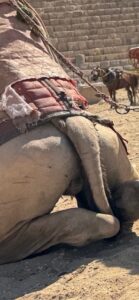
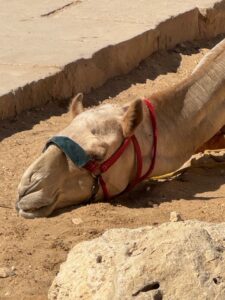
Standing and sitting about are countless bored camels and hot horses. Temperature is about 80° with a nice breeze. However, after what has been a long but exciting day, I empathize with the camels.
September 2026 I continue to hope to find the name of my 4Xs great grandmother. Women’s roles were hard work, birthing children, then anonymously dying. Unless from a family of wealth or importance, many women Read more
September 2026 I visit Richmond expecting one large history lesson rather than separate attractions. How closely do power, economics, race, government, religion, memory, and the physical landscape connect. Historic Richmond with its brick and cobble Read more
September 2026 As reality currently exists, I accept the later. I travel to my nation’s capital to visit my niece and her new abode. Also, to explore two national museums. For the niece, it will Read more

0 Comments