18 March 2026
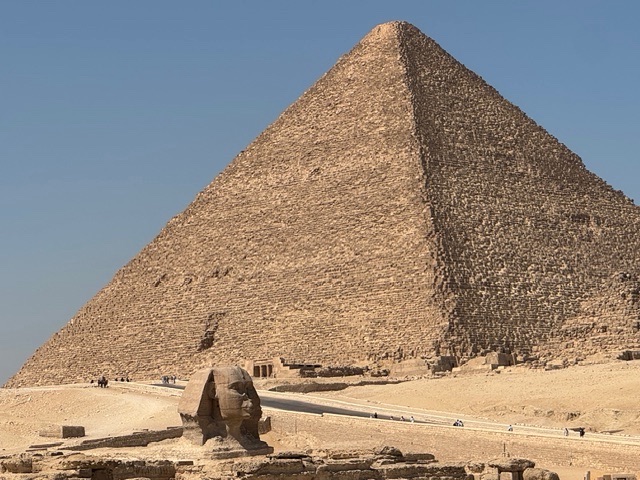
No traveler in centuries has visited all Seven Ancient Wonders of the World, recognized for their grand scale and awesomeness. As a reminder:
- Great Pyramid of Giza
- Hanging Gardens of Babylon now Iraq (uncertain location, likely destroyed by earthquake or neglect)
- Statue of Zeus at Olympia Greece (could be at the bottom of the sea, maybe burned in Constantinople)
- Temple of Artemis at Ephesus Turkey (burned, now a few rocks)
- the Mausoleum at Halicarnassus in Turkey (destroyed and recycled rocks)
- Colossus of Rhodes Greece (gone, earthquake, remains sold for scrap)
- Lighthouse of Alexandria Egypt (destroyed by earthquake, ruins underwater)
Who Decided the Top Seven?
Popular theory says the list came from literary tradition developed among ancient Greek writers like Herodotus. The earliest references appear around the 2nd–1st century BCE, in Greek travel writings and poems celebrating remarkable sights of the Mediterranean and Near Eastern world. One of the most cited early sources is Antipater of Sidon (ca. 2nd century BCE), who wrote a list of seven notable monuments in a poem praising their grandeur.
The number seven was symbolic in Greek culture, often representing perfection or completeness. So, picking seven monuments symbolized the pinnacle of extraordinary feats of human artistry and architecture, beauty or scale.
And maybe he meant to increase tourism.
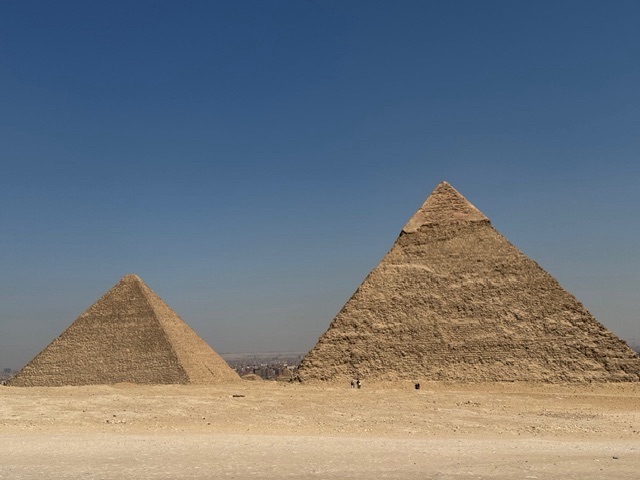
In his poem, Antipater reportedly wrote:
“I have gazed on the wall of Lycian (or Babylonian) gardens, the Statue of Zeus at Olympia, the Mausoleum at Halicarnassus, the Colossus of Rhodes, the Temple of Artemis at Ephesus, the Lighthouse of Alexandria, and the Pyramids of Egypt; but I think the Pyramids are the greatest of all.”
In early travel tips and guides, Greeks documented these marvels as essential stops for all travelers. Their sites still attract travelers – like me. I have been to 5 sites and add my 6th today.
Alexandria
Lighthouse of Alexandria
Ptolemy I and II built the Lighthouse of Alexandria, also called the Pharos, in the early 3rd century BCE to guide ships safely into Alexandria’s busy harbor. Rising an estimated 330–390 feet, it was among the tallest structures of the ancient world. Constructed of limestone and granite, it featured a square base, an octagonal middle, and a cylindrical tower topped by a fire and reflective mirror, making it visible for miles at sea.
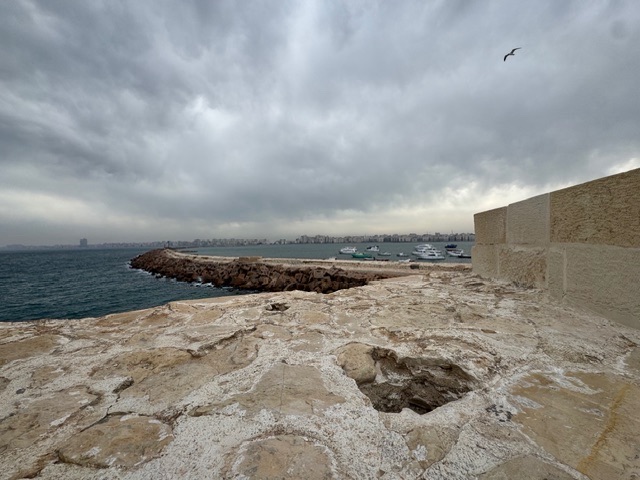
It earned its place on the Seven Wonders list because it combined monumental scale with practical engineering—beauty in service of navigation and trade. The lighthouse stood for over 1,500 years before a series of earthquakes between the 10th and 14th centuries CE caused its collapse. Its stones were later reused to build a medieval fortress on the site, ending one of antiquity’s most influential structures and creating another.
No standing portion of the lighthouse itself remains above ground. Its form survives through coins and written descriptions. However, in the harbor just offshore, archaeologists have found massive stone blocks, statues, and architectural elements, believed to be from the Lighthouse itself and documented by underwater divers.
While I can’t see the Pharos rising over the harbor any longer, I can stand where it stood, touch stones that once belonged to it, and see how its afterlife continued as a fortress—one wonder literally transformed into another era’s defense.
Qaitbay Citadel in Alexandria
Traces of the Lighthouse exist, though not in its original form. The Qaitbay Citadel, a 15th-century fortress built in 1477, dominates the harbor entrance on the former island of Pharos. The building of the fortress used limestone blocks taken from the collapsed lighthouse, meaning the stones of the ancient wonder are still physically present, just repurposed.
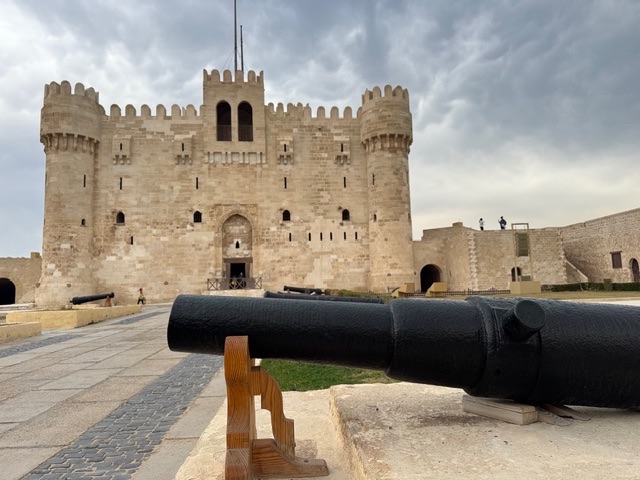
Visitors walk the ramparts and interior spaces of the citadel. In addition, underwater archaeological surveys have identified massive fallen stone blocks and architectural fragments believed to be from the lighthouse. These submerged remains are accessible mainly to divers and researchers. While the lighthouse no longer stands, its presence endures both above and below the waterline.
Library of Alexandria
While the Library of Alexandria did not make the original list of ancient wonders, people considered it great and often spoke of it in the same breath as the 7 Wonders. Writers informally treated it as wonder-worthy. Why?
Once standing in the harbor, colossal statue of Ptolemaic, represented as a pharaoh in Egyptian style, now greets visitors to the awesome Alexandria Library complex.
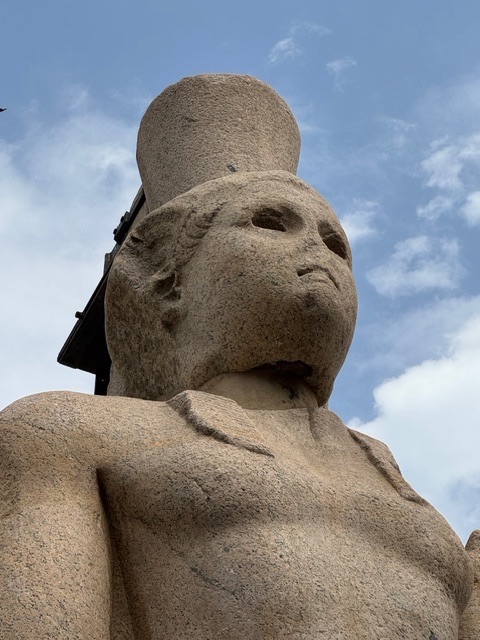
Founded in the early 3rd century BCE under Ptolemy I and II, the Library aimed to collect all human knowledge. Ancient sources estimate 40,000–400,000 scrolls. Even the lower number would be staggering for the times. Works incuded philosophy, medicine, mathematics, astronomy, geography, drama, and law. Texts gathered from Greece, Egypt, Persia, India, and beyond sat on its shelves. This was not just any library but a location encouraging global knowledge and learning.
The Library became part of the Temple of the Muses, acting as the world’s first research university. Scholars lived on site and given salaries, food and lodging. They conducted experiments, wrote treatises, taught students. Figures thought to have studied here included Euclid Eratosehtnes who calculated the Earth’s circumference, Herophilus, who advanced anatomy and medicine, and Callimachus, who created one of the first library catalog systems.
Collecting information and books was aggressive. Ships entering Alexandria were required to surrender books on board. Originals remained and copies returned to owners.
The Library’s Sad Decline
The Library of Alexandria did not rank as a Wonder because it wasn’t meant to impress the eye but change how humanity understood the world. In that sense, its loss may be the greatest tragedy of all the ancient marvels. What happened to the Library is less a single catastrophe and more a slow, decline—a series of blows spread over centuries. It became damaged, diminished, defunded, and finally forgotten, piece by piece, as political and cultural priorities shifted.
Julius Caesar delivered the first major blow in 48 BCE. During Caesar’s civil war in Egypt, fires set in Alexandria’s harbor spread into nearby districts. This likely damaged parts of the Library’s collections. Depending entirely on state funding, as it lost royal patronage, the institution slowly withered.
The Christian-era, lacking appreciation for the library and what they considered pagan institutions, pushed the library into greater decline. The Muslim conquest in the 7th century CE burned the Library on religious grounds. Thus, knowledge suffered no dramatic destruction – it was allowed to decay, uncopied, unstudied, and eventually lost. Basically, one can say the Library of Alexandria died the way civilizations often do: not in a blaze of fire, but in a long silence.
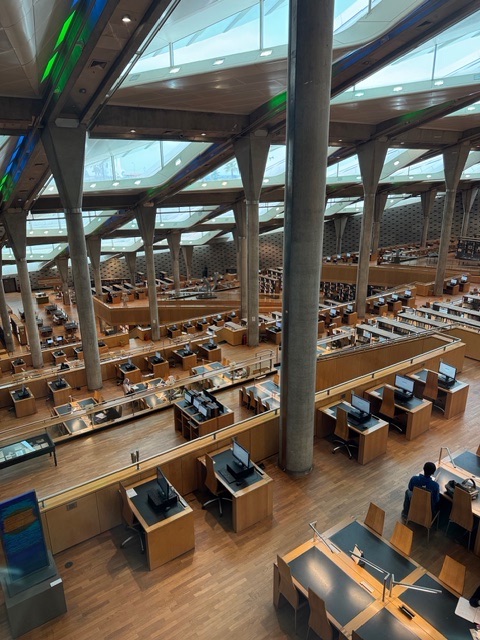
Nothing in decline here. Library designed to be bright, open, technologically advanced and organized for the continued spread of knowledge and culture.
Today, close to the original library site, which sat across the Bay from the Lighthouse-now-Citadel, sits the very modern Bibliotheca Alexandrina complex. This includes the massive library, built in 2002 with space for several million books, and 4 museums dedicated to: Planetarium and Science, Manuscripts, Anwar Sadat, and an Archaeological Museum.
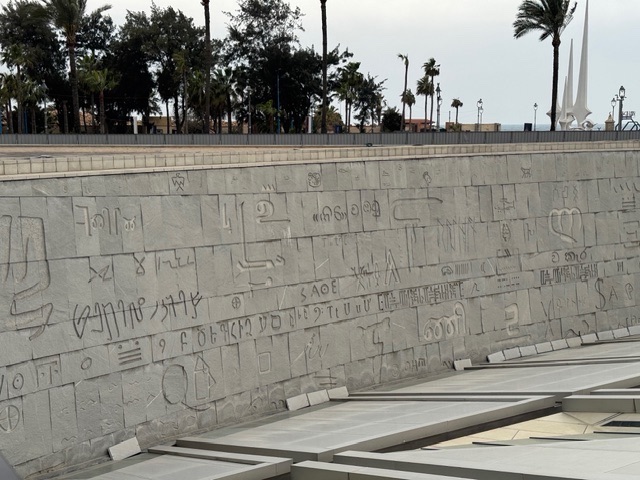
Time and interest allowed us to explore but there is so much to see, including:
• Antiquities Museum
This museum displays over 1,000 artifacts found during excavations on the very site of the library, as well as objects recovered from the nearby Mediterranean seabed. The pieces span Egypt’s Pharaonic, Hellenistic, Roman, Byzantine, and Islamic eras. Standout items include Greek-era statuary, colored funerary masks, and intricately decorated mummy cases.
• Manuscripts Museum
This area preserves and showcases rare ancient texts and manuscripts, giving insight into early writing, bookmaking, and intellectual history — including treasures connected to Alexandria’s scholarly legacy. It’s a beautiful and tactile way to connect with history through original written works.
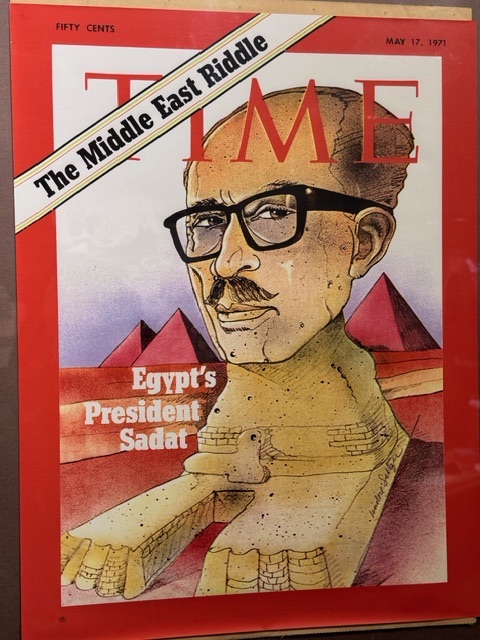
• Sadat Museum
Dedicated to the life and legacy of Egypt’s President Anwar el-Sadat, this small museum displays personal artifacts. Those include his uniform, desk, radio, documents, images, and memorabilia from his life and presidency.
• History of Science Museum
Explores scientific advancements and Egypt’s contributions over time, often with interactive elements and activities. It ties in well with the adjacent Planetarium Science Center, which brings astronomy and scientific discovery to life through shows and exhibits.
Catacombs of Kam el Shoqafa
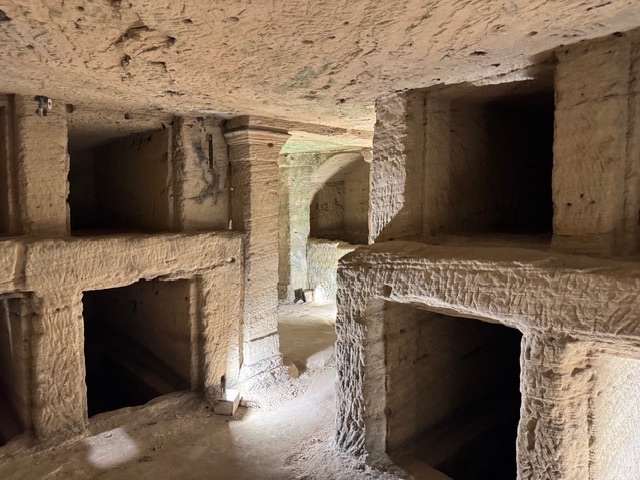
The Catacombs of Kom el Shoqafa represents one of Alexandria’s most unusual and important archaeological sites. They embody the city’s deep cultural blending during the Roman period. Dating mainly to the 2nd century CE, they are the largest known Roman burial complex in Egypt, only rediscovered in 1900 when a donkey accidentally fell through a hidden shaft. (According to our guide, the donkey did not survive the fall.) The catacombs name, meaning “Mound of Shards,” comes from the piles of broken pottery left behind by ancient mourners who ate and drank at the tombs, then ritually smashed their vessels (common in Greece) before returning to the topside.
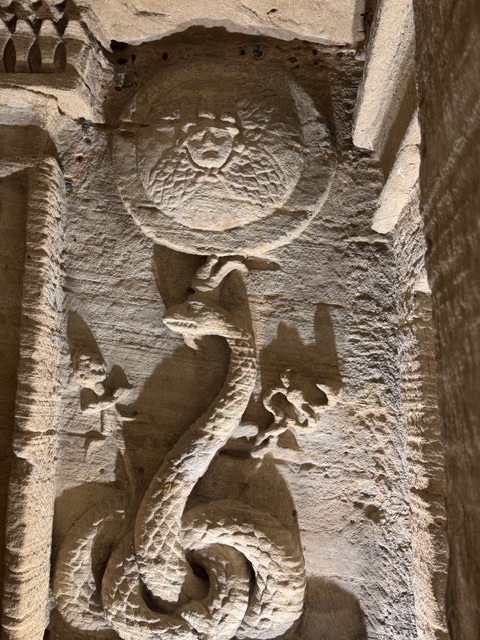
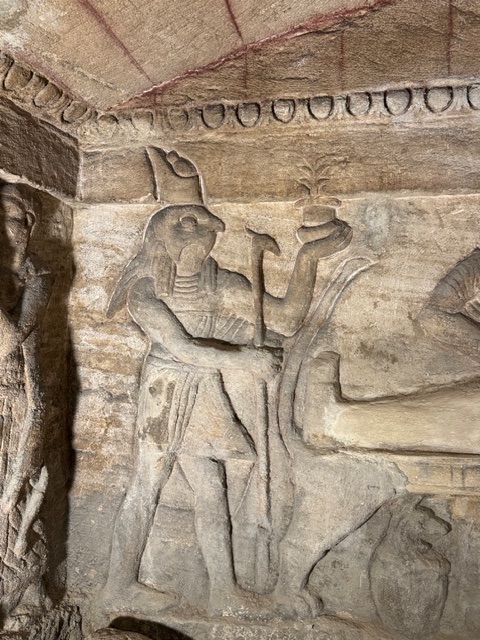
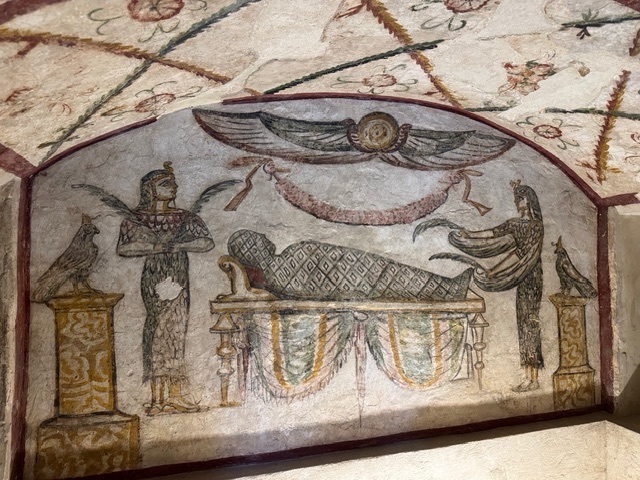
What makes the catacombs significant is their fusion of Egyptian, Greek, and Roman beliefs. Traditional Egyptian burial practices coexist with Roman architectural forms and Hellenistic decorative styles. Artisans carved statues of Anubis, the jackal-headed god of mummification, wearing Roman military dress. Other artists depicted Egyptian funerary scenes in reliefs framed by classical columns. This blending reflects Alexandria’s identity as a cosmopolitan city where cultures overlapped rather than replaced one another.
Architecturally, the site was created in a three-level subterranean design, carved directly into the bedrock. A central spiral staircase once allowed funeral processions to descend into the tombs. The complex includes a triclinium, or banquet hall, where families held commemorative meals for the dead. Kom el Shoqafa represents not just a burial place, but a window into how Alexandrians understood death, identity, and cultural coexistence in the Roman era.
Abu al-Abbas al-Mursi Mosque
The Abu al-Abbas al-Mursi Mosque represents one of the city’s most distinctive religious and cultural landmarks. It stands near the eastern harbor and is visible from the Citadel and from the sea, with a soaring minaret dominating the skyline. The mosque stands atop the tomb of Abu’l-Abbas al-Mursi, a 13th-century Sufi saint from Murcia, Spain, whose spiritual influence made the site a place of pilgrimage for many Egyptian Muslims.
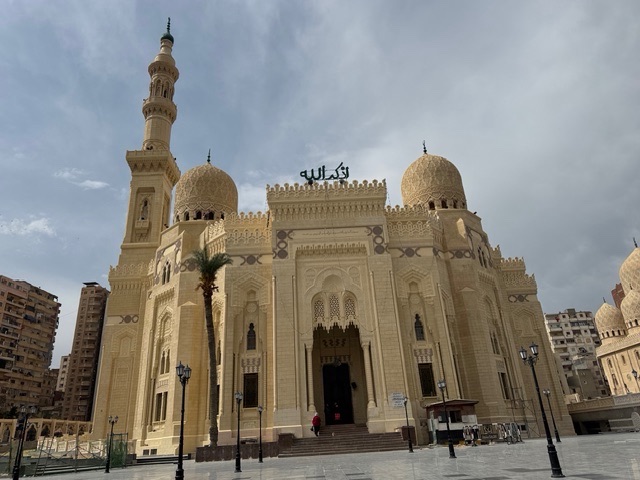
Architecturally, the mosque is notable for its Andalusian and Islamic design, blending influences from Egyptian, Ottoman, and North African styles. The main structure is largely octagonal, rising about 75’, and features a tall minaret at roughly 240’ with distinct sections reflecting medieval design influences. Builders finished the exterior walls in light stone and mosaic, while artisans richly adorned the interior with arabesque patterns, mosaic panels, carved woodwork, and stained glass. Marble floors, columns of granite and high ceilings give the interior a sense of expansive scale.
Unfortunately the interior was not open, but the mosque houses the mausoleum of Al-Mursi and several other revered figures, making it not just an architectural marvel but also a spiritual center. Pilgrims and local worshippers alike visit the shrine, especially during annual celebrations tied to the saint’s legacy. Surrounding the mosque lies the Midan el-Masaged (Mosque Square), a broad plaza that brings together several other historic mosques and reinforces the area as a hub of religious and social life in Alexandria.
Serapeum and Pompey’s Pillar
Located on a rocky plateau surrounded by downtown Alexandria sits the Serapeum of Alexandria. Once the site of an ancient Greek temple built by Ptolemy III (reigned 246–222 BC) and dedicated to the Greco-Egyptian god Serapis, recognized protector of Alexandria.
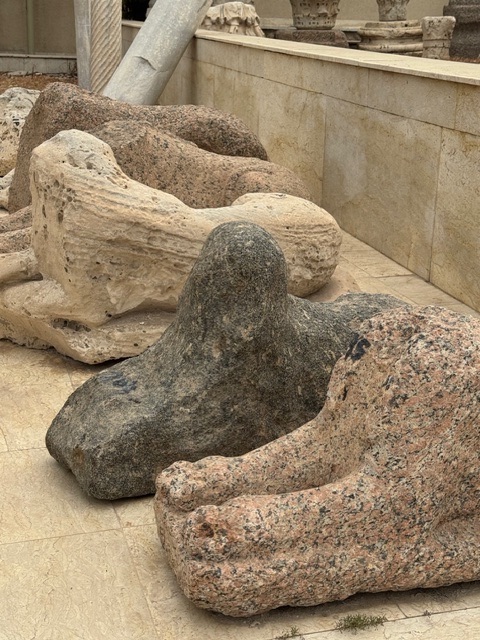
The site has been pretty much decimated and plundered, but it’s worth a quick stop to check out the remains which include a tall column and two sphinx, both of which retain their heads.
Not so lucky these sphinx. It was common for antique hunters to plunder ancient sites. Because the entire statue was too heavy to jam in one’s bag, heads were removed and lugged home. As one travels, be on the lookout for bodiless sphinx.
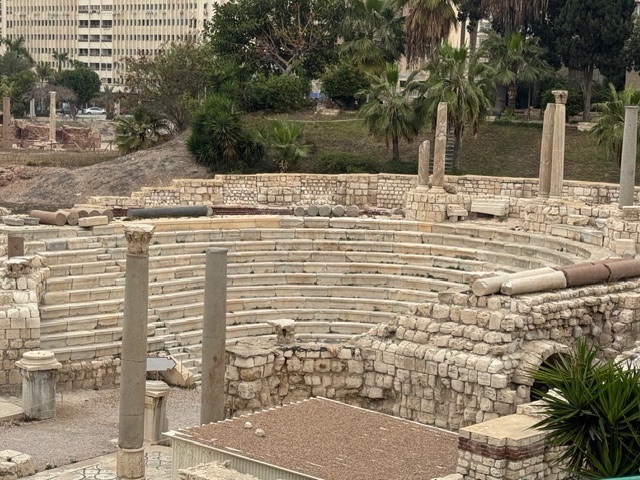
Roman theater in Kom El-Deka
The other quick stop is at Kom el-Dikka archealogal site which retains a theater, remains of Roman baths, and stone bases for quite a large ancient complex.
Perhaps almost as interesting is the drive to each of these ruins. The drive allowed me to observe Egyptian drivers. The conclusion? Most had driving lessons, but the real world is not like the lessons which only teach one how to drive efficiently in a civilized manner – not like an Egyptian.
Driving in Egypt
The drive between Cairo and Alexandria is generally straightforward and easier than navigating city streets. Most travelers take the Desert Road, a modern, five-lane highway that cuts through flat, sandy terrain. The route feels efficient rather than scenic, with long straight stretches, occasional service areas, and very little in the way of landmarks. Depending on traffic and checkpoints, the journey usually takes about three hours.
The landscape may change as the desert gives way to greener farmland, canals, and low buildings always in the same shape of tan. Alexandria was overcast and a couple drops of moisture could be felt. The intensity of city traffic becomes noticeable.
Drivers Be Crazy
Practically no Egyptian driver respects lanes even tho lanes do exist. I see them drawn on the road! Lanes are treated as suggestions, not absolutes, and cars often flow wherever there is space. Drivers overtake us at any time, usually from the left, but sometimes even from the right.
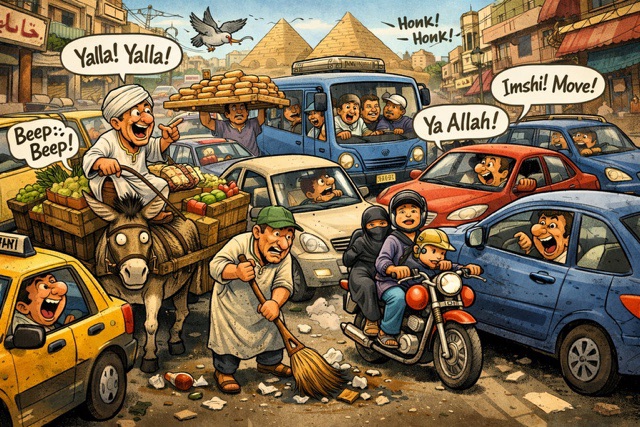
Egyptian drivers intimidate at first, especially if one comes from a place practicing some degree of lane discipline. But, the rhythm becomes easier to understand – eventually. As we have an Egyptian driver, we accept he doesn’t want to die either.
Drivers are very assertive, committed fully to their decisions, and definitely not rule-bound. Driving becomes a learned skill set – less about rules and more about awareness, negotiation, and nerve. What looks like chaos usually follows an unspoken logic where drivers anticipate each other’s moves rather than rely on signals or signs.
Horns honk constantly, but not usually in anger. They function more as communication tools: a quick beep to announce presence, warn a pedestrian, or signal an intention to pass. Turn signals may be used, red lights may be obeyed. Or maybe not. Drivers tend to watch the behavior of surrounding cars closely. (We experienced an even more chaotic, noisy style in India; Greek drivers ignored lanes and their horns.)
Donkey carts, tractors, and local buses share the road. Pedestrians stand and cross everywhere, even on the main highways. And, there actually exists survivors who are sweeping the streets during this mayhem!
I recognize there exists one major rule of the road – just don’t kill anyone!
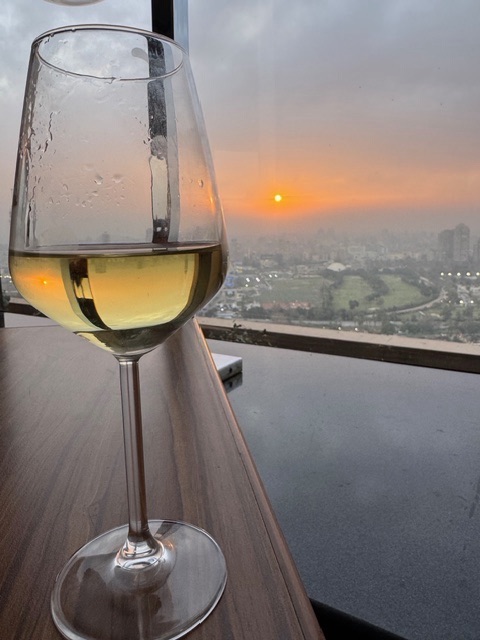
Arriving safely back at our hotel in Cairo, we sigh with relief. We both agree, we deserve a cocktail in the lounge.

0 Comments