25 March 2026
Every breakfast combination known to Man and then some appears spread out in the dining area. No known soup, salad, sliced meat, cheese, olive, date, egg, bread, jellies, and mystery stuff is lacking. A boiled egg and yogurt, plus very strong coffee, and I am fortified for another day of desert adventure.
Today, we explore unique architecture, walk in the steps of Luke Skywalker and Chewbacca, and I will continue an attempt to capture the essence of unbelievable landscapes. And, I hope, find a glass of wine!
Desert Challenge
Boarding our 4×4 jeep, we retrace our drive thru the Sahara and return to Douz. The drivers are amazing as they speed through sand and rock, never getting lost in what, to me, looks much the same. Well, almost. We did seem to get off track for a bit before regrouping. However, dunes block sight-lines every direction I look. Your guess is as good as mine where we are. My GPS indicates a blue dot in the middle of miles of brown. No roads, not even a camel path. Our driver uses no GPS or phone.
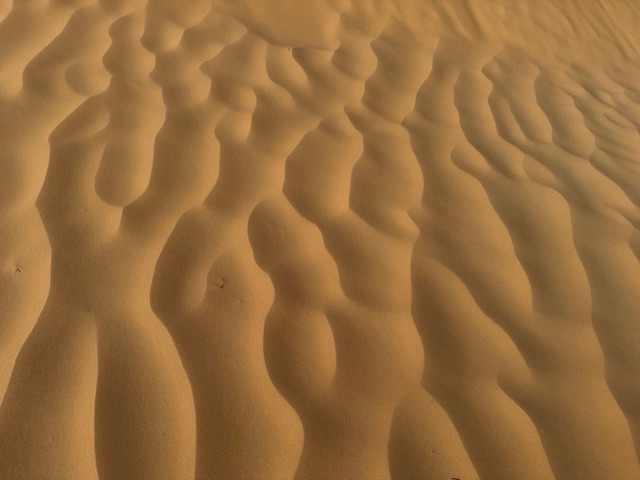
The drivers have an order to the cars but that does not prevent one from blazing a new track parallel to another. Racing ahead, kicking up clouds of sand as we reach bursts of speed up to 75mph. Possibly, we are being driven by frustrated 100km del Sahara competitors – a multi-stage race from Douz to Mount Tembaine over these dunes and desert plains.
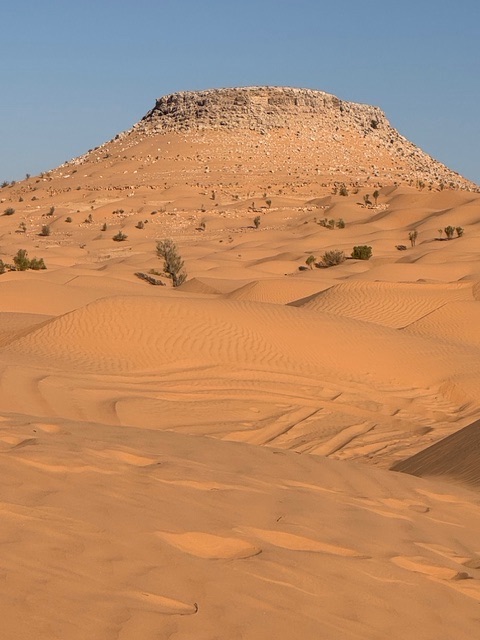
Strap in and hold on! I avoid thinking of danger. Instead, it feels exciting blasting over the dunes. Sharply climbing up one side, tipping over the crest, zooming down the backside. Until one’s timing is a bit off.
Then, the jeep stalls, suspended, wheels spinning, trapped up to its axel on sand. No movement up, none down. Wheels require a constant, smooth transfer of power, usually in high or low range, to avoid stopping. Unfortunately, we stop at the top which leads to sinking. Switching gears, rocking the jeep back and forth to compact the sand under our tires, we free the jeep.
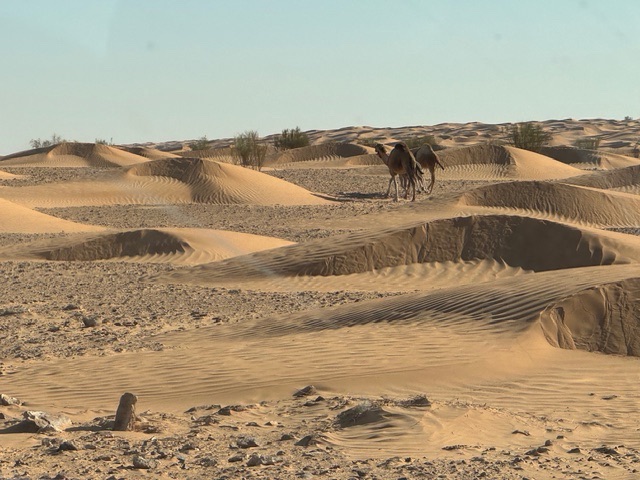
The rest of our drive over sand and rocky hardpan feels mostly uneventful. A family of camels strolled cross our path, unbothered by us mortals and our noisy, impractical mode of transport.
Douz
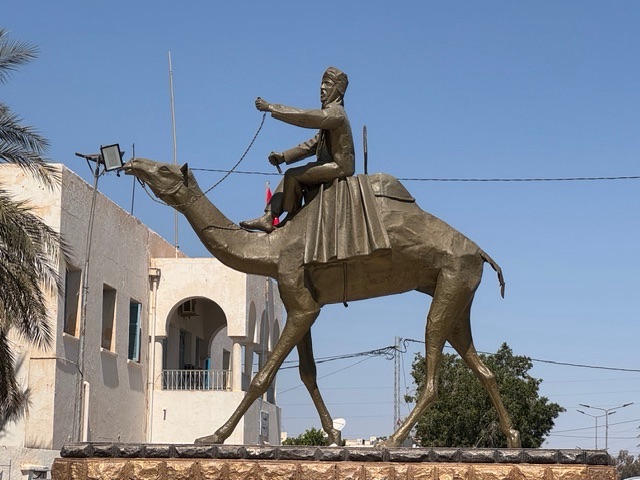
We return through the Gate to the Sahara and pause for a coffee in the midst of bustling souks of Douz. Like most souks and medinas I have walked, this market is alive with noise, smells, colors and crafts. I do recognize the difference in this souk in that it is smaller, less maze-like but a definite desert market. There exists fewer layers of bling and ornamentation and less sensory overload. Instead of endless lanes, Douz’s souk feels practical—set up for people who live at the edge of the Sahara.
In fact, with its myriad of tables piled with used clothing, I imagine a Reacher shopping day. This is the first market area that I would love to shop. Like browsing the best thrift shops in the US. I am tempted to walk over to the toy table and buy that little boy the plush toy he fondly handles. I probably should have.
What stands out in this market is what’s for sale. I see piles of dates (Douz is famous for them), sacks of grains, the ubiquitous spices, wool blankets, camel gear, saddles, ropes, and leather goods made for desert use.
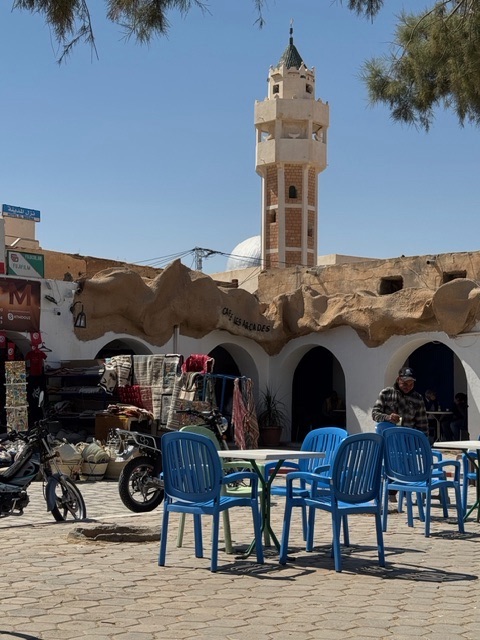
Jewelry is often Berber in style—chunky silver pieces with coral or enamel—less polished, more symbolic. The pace is slower, bargaining is softer, and sellers tend to chat rather than pressure. It feels less like a performance and more like a working market, where the Sahara shapes both what’s sold and how business operates.
Matmata
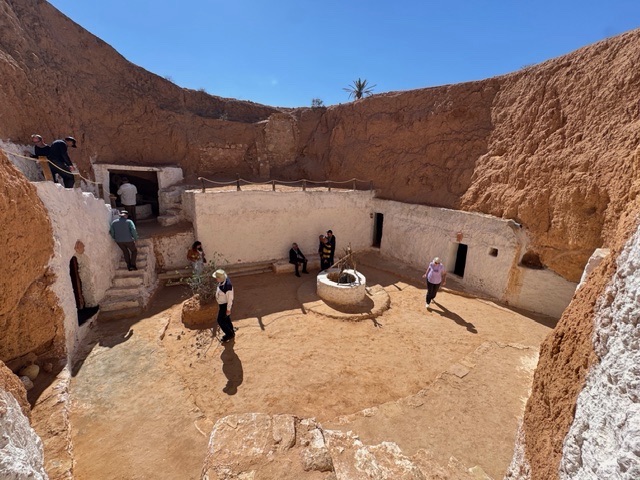
We travel real roads towards Matmata. This entire section of desert, along with the village of Matmata, hosts several Berber troglodyte houses. The regions Berbers built these troglodyte houses underground, carving them directly into the soft rock.
Rather than building upward, Berber families dug deep circular pits—often 26-32 feet across—and hollowed rooms into the surrounding walls. Because of the soft rock, rooms could be dug in a day! These rooms open onto a shared central open-air courtyard at the bottom of the pit. This acted as the heart of the home. Everything was designed to survive the extreme climate of southern Tunisia.
Our guide constantly reminds us of the “extreme heat” of the desert. However, I remember summers in Bakersfield, California where it easily reached 42°C to 45°C or 107.6 °F to 113 °F. It is currently about 20° hotter in Bakersfield than in the desert. However, I digress.
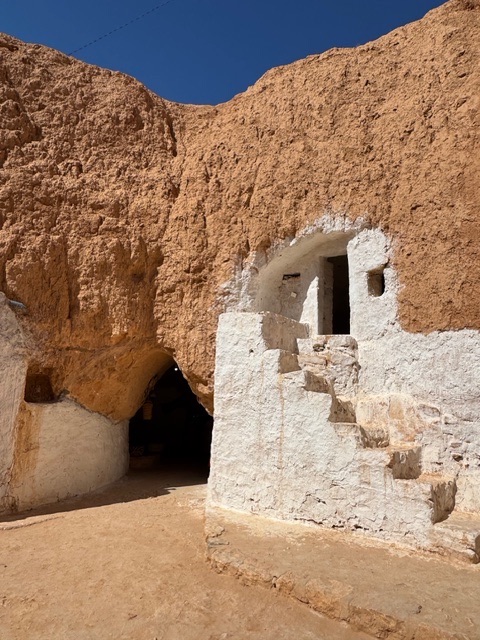
The genius of troglodyte houses is their natural insulation. Being underground keeps temperatures relatively stable—cool in the scorching summer heat and warm during chilly desert nights. From the surface, the homes are nearly invisible, blending into the landscape. They also offer protection from wind, sand, and invaders.
Today, some troglodyte houses still function as homes. Oters have become museums or guesthouses. Walking into one feels like stepping into a hidden world—quiet, practical, and deeply connected to centuries of Berber adaptation to desert life.
Hotel Sidi Idriss
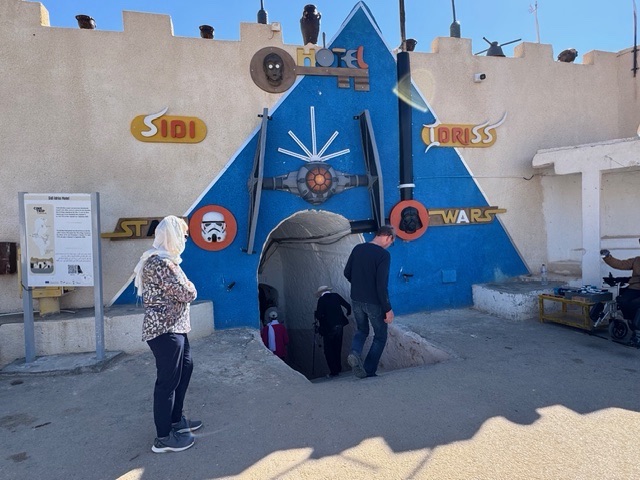
We are not done with Star Wars sites. Without these, I believe the tour would be much less busy.
Today, we visit Hotel Sidi Idriss, an underground hotel carved like a traditional Berber troglodyte dwelling. What makes it special is its role in Star Wars. In the original Star Wars: Episode IV — A New Hope (1977), the interiors of Luke Skywalker’s childhood home on the desert planet Tatooine were filmed here.
Parts of the hotel’s courtyard and cave rooms acted as the backdrop for the Lars family homestead. It served again for Episode II — Attack of the Clones in 2002.
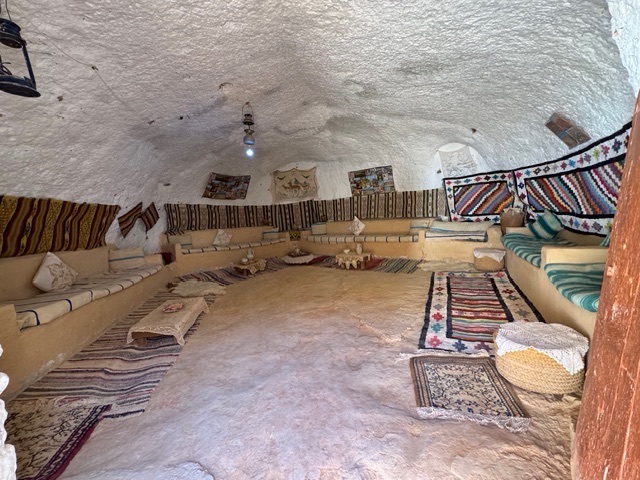
Some of the original set dressing — like moisture vaporators, pipes, and props — remains visible in parts of the courtyard, alongside photos and Star Wars memorabilia.
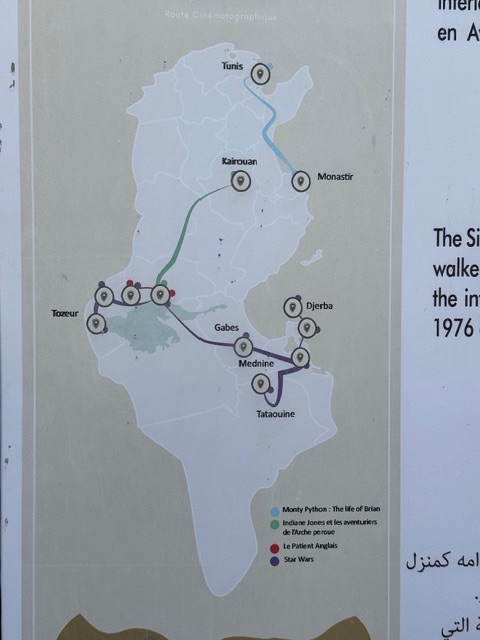
This map in the courtyard is worth a pause. Many movies were filmed in Tunisia. Not only Star Wars but The English Patient, Indiana Jones, and my favorite, The Life of Brian.
The hotel itself was originally a traditional Berber underground dwelling long before Star Wars arrived. Today, you can lodge in basic cave rooms named after Star Wars characters or wander through the interconnected pits and tunnels that feel like Tatooine without being transported to a galaxy far, far away. Hotel Sidi Idriss stands as both a living example of Berber troglodyte architecture and a pilgrimage site for fans of Star Wars, blending real desert culture with its iconic portrayal in film.
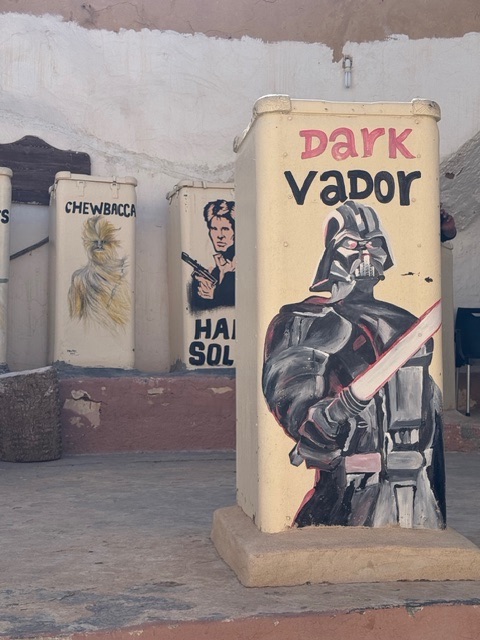
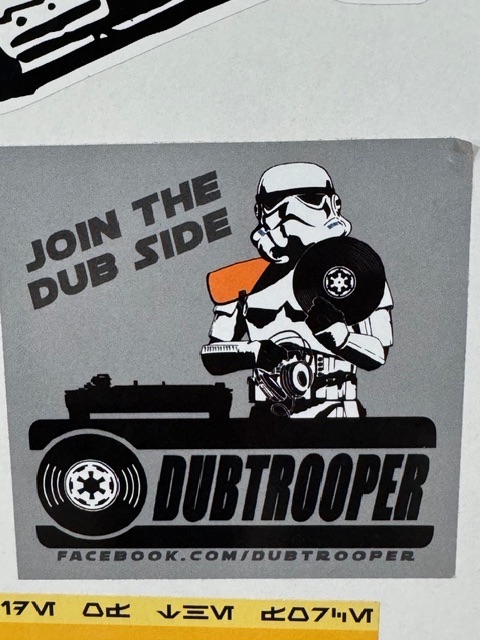
Really campy but only 3 dinar!
Toujane
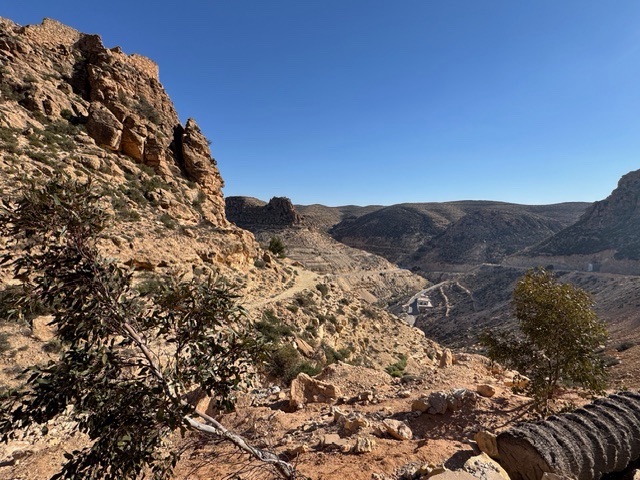
Toujane, a mountain village perched high in the Dhahar region, remains a place of adaption and survival. The Dhahar’s rugged mountain and plateau zone stretches across southeastern Tunisia, forming a natural transition between the Mediterranean coast and the Sahara.
It’s a land of limestone ridges, deep wadis, rocky escarpments, and wide desert plains shaped by erosion and a scarcity of water. This is historically Berber country, where communities adapted to harsh conditions by building stone villages, ksour (fortified granaries), and troglodyte homes tucked into hillsides.
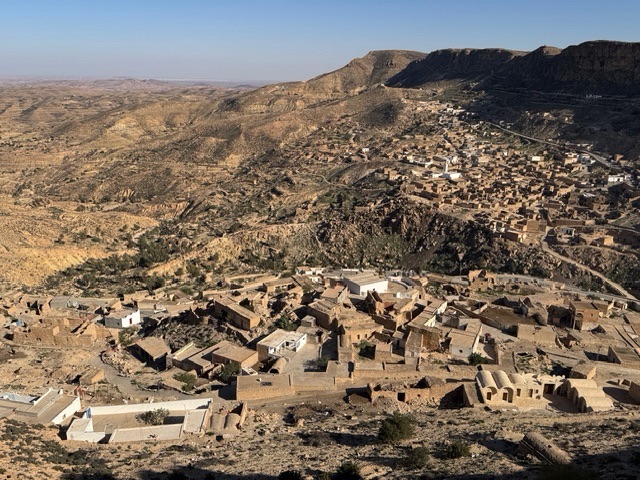
A ksar is a traditional fortified village or communal granary found across parts of North Africa. Built mainly by Berber communities, ksour (the plural of ksar) were designed to protect both people and precious food supplies in harsh desert environments where raids, drought, and isolation were constant threats.
Toujane itself clings to a mountainside overlooking these vast desert views. From a distance, its stone houses seem to melt into the rock, camouflaged against the earth tones of the Dhahar. The village consists of steep paths, old cisterns, and simple homes designed to block heat and wind. The surrounding landscape is stark but beautiful. One of rolling hills stripped to bone, sudden green wadis after rain, and long vistas . It helps you to understand how exposed and strategic this region once was.
Perhaps strategic explains why just a few desert miles to the northeast sits the desert camp of Marshal Erwin Rommel. Surrounded by stark hills lies the remains of Rommel’s camp, used during his North African campaign of World War II. The German Afrika Korps used this area in late 1942 and early 1943, when Rommel’s army was retreating westward across southern Tunisia after Allied defeats in Egypt and Libya.
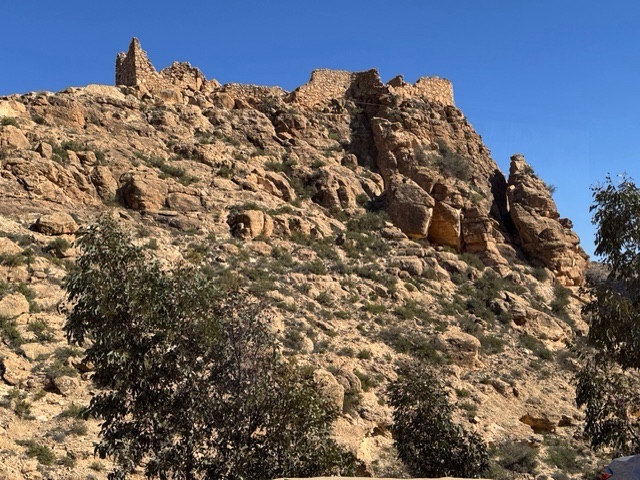
There remains very little left to see. However, the Dhahar Mountains offered natural concealment and a strategic high ground. This made them suitable for temporary command posts, supply halts, and troop movements. Rommel, known as the Desert Fox, relied heavily on terrain, speed, and improvisation. This harsh, broken landscape fit his defensive retreat strategy as Allied forces closed in from both east and west.
Tataouine and Ksar Ouled Debbab
Late afternoon, we continue in our jeeps for another 20 miles to the area of Tataouine. Supposedly, another Star Wars site. However, it is possibly more noteworthy because I have read it is the source of the name for the fictional planet Tatooine.
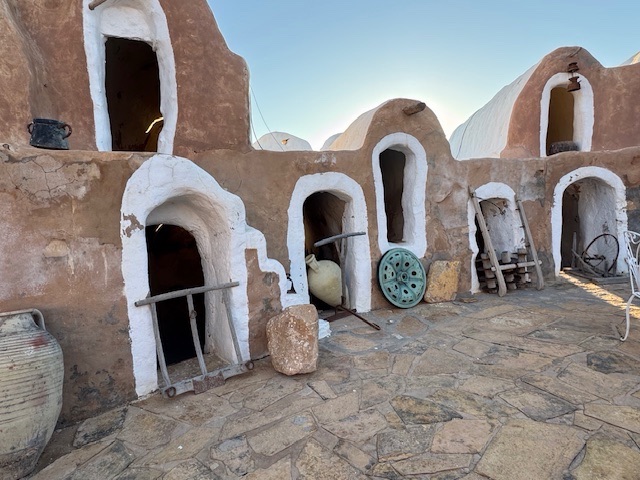
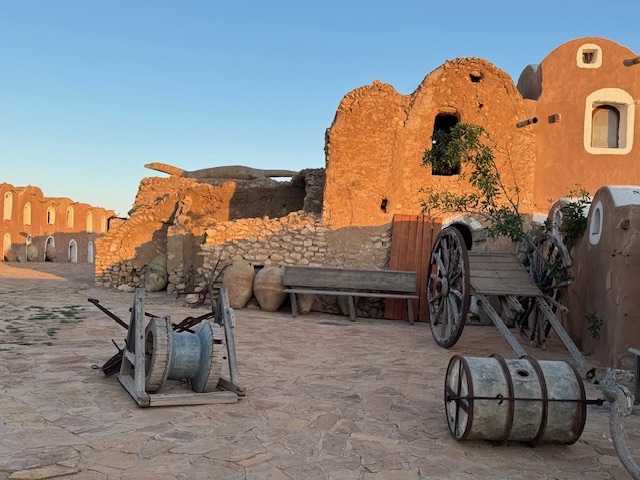
Our final stop becomes our overnight destination at Ksar Ouled Debbab, a beautifully preserved ksar. We lodge at a hotel of the same name somewhat south of the village which occupies part of an 18th century Berber granary.
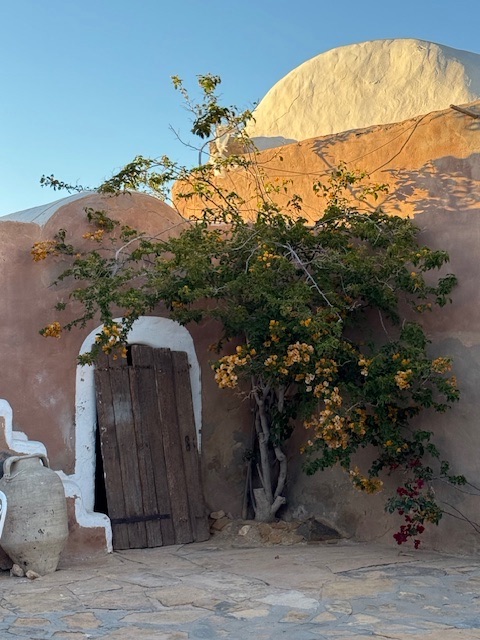
The Ksar Ouled Debbab combines traditional architecture with modern comforts(like air-conditioning to battle desert heart). Its guest rooms set within restored ghorfas and are decorated in local Berber style with panoramas over the surrounding countryside. The hotel includes a restaurant serving Tunisian cuisine and a museum of Islamic and Berber culture.
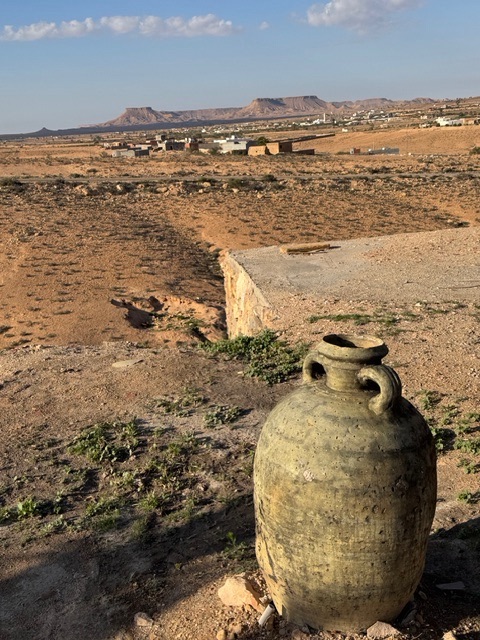
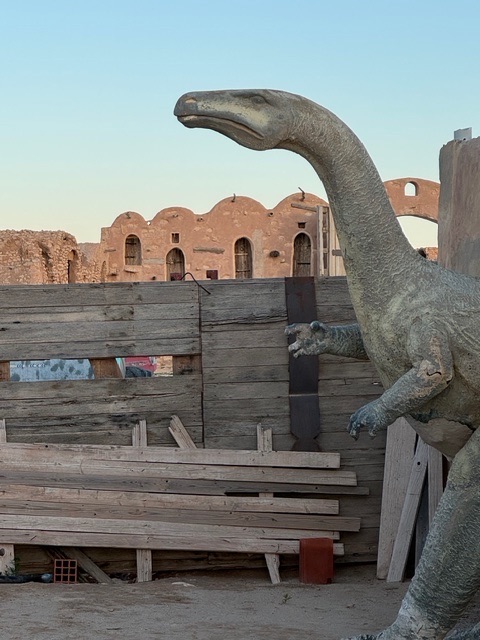
The hotel fills its rooms and nooks and crannies with all sorts of bric-a-brac, some interesting some campy. The location overlooks a stark but beautiful desert.
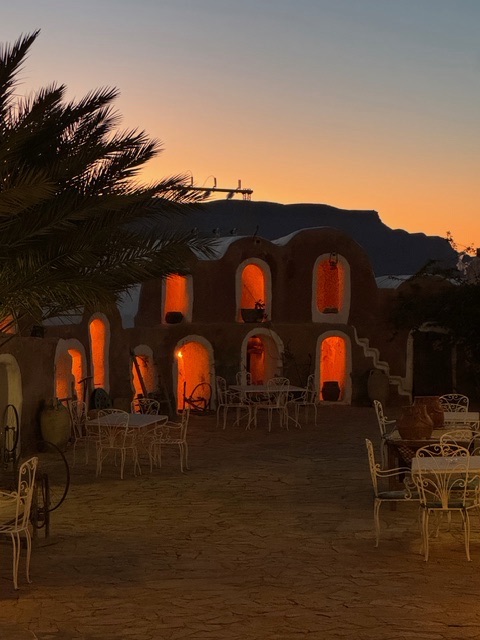
I find a nice lounge area but no alcohol.
Donc ça va.

0 Comments