24 March 2026
Google Maps and my eyes tell me – there are no roads where we go. In fact, our destination, a desert camp in Tembaine, appears not on a map. But dessert car wrecks appears. Sounds like a fun direction of travel.
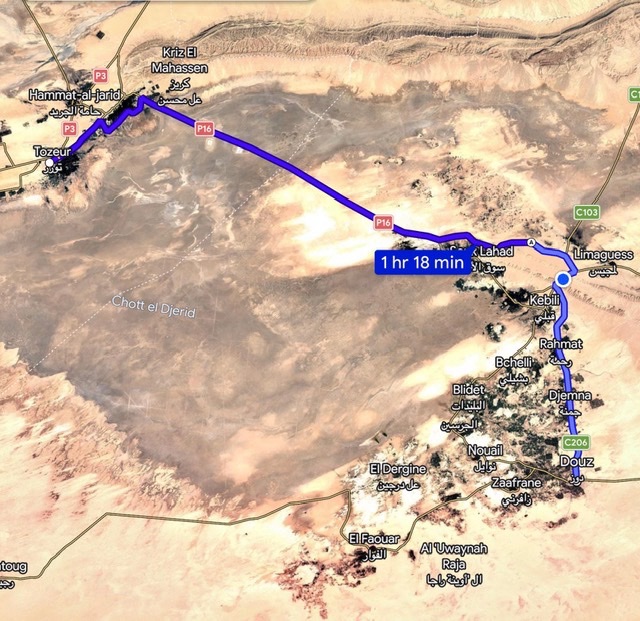
Although Tozeur roads are generally paved near towns, once we venture into the salt flats and true Sahara, our bus will park and we will travel in 4×4 drive Land-rovers.
Douz
Continuing along a section of a somewhat paved road, we make our way to Douz, known as the Gateway to the Sahara. It’s a small town sitting at the edge of the vast sand seas of the central Sahara, giving it a desert-town vibe combined with local life and culture. Palm groves line the outskirts and date palms abound.
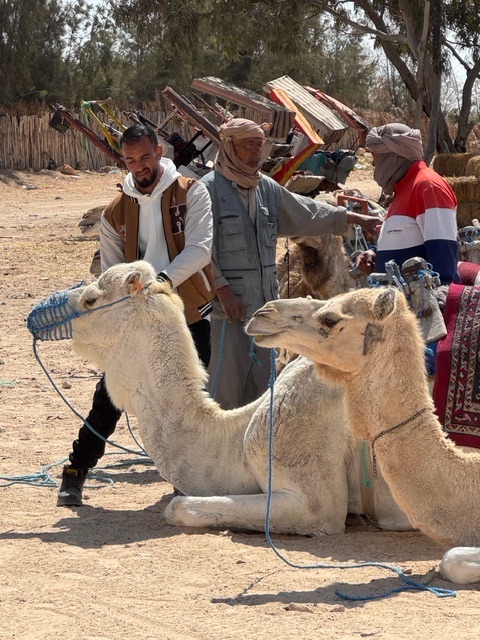
Douz, with its dusty charm, low buildings, narrow streets, and lively markets, will be the last of civilization we will see for a couple days. Before starting out, we meet some camels then go have lunch.
The blue mask prevents the camel from spitting.
Lunch and Tunisian Cuisine
So, what about the “savoring the flavors of traditional Tunisian cuisine? Tunisian cuisine is rich, flavorful, and often boldly spiced, making every meal a lively experience.” Okay, what does it really taste like?
Breakfast usually consists of several stations of foods, several breads, which can be fresh flatbreads or crusty loaves, served with olive oil, harissa (spicy chili paste), cheeses, eggs, and olives. Often, stews or soups from the previous day appear alongside fresh dates or fruit as nothing goes to waste. Mint tea is served but thankfully strong coffee is also available. The combination of spices, tangy or salty accompaniments, and fresh ingredients gives breakfast a savory, satisfying character even when the dishes are light.
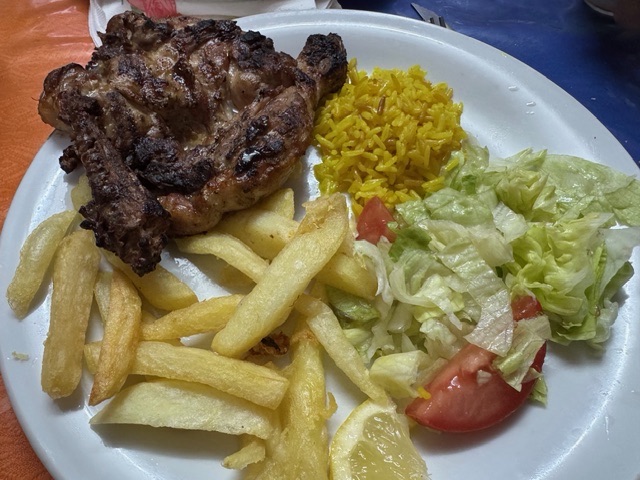
Lunches and dinners become more elaborate featuring a mix of meat, fish, vegetables, and legumes. Couscous is a staple, served with richly spiced stews that may include lamb, chicken, or fish, simmered with tomatoes, onions, chickpeas, and a mixture of spices like cumin, coriander, and caraway.
Seafood along the coast is often grilled or stewed with garlic, olive oil, and harissa, offering layers of flavor. Pickled vegetables, olives, and fresh salads add tang and texture. What makes Tunisian meals so savory is the balance of spices, fresh local produce, olive oil, and preserved flavors. The mixture creates a depth that simultaneously tastes and smells earthy, spicy, and aromatic.
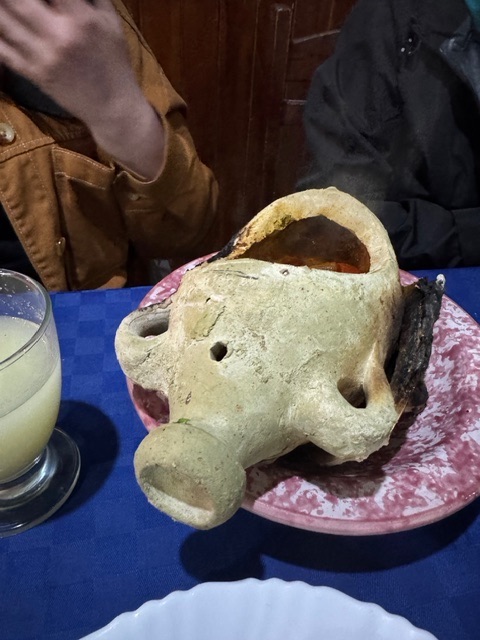
And then there may appear why may look like a chunk of beef. Instead, this will be camel. Prepared properly, especially roasted, it is very good. More often, it has been dried and occasionally inedible. The absolute best preparation is when the camel alo g with chunks of vegetables are slow cooked in what looked to us as a pig terra cotta jar.
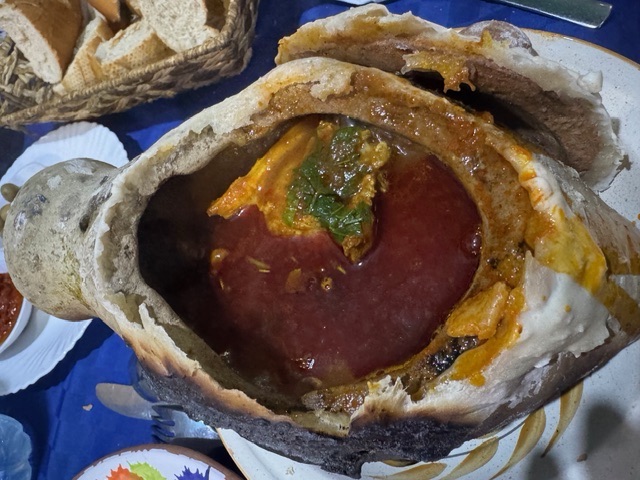
Being predominantly a Muslim culture, alcohol is not as ubiquitous as in Western cultures. Tea, coffee, and fresh fruit juices are far more common in daily life. Locals typically favor these over alcoholic beverages. However, wine and beer may be locally produced. Tunisian wine, particularly red and rosé, is okay thou I haven’t heard a person rave about its quality. Beer may be available in lounges or restaurants catering to tourists but definitely don’t plan on it being available, especially in rural areas or near mosques.
All really, really good food. Well, except the chili paste and being unable to wash it down with a chilled beer or two.
Gateway to the Sahara
After lunch, we meet our driver, climb aboard a 4×4 jeep and head into the Sahara. Beyond the Gate, endless dunes stretch toward the horizon.
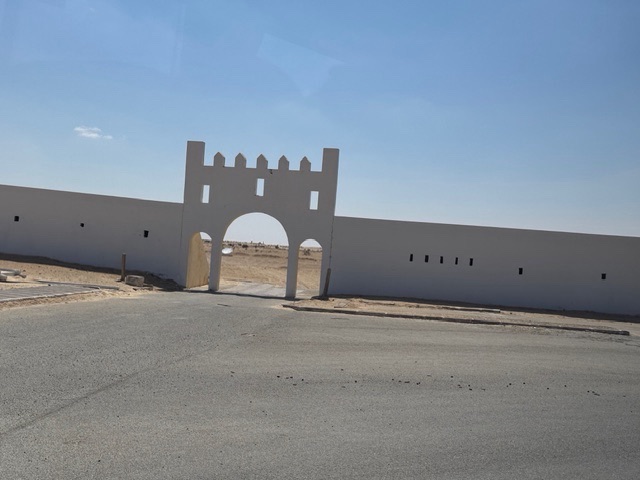
Tembaine
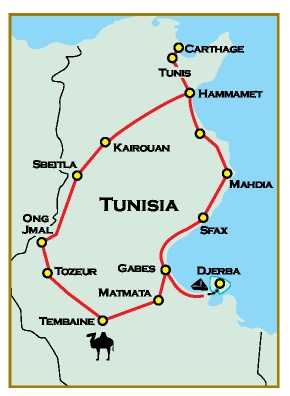
Our jeep exits paved roads as we bounce and sway some 60 miles south to Tembaine, where this off-road adventure will lead us to our overnight Desert Camp.
We cross the dunes of the Jebil National Park. Tunisia’s largest protected area, the park covers roughly 580 square miles of sand and Sahara Desert, near the Grand Erg Oriental.
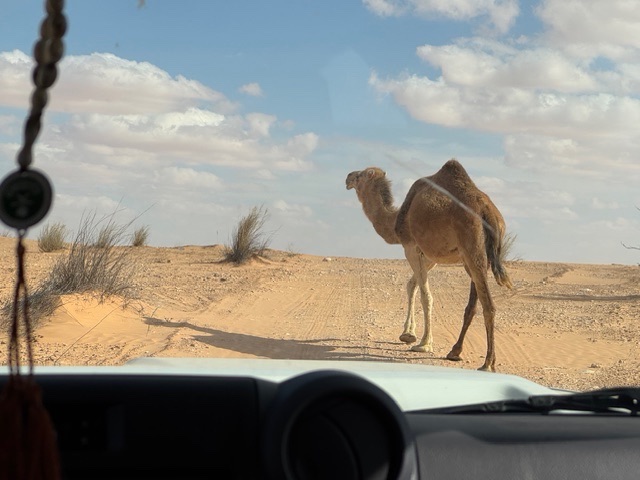
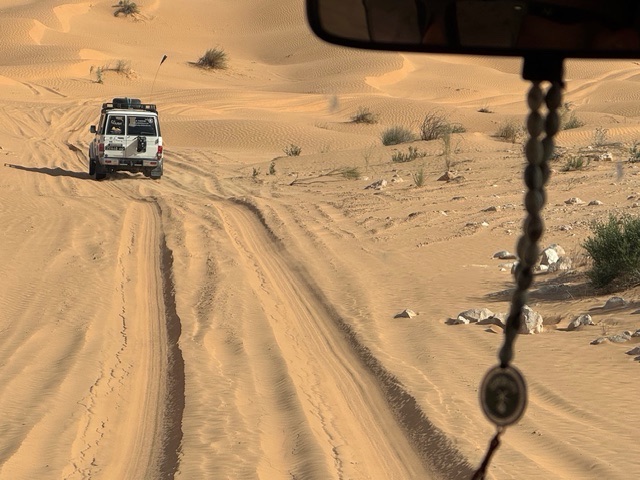
The Grand Erg Oriental is one of the largest sand seas in the Sahara Desert, stretching across eastern Algeria and southern Tunisia. Erg means a vast area of wind-blown sand dunes, and the Grand Erg Oriental lives up to that name. It’s a seemingly endless expanse of rolling, towering dunes that shift and change with the wind. In some areas, dunes can reach 400 feet high!
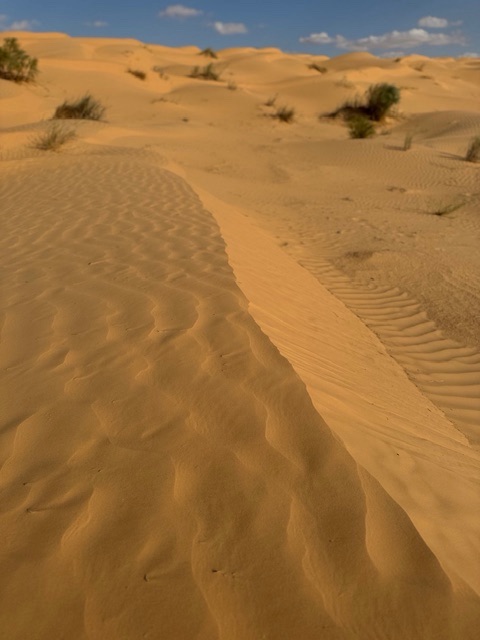
Established to preserve the desert ecosystem, the Jebil National Park protects sand dunes. These rocky plateaus, seasonal salt flats, and rare desert flora and fauna allow a glimpse of the Sahara’s wild, untouched side.
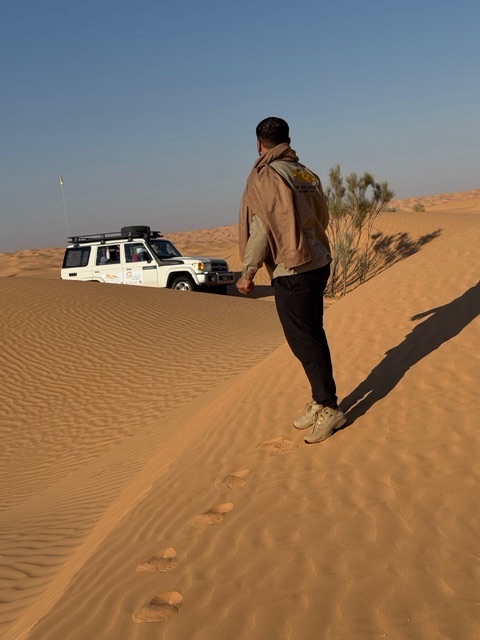
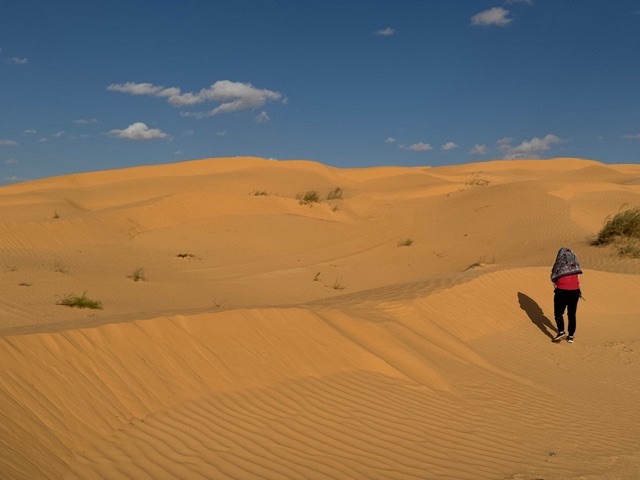
Camp Abdelmoula
Suddenly appearing as we crest a tall dune, within an isolated, peaceful environment sets our camp for the night. While not equipped with all the modern amenities, Camp Abdelmoula offers 50 tents and an unforgettable night under the stars surrounded by dunes and the occasional night noise.
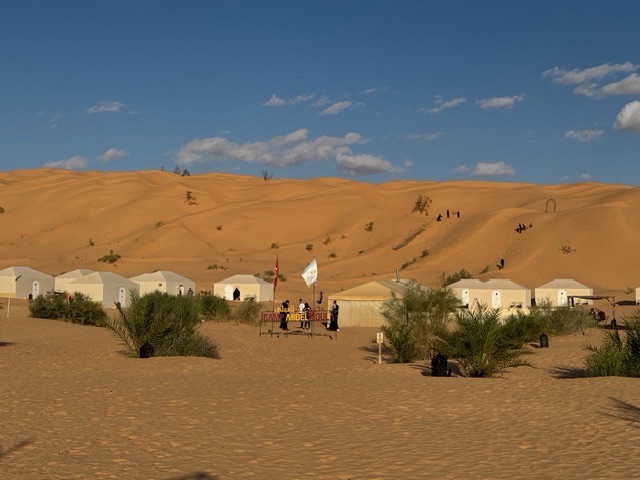
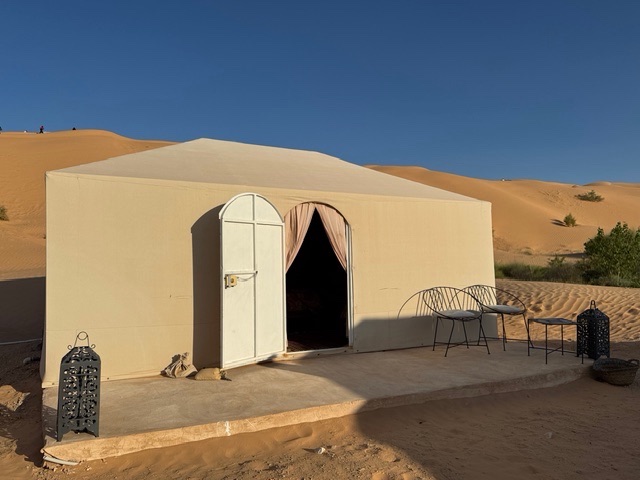
The hard-sided tents are quite comfortable and have toilets and electricity. Thankfully, there are plentiful blankets available as the night was very cold! Forget using the shower, at least for this Californian.
Actually, our tents have a private bath, electricity, plugs and wonderfully comfortable beds. No wifi, weak cell reception. Just stars, sand, and serenity. And one can have a wonderful dinner without having to make one’s own bread, followed by a pleasant dance around the campfire.
Everything must be shipped in by large army trucks. Even the fire wood, which comes from the palm tree.
Bread Making
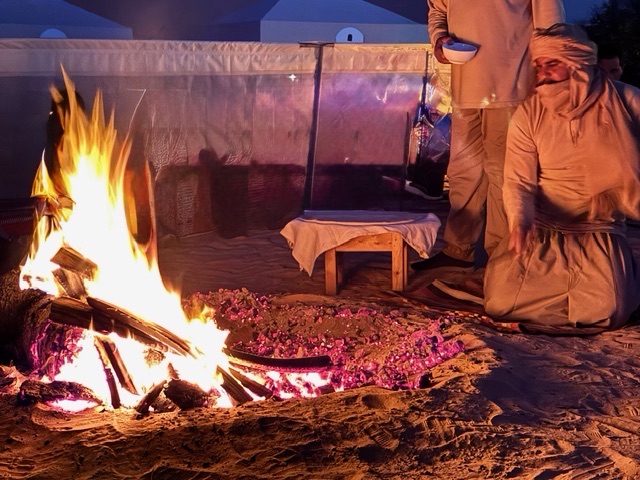
A highlight, but not surpassing the incredibly beautiful scenery, is our opportunity to take part in making bread. Nomads practice a long tradition of hand-making bread using simple, portable methods suited to harsh desert conditions. They mix wheat or barley flour with water and a pinch of salt, sometimes adding a bit of yeast or fermented dough for leavening.
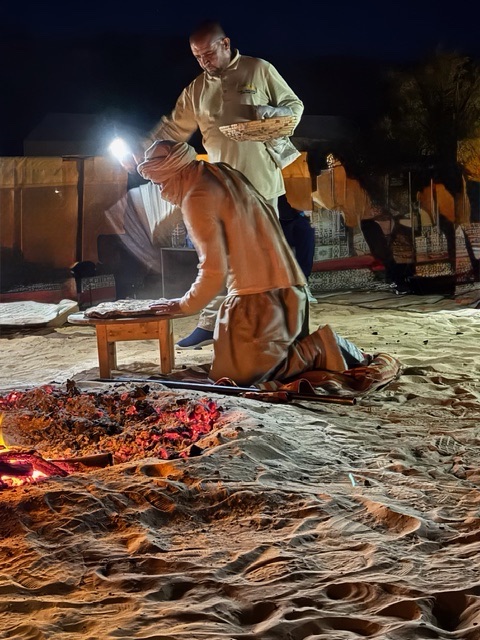
The dough is kneaded briefly, then shaped into round, thin flatbread designed to cook quickly and carried easily. Then, our baker threw the dough into the fire and covered with embers. Sometimes, a small clay oven, or it is buried in hot sand to bake using the sun’s residual heat.
The resulting bread is crusty with a slightly smoky flavor and soft in the middle, ideal for scooping stews, dips, or dates. This method allows the bread to be portable, quick to prepare, and long-lasting without the need for modern ovens or electricity, reflecting the resourcefulness and sustainability of desert life.
Stars of the show
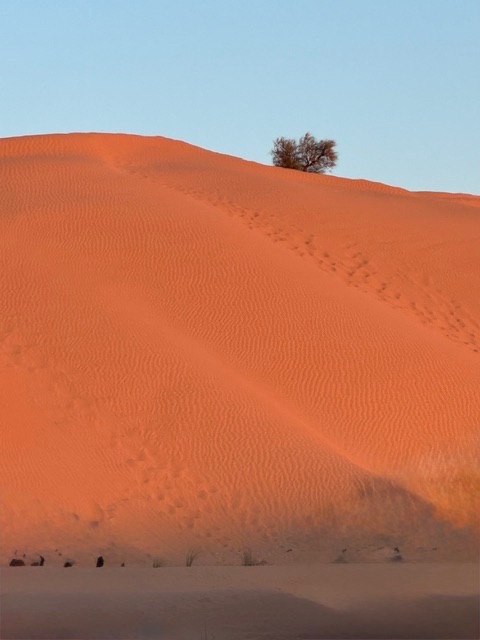
Of course, the best comes out with the setting sun. The sun sets behind the western dunes. However, the best show plays in the east. The sands of the dunes turn a brilliant red. It becomes quite a show as colors shift and shadows play.
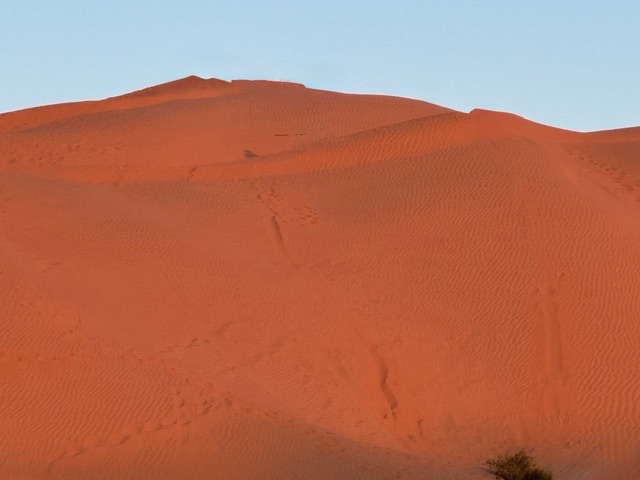
Then a sky of stars blossoms across the cloudless black heavens. Many familiar stars of the Northern Hemisphere appear. One can see a wide array of constellations and planets. Venus first, then easily spot Orion’s Belt and Big Dipper.
Can’t get much better than this.

0 Comments