10 April 2026
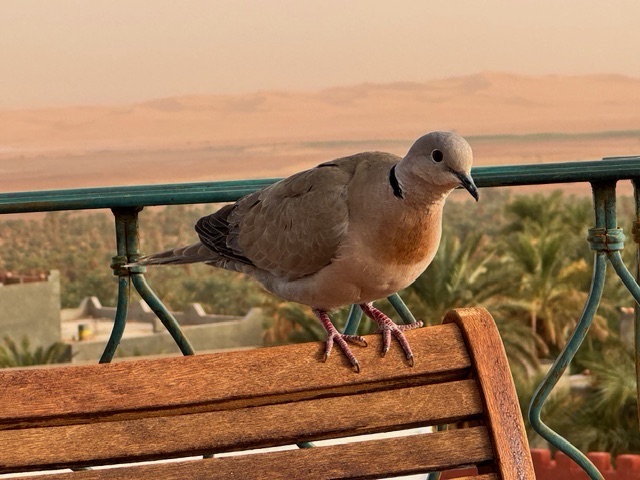
It’s a cool, pleasant but hazy day. I grab a cup of Nescafé, sit on the terrace overlooking date palms and dunes listening to doves cooing in the trees. Cooing good morning or good riddance?
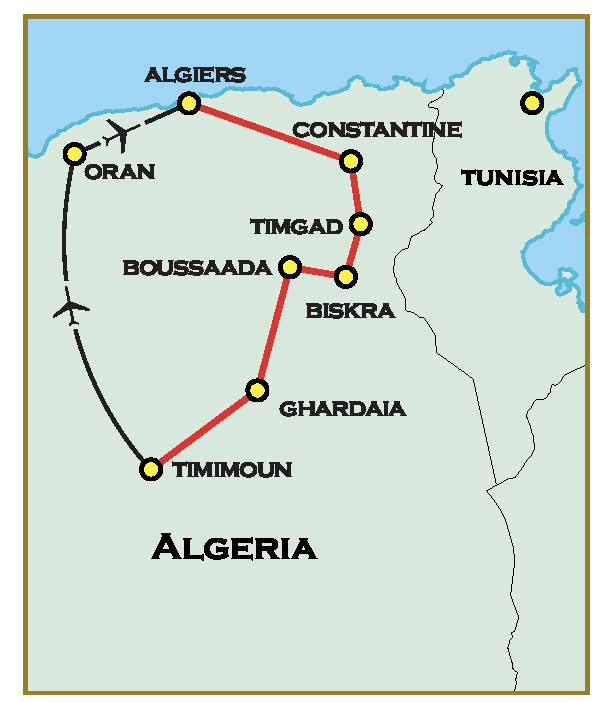
The good news – we fly to our next destination: Oran. This eliminates a 600-mile drive and replaces it with a fast 5 miles to the Timimoun Airport. I feel relief. Possibly, I have been driven through enough Saharan landscape during the last couple years.
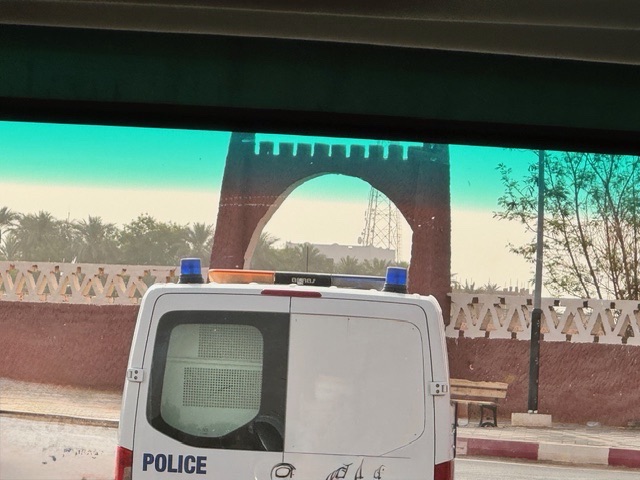
The police escort us to the airport. On the way, we shop for water, then for suitcase locks for someone. No rush, I guess. I have been told the police will arrange for domestic flights to be held for late arrivals. Again, good treatment or good riddance?
We say goodbye to our driver, a most pleasant, efficient and skilled fellow. I always appreciate the bus drivers as they maneuver the roads, avoid killing anyone or anything and get us to our next destination. He smiles no matter the width of the street, the density of pedestrians or bikes, tradesmen or length of day. We complain of 12 hour days, he drives them.
Saga of Two Algerian Airports
Timimoun Airport
Timimoun Airport is a small regional airport, handling primarily domestic flights connecting the desert town with cities like Oran and Algiers. There’s one terminal and one runway. Everything from departures to boarding takes place within walking distance of each other. There are several security stops. Services remain basic. Time here would fail be a highlight of any trip.
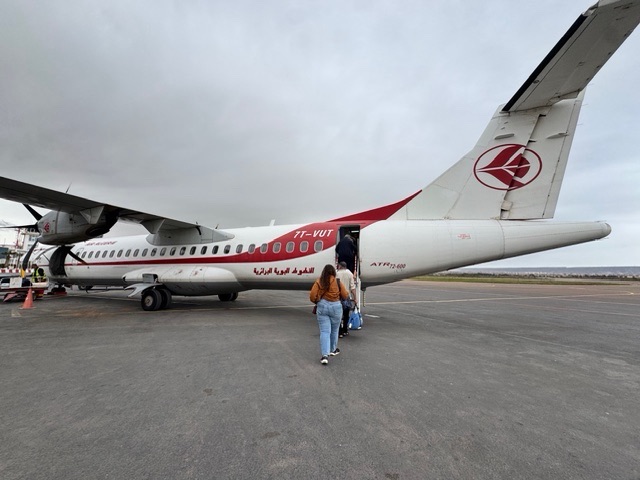
Our Air Algérie flight operates both direct and connecting flights to Oran. Thankfully, the tour has paid for a direct, 2-hour flight. We wait in a small, plain area for our flight. Boarding starts with a bus ride to a prop plane. The airline practices open seating but surprisingly it goes well.
Oran Ahmed Ben Bella Airport
The flight bumps and wiggles a bit coming into Oran. But we land on time and collect our bags. Or more correctly, I wait while others collect their large bags. Oran is another small, uncrowded regional airport. This one has three runways.
The airport has some history behind it. During WWII, its runways were used by the Vichy French Air Force as a military airfield, even though the population held mixed loyalties. During the Allied Operation Torch in early November 1942, the Allies met Vichy resistance here. However, after capturing the French naval base at Casablanca, General Eisenhower approved plans to attack and take this airport. Within a day, resistance fell and henceforth the airfield was used by American forces to begin their assault toward Algiers and then Tunis.
Historical Oran
Oran represents Algeria’s second-largest city and a cultural and commercial center on the western Mediterranean. Founded during the 10th century and reshaped by Berbers, Spaniards, Ottomans, and French colonists, all of whom left their mark.
Culturally, Oran is famous as the birthplace of raï music. Raï originated in Oran in the 1920s–1930s and grew out of a mix of local, folk, and global influences. Raï, means opinion or advice in Arabic, reflecting its origins as a form of social commentary. Traditionally, raï was sung by shepherds and later urban musicians. It blends traditional Algerian folk rhythms, Andalusian melodies, and later, instruments like the gasba (reed flute), darbuka (drum), and oud, a traditional stringed instrument.
Religious architecture is also notable, from the Great Mosque to Catholic churches reflecting colonial influences. The city’s Mediterranean location means abundant fresh seafood, and cafés spill into the streets for a relaxed, social atmosphere.
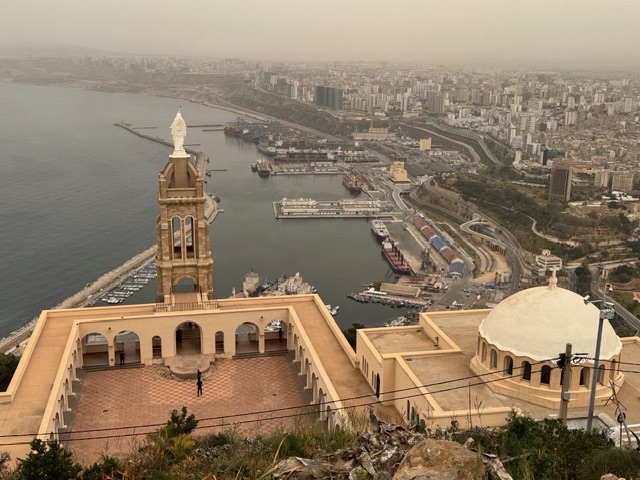
Little of which I see or hear. On our climb up to Fort Santa Cruz, views were limited because of haze. Colonial downtown appears tired and dirty. Gabrielle compared it to Naples; I’m inclined to think Havana. The beautiful architecture suffers from neglect. Trash lies everywhere. While the waterfront has become a series of high rise hotels and resorts, with more to come, the beautiful colonial city is crumbling from neglect. Oran may be considered Paris in Algeria but I don’t see Gay Paree.
Fort De Santa Cruz
Oran’s hilly terrain offers several lookouts, including the Santa Cruz fortress. Above the city, it affords sweeping views of the city and port. Today, the views are very limited by dust and haze.
Fort Santa Cruz, originally built by the Spanish in the early 16th century during their occupation of Oran, acted as part of a defensive network to control the harbor and protect the city from both Ottoman and local forces. The fortress expanded and modified over the centuries, both by the Ottomans and again under French colonial rule.
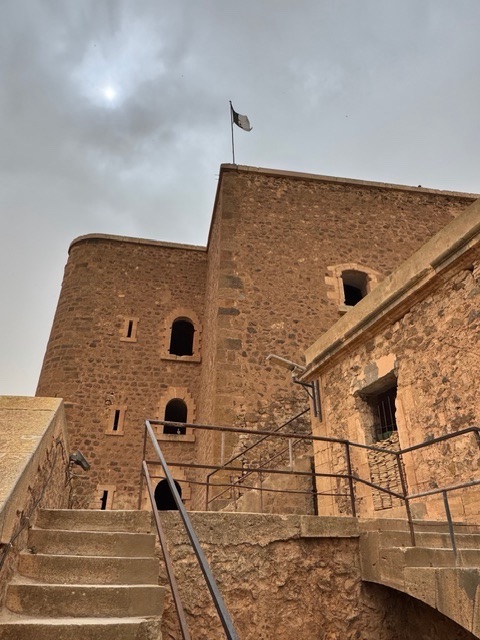

Today, the fort includes massive stone walls, bastions, and watchtowers that outline the defensive layout. Some internal structures, such as barracks and cisterns, survive in partial form. The site lay largely in ruins but offer both a sense of the military might that once dominated the region and panoramic views over Oran, the port, and surrounding hills. I can walk along its ramparts and stairways, imagining the cannons and soldiers stationed there, while seeing how the fort commanded both the city below and the approaches by sea. My BFF would have loved this place.
Walking Oran
I’ve read Oran offers a waterfront lined with cafés and restaurants, a lively medina with narrow streets and bustling markets, and wide colonial boulevards lined by early 20th-century architecture. In reality, there are many beautiful buildings, a couple of which have been restored. The Town Hall Place d’Armes and the municipal theater both indicate an European‑influenced pocket of the city. French continues to dominate names, streets and conversation.

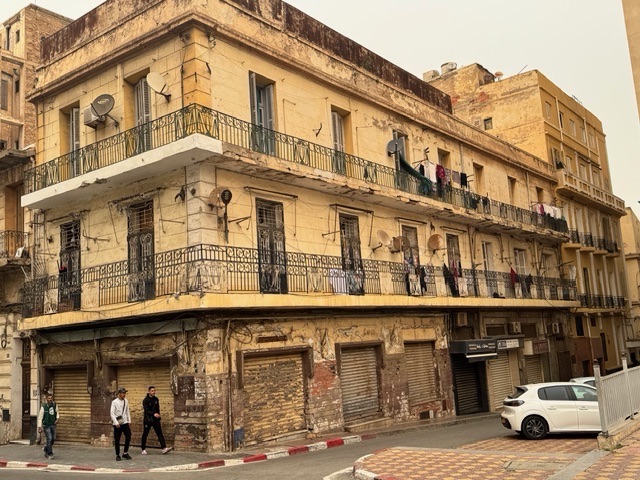
However, for the most part, the beauty is overshadowed by the badly maintained colonial structures. Oran’s old colonial buildings stand like aging aristocrats—once dazzling, now a little undone. Their wrought-iron balconies and high, shuttered windows hint at a past life that wouldn’t feel out of place in New Orleans or Paris. Here, though, the plaster peels, the paint sighs in long curls, and time has settled into every crack.
I can see Rhett Butler, once impeccably turned out, standing on a veranda that’s seen better days, drink in hand, watching the world move. There’s a sadness in the decay. They don’t just need repair—they seem to beg for it. A coat of paint, a careful restoration, a bit of pride returned, and they could step right back into their former lives, equal parts elegance and drama. It’s just enough deterioration to break your heart.
Highlights
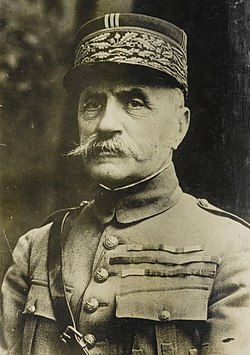
Place Foch (named for Marshall Foch, the French Supreme Allied Commander in WWI) is a small plaza surrounded by formal buildings that once projected colonial authority. The restored town hall remains imposing with neoclassical façades and decorative stonework. The theater, also built in French style, sits across the square.
The Regional Theatre of Oran, also known as the Abdelkader Alloula Theatre, occupies an historic building at Place du 1er Novembre 1954 in Place Foch. The structure was originally built as the Opéra d’Oran at the beginning of the 20th century by an architect identified as Inez. Construction was completed and the opera house opened its doors in 1907, serving as a cultural hub during the colonial era.
After Algerian independence in 1963, the building became nationalized along with other cultural institutions and underwent several name changes. After 1972, the theater was named in honor of the Algerian playwright Abdelkader Alloula, a leading figure in Algerian theatre history. The theater remains a modern active venue.
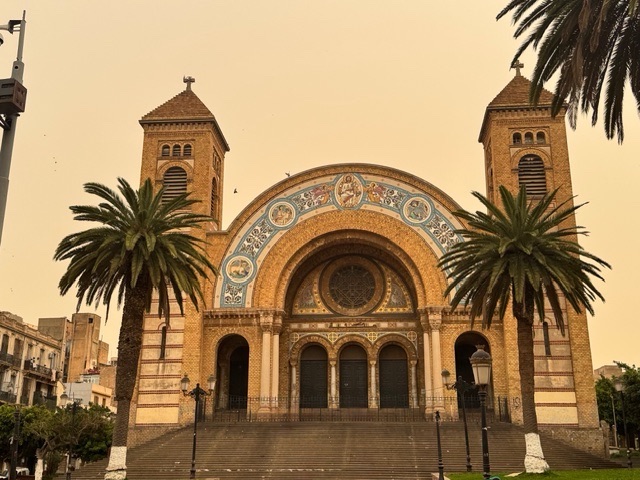
The Cathedral of the Sacred Heart was built between 1903 and 1913 during the French period. It reflects a mix of Romanesque and Byzantine influences, with a distinctive dome and ornate interior.
Originally a Roman Catholic cathedral, it lost that role after Algeria gained independence in 1962, when many Europeans left the country. Rather than falling into disuse, the building was repurposed as a public library, preserving its structure while giving it a new civic function.
Along the Waterfront
Oran’s waterfront reflects a mixed-use space. From here, ferries leave for Spain, just 130 miles across the water. Along the main coastal road and port area sits a working harbor with commercial shipping and some shipping infrastructure. However, much of the waterfront is urban, lined with large modern hotels, restaurants, and promenades.
Overlooking the Mediterranean sits our hotel, the Le Méridien, just one of many high-rise, modern hotels overlooking the sea. It offers a comfortable restaurant and the Cliff Bar on the patio overlooking the sea. All seems well and good.
À votre santé! Or, perhaps when in Algiers “Fi sihtak wa riḥla sa‘īda!”
11 April 2026
We remain another day with an option to explore Oran. Driving back the short distance to the city center, we visit two local highlights.
Bulls and Matadors in Oran
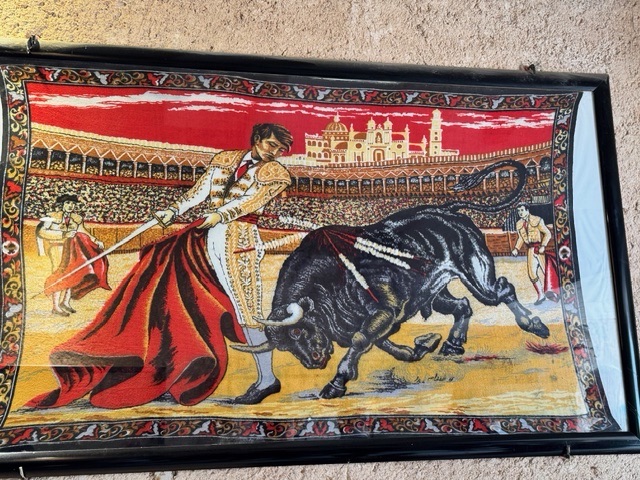
Totally unexpected was Oran’s Bullring! It was built in the early 20th century during French colonial rule, when Spanish cultural influence in the city was strong. Bullfighting was a popular spectacle among Europeans, especially those of Spanish origin, and the arena hosting corridas and lively public gatherings.
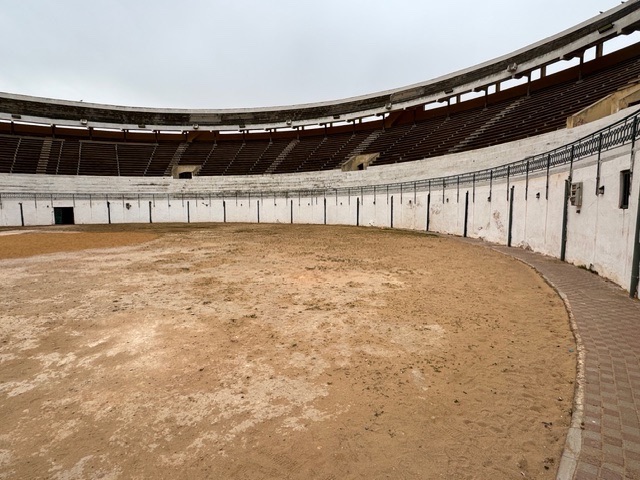

After Algeria gained independence in 1962, bullfighting quickly disappeared, seen as part of the colonial past. The bullring fell into disuse. Over time, it has been used occasionally for cultural events or left largely abandoned.
Today, the structure remains a striking but somewhat sad relic—an echo of a different era in Oran’s history, when European traditions shaped much of the city’s public life.
Ahmed Zabana National Museum
There exist several museums in Oran but possibly the Ahmed Zabana National Museum is the most unusual. It displays a little bit of everything and kids probably love it for all the displays of bugs, bones, and bottled weird stuff.
Named after Ahmed Zabana (1926–1956), a national hero and revolutionary, the museum offers insight into Algeria’s revolutionary past through exhibits and artifacts.
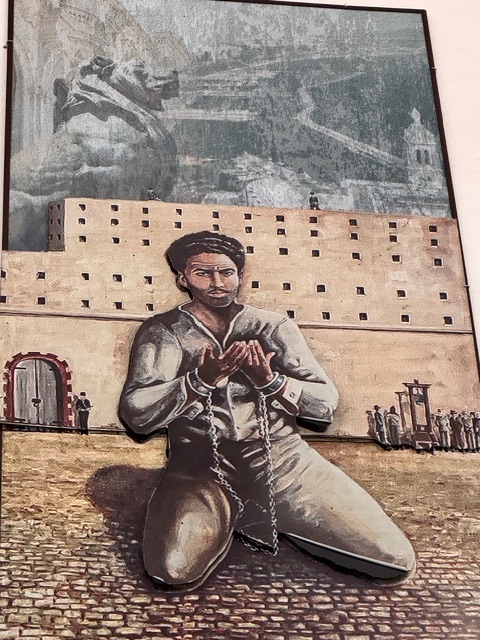
Zabana was one of the first Algerians executed by the French during the War of Independence. He became a symbol of resistance and sacrifice, and the museum honors both his memory and the broader struggle for Algerian independence.
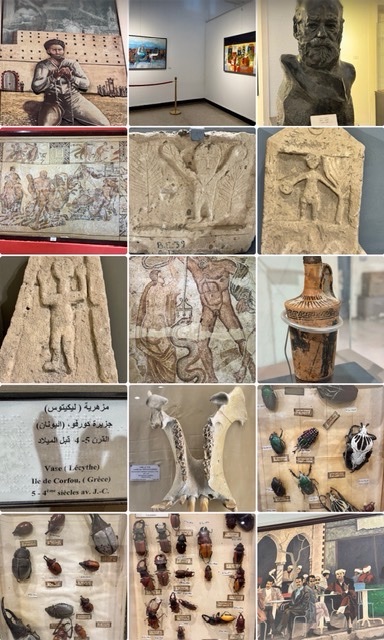
The museum itself combines history, archaeology, and art. On the historical side, it documents Algeria’s fight for independence, with exhibits including photographs, personal effects, documents, and military paraphernalia. Archaeologically, the museum displays ancient artifacts, including Roman mosaics, steles, pottery, and other relics from ancient Caesarea (modern Cherchell) to Greece, highlighting Algeria’s long and layered history and seafaring presence.
Also, there are sections dedicated to Algerian culture and arts. Some excellent paintings are displayed. My favorite of sculptures was the bust of Victor Hugo by Auguste Rodin. Overall, the museum offers a compact view of Oran’s historical and cultural landscape, linking ancient, colonial, and modern periods in one space. All surrounded by stuffed animals, a theater of Osteology, and double-headed sheep in laboratory jars.
Lodging
We lodged for our one night at the high-rise, modern Le Meridian Hotel. Perched on cliffs overlooking the Gulf of Oran and Mediterranean Sea, the Meridian offers some pretty spectacular views. I generally check my room’s view first, even before checking internet. Here, our balcony faces the blue Gulf. A bar is on a terrace overlooking the water and lights of the city and port. If there were no haze or pollution, it would be spectacular. But, they serve cold beer!

Preparation for development along the waterfront, a site for more hotels and resorts. Meanwhile, Oran’s beautiful colonial city is crumbling from neglect.
Our Return to Algiers
This afternoon, with police escort, and eliminating a long, dull 5-hour drive, we return to Oran’s airport. We fly back to Algeria. Bright lights, big city, traffic jams sans camels.
We depart Oran via Air Algérie direct to Algiers’ Houari Boumediene International Airport. Departure involves multiple security scans none of which feel that secure, a pat-down, waiting, and a bus ride to the plane.
Up steep stairs into the back. Again, prop jet, leather seats worn and torn. Modern touch: no smoking sign replaced with no lap top sign. Open seating but it proceeds with far less chaos than had I boarded a flight to Fort Lauderdale.
This time, we fly to the refrains of a very unhappy cat who would rather walk than fly.

0 Comments