30 May 2026
Transportation requires planning. Once leaving major cities, moving from one city to another becomes more difficult. Thus, when I travel from Vilnius to Kaunas, I ask, train or bus? Book ahead or last minute?
I discover train tickets do not go on sale until 30 days before departure. So, with that timing in mind, I want the easiest, fastest route. I use LTG LINK to consider regional trains. Another option is a bus. Train is cheaper but the bus station sits closer to my hotel.
An attractive aspect of train/bus transport in Lithuania becomes their 80% discount for travelers over 80. I dislike the high number but I appreciate the perks of age.
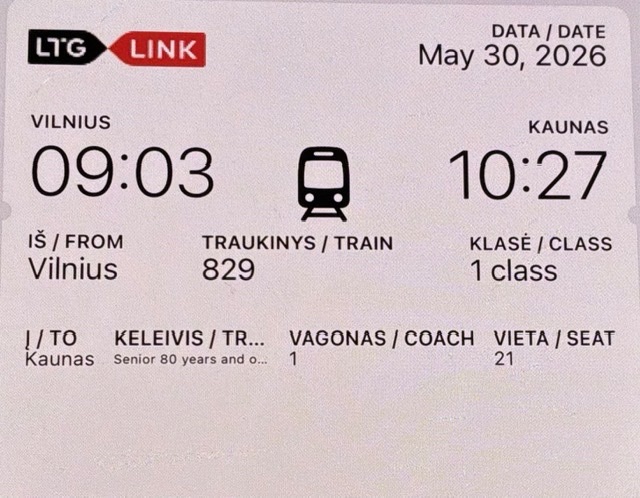
I purchase a ticket using the LTG Link mobile app and digitally download my ticket for a paperless journey. With 1st class, I may access the LTG lounge. Cost of train travel? Just .86 cents 2nd class! Only 6€ 1st including choice of seat. I like all that.
I walk from the train station to my lodging at the Kaunas City Hotel. I seem to have chosen the parking lot path which may be shorter but leaves me thinking of a better route when I return this way on Monday.
I am very pleasantly surprised that my room is available. I quickly find it more than adequate. Leaving my bags, I start my exploration of Kaunas.
Kaunas – Temporary Capital, Lasting Impression
Kaunas represents Lithuania’s second-largest city. It exudes a distinct identity shaped by resilience and reinvention. While Vilnius offered historical grandeur, Kaunas feels more interwar and modern. Its defining moment came between the world wars, when Vilnius was under Polish control and Kaunas became the temporary capital of Lithuania from 1919 to 1940.
During this period, Kaunas rapidly modernized, producing a remarkable collection of functionalist architecture, now recognized as Modernist Kaunas, a UNESCO World Heritage site. Functionalist architecture represents a design approach where buildings are shaped primarily by their purpose rather than by decoration or historical styles. The guiding idea is that form follows function.
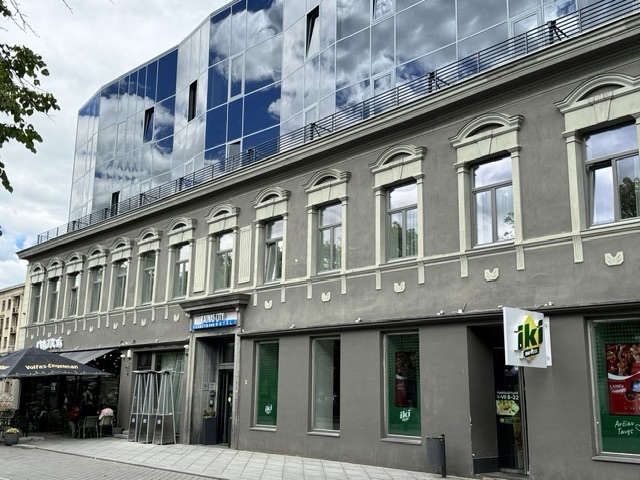
Instead of ornate details, architecture consists of clean lines, simple geometric shapes, flat roofs, large windows, and layouts designed for efficiency, light, and practicality. Materials like concrete, steel, and glass are often left visible rather than dressed up.
From Old to New
Earlier Kaunas developed as a fortified city of the Grand Duchy of Lithuania, strategically located on a spit of land at the confluence of the Nemunas and Neris rivers. Its Kaunas Castle reflects centuries of conflict with the Teutonic Knights.
But the 20th century brought hardship: Nazi occupation, the destruction of its once-large Jewish community, and later Soviet rule. Resistance and cultural preservation became central themes. Today, Kaunas blends its rich history with a modern energy, street art, and a strong café culture.
The Other Capital with Its Own Story
Kaunas’ Old Town is the oldest part of the city. It rests next to the confluence of the Nemunas and Neris rivers and Santaka Park. Old Town had industry in the past, but today it is primarily a residential, retail and leisure area.
Old Town feels more compact and relaxed than Vilnius, which is exactly its charm. The beautiful and busy pedestrian-only Laisvės Aléja / Vilniaus gatvė run 1.5 miles east to west from Kaunas Town Hall to Church of St Michael the Archangel.
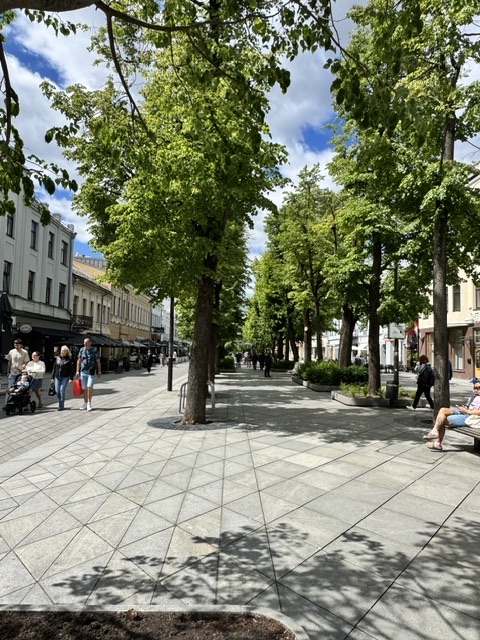
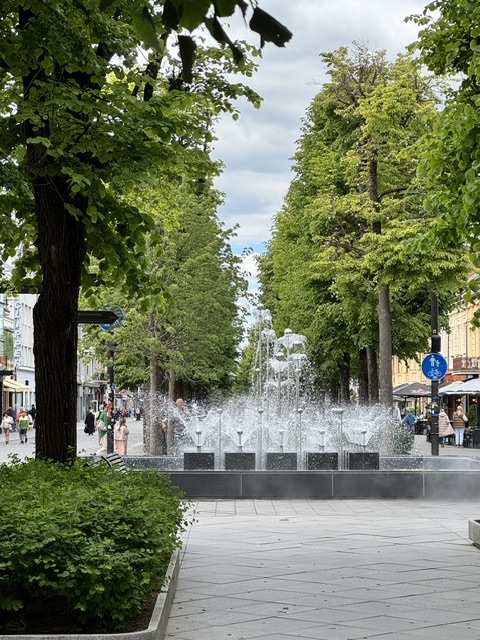
Laisvės Alėja (Liberty Avenue) is broad, tree-lined, lively and elegant. A cornucopia of café terraces, restaurants, fountains, and shoppers give it a relaxed European promenade atmosphere. It gracefully blends into Vilniaus gatvė — a cobbled, historic, intimate and atmospheric a street lined with medieval architecture, church spires, more outdoor dining, and the feeling of stepping into old Kaunas.
Together they form a pleasant transition from Nepriklausomybės aikštė (Independence Square) up the grand boulevards of modern Kaunas into the charming streets of its Old Town. And except for excursions to nearby museums and churches, one could spend an entire day strolling and exploring from one end to the other.
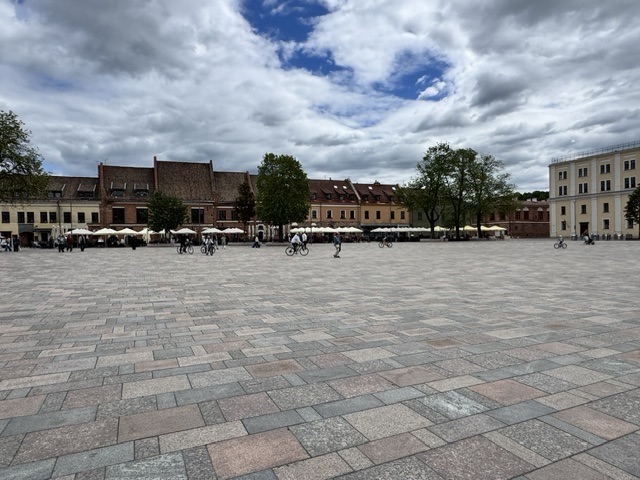
Breakfast under the bells of St Michael, lunch relaxing midway amid the fountains and sculptures of the Music Theater park, then dinner in the massive Town Hall Square. Even better, get a hotel with balcony, like Kaunas City Hotel, and I never need to venture far.
Kaunas Castle
At the west end of the avenues, sits Kaunas Castle. This stone fortress , one of the oldest in Kaunas, dates to the mid-14th century. Built at the strategic meeting point of the Nemunas and Neris rivers, it defended the lands of the Grand Duchy of Lithuania against the Teutonic Knights, a powerful military order pushing eastward.
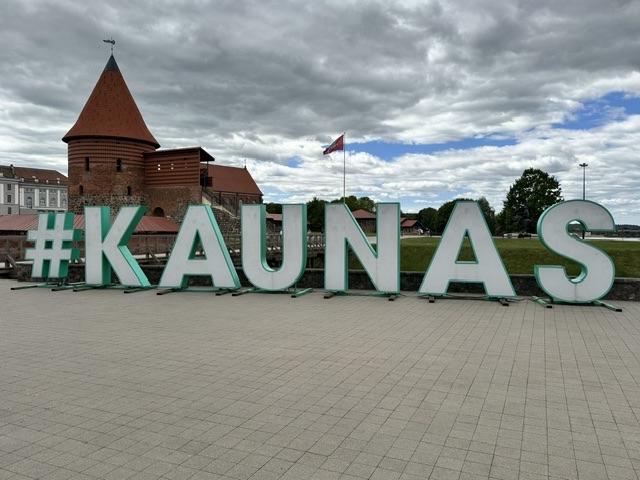
In 1362, it was besieged and heavily damaged by the Knights, marking one of the earliest major clashes in the region. The Teutonic Knights were primarily a German Catholic military order. They resided to the west and northwest of Lithuania, in what is now parts of Poland and the Russian exclave of Kaliningrad. At the time, this region was known as the State of the Teutonic Order, with major strongholds like Marienburg (modern Malbork in Poland).
From there, they launched repeated campaigns eastward into the lands of the Grand Duchy of Lithuania. Their stated goal was to Christianize pagan Lithuania, but the conflicts were also about territorial control and power.
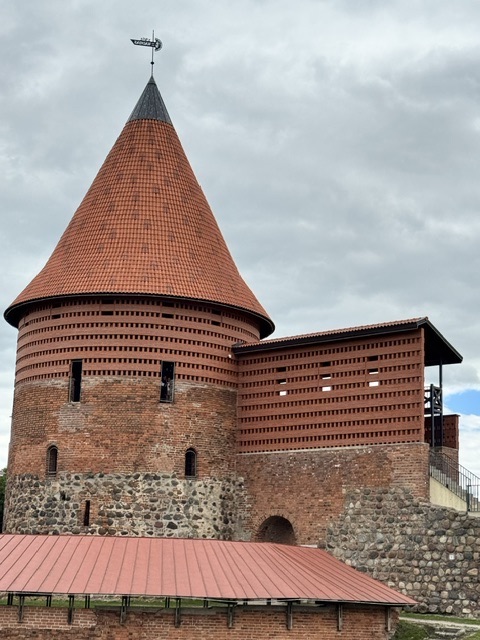
Though Kaunas Castle was later rebuilt and strengthened, advances in warfare and shifting borders reduced its military importance. It gradually fell into ruin. Today, it is partly restored, including its distinctive round tower and sections of red brick walls.
Inside, a small museum exhibits items of medieval warfare, castle life, and the history of Kaunas. I can descend a floor to the dungeon or climb a winding staircase to the fourth floor observation balcony. There is little else here. The surrounding park and riverside setting teem with families and strollers. All in all a pleasant place to linger for the views.
Four Churches, Four Centuries
Churches of all denominations strategically perch on hills, along rivers and what seems like on every major corner of the city. Open for visits, four churches in Kaunas show very different eras and styles, almost like a timeline in stone.
The Church of Vytautas the Great
On the west end of the avenues, this church is one of the oldest in Kaunas, dating to the early 15th century. It traditionally links to Vytautas the Great, who is said to have commissioned it after his campaigns against the Tatars.
Built in simple Gothic style from red brick near the Nemunas River, modest in size, it served merchants, travelers, and river traders entering the city. Today, it is serving a young couple as they exchange wedding vows.
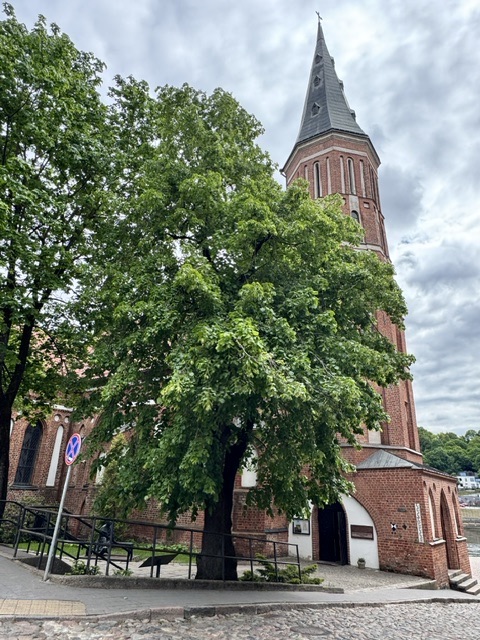
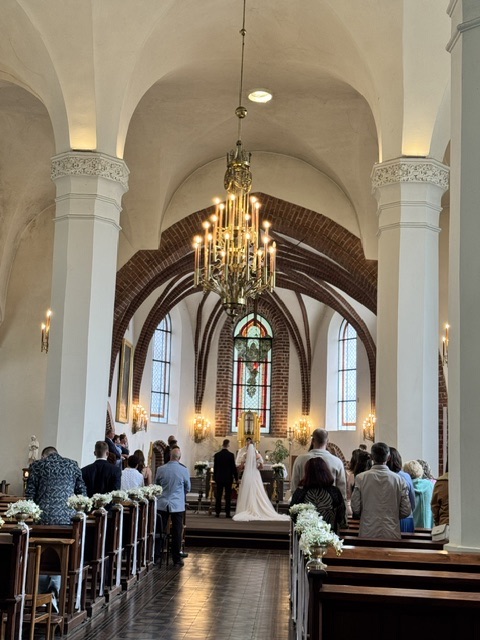
Over the centuries, the church endured floods, fires, and periods of neglect, especially during times of political upheaval.
Who was Vytautas?
Vytautas the Great (c. 1350–1430) became one of the most important rulers in Lithuanian history. As Grand Duke, he led the Grand Duchy of Lithuania at its height of power, when it stretched from the Baltic toward the Black Sea.
Vytautas gained fame for strengthening the state, centralizing power, and expanding its influence. Militarily, he played a key role alongside Poland in defeating the Teutonic Knights at the pivotal Battle of Grunwald in 1410, a turning point in the region.
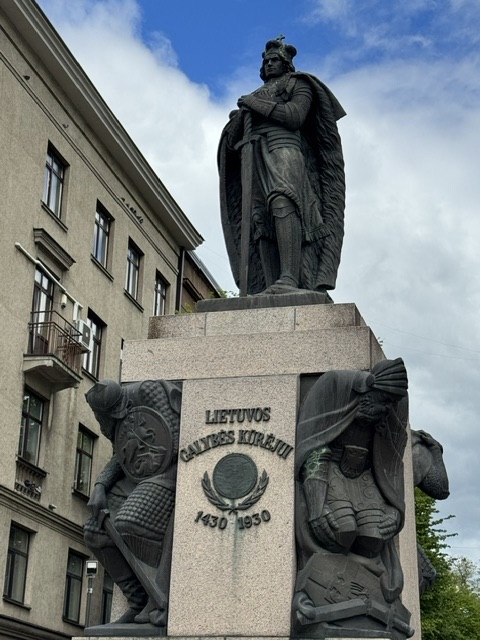
Vytautas also promoted Christianity in Lithuania (which had only recently converted) and supported trade and ties with Western Europe. Though he never became king, he is remembered as a strong, pragmatic leader who helped shape Lithuania into a major European power.
The Cathedral Basilica of St. Peter and St. Paul
Anchoring the massive Town Hall Square, the Basilica is the city’s main cathedral with roots in the 15th century. It blends Gothic structure with later Baroque additions. Inside, it feels traditional with vaulted ceilings, side chapels, and a sense of long continuity.
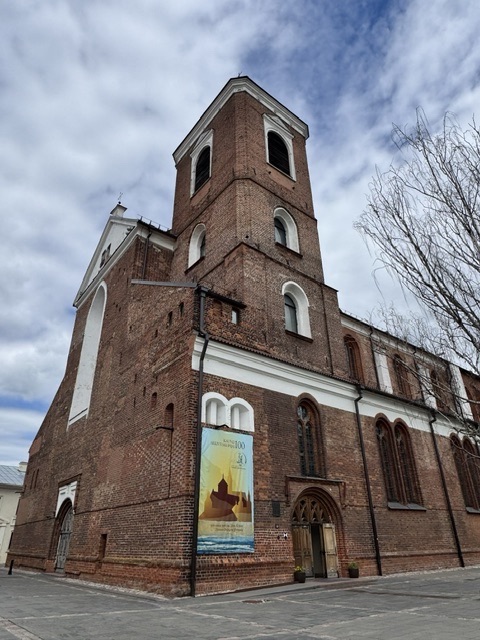
Outside, its best feature is its pale, harmonious façade and Gothic-Baroque proportions. The tall central tower rises cleanly above the square, giving it a calm but dignified presence. It doesn’t dominate the city; instead, it anchors the space with simplicity and grace, especially when seen from the open square around it.
Inside, the beauty is in the light and atmosphere. White vaulted ceilings lift the eye upward, while soft Baroque details and side chapels create a sense of depth without clutter. Sunlight filters in giving the interior a warm, reflective calm. The altar area draws focus but remains integrated into the overall serenity of the space.
Christ’s Resurrection Church
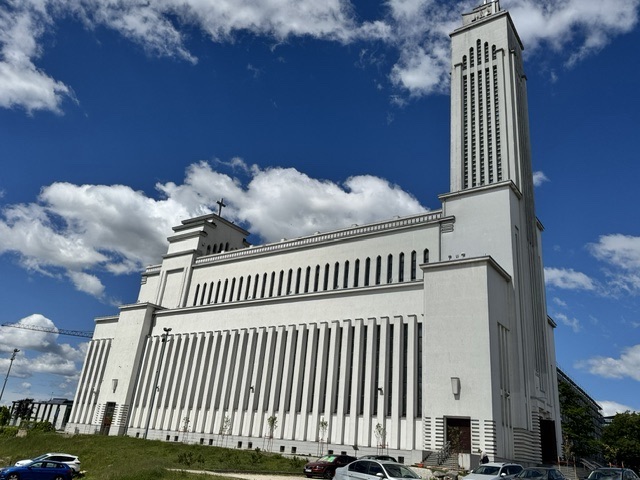
This church is completely different. This massive 20th-century modernist church, originally built during independence, was used as a factory under Soviet rule and later restored. It’s stark, white, and monumental, with a rooftop terrace offering sweeping views. The church lies on a scale between modernist and gargantuan ugly. I lean toward the latter.
St. Michael the Archangel Church
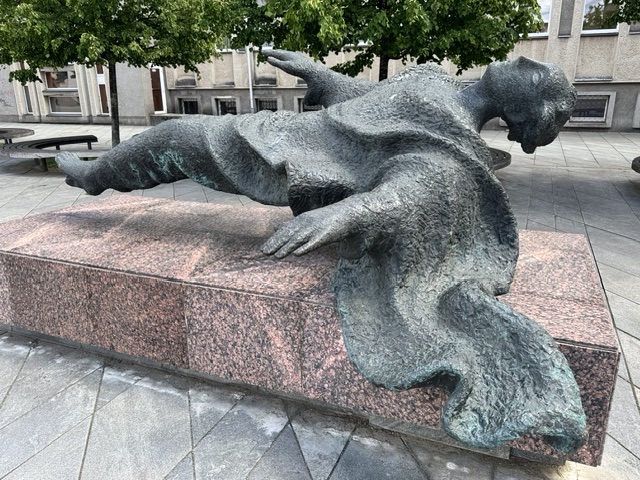
Nepriklausomybės aikštė
Anchoring the east end of Laisvės Alėja, St. Michael was built in the late 19th century when the city suffered under the Russian Empire, it was originally designed as an Orthodox military church. Its glaring white facade stands out along with its Byzantine style consisting of onion domes and a commanding presence.
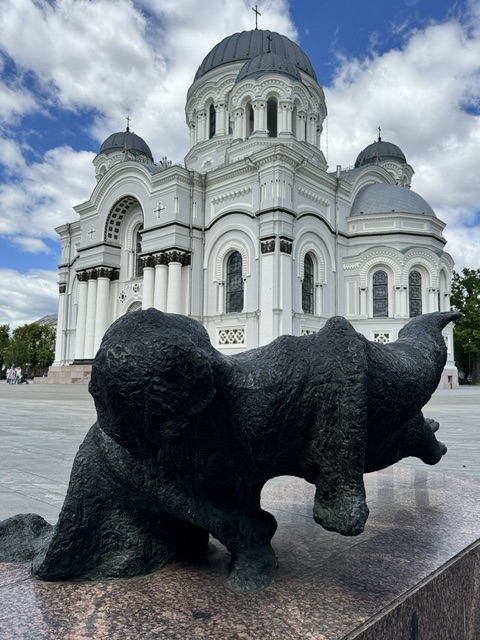
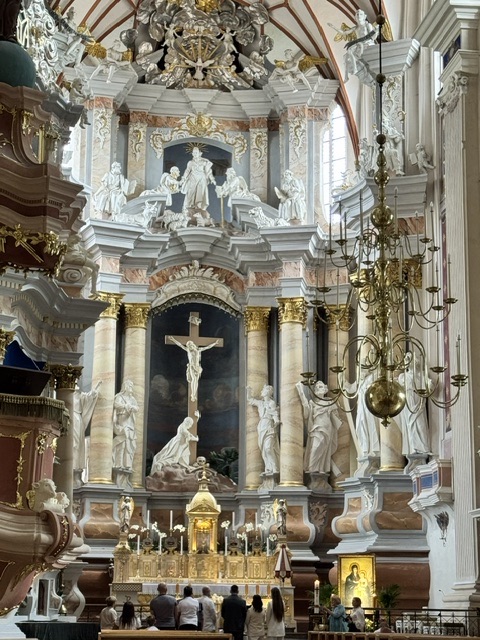
Inside, I immediately notice its scale with high domes, strong vertical lines, and a sense of symmetry that feels more imperial than intimate. The space is wide and uncluttered, with tall arches that create a feeling of elevation and structure rather than ornament.
Together, these churches reflect Kaunas as a crossroads of medieval faith, imperial influence, and modern identity.
White Swan Square
Town Hall Square becomes the city’s natural gathering place, and it works especially well at the end of a walking day because everything slows down here. The white Town Hall (often called the White Swan) gives the square a calm focal point, and the surrounding cafés feel open and unhurried rather than crowded or performative.
Historically, this has been a civic heart of Kaunas since medieval times. Markets, announcements, celebrations, and everyday life all unfolded here.
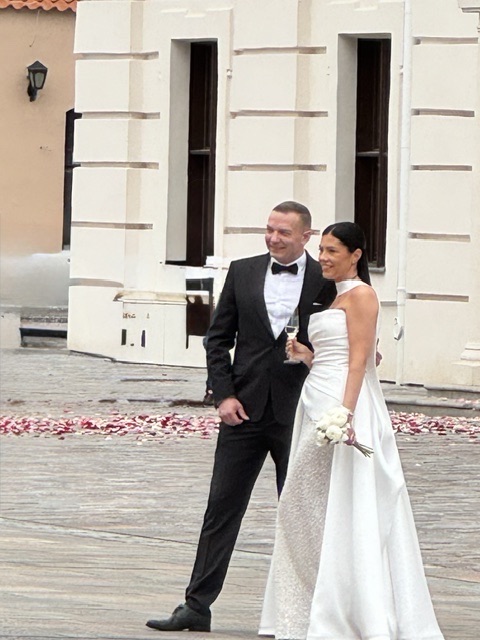
A plethora of new brides exit the Town Hall to gather among friends for champagne, music and photos. It’s Saturday and I estimate I have witnessed between ten and twelve newlyweds. There are seven churches and a Town Hall doing brisk business around the neighborhood. This seems a good place to take the leap and celebrate.
Ending my Day over Ale
For me, I walk back to the area of my hotel. There I choose the 400 laipsnių for dinner and ale. I can relax within sight of my lodging. Dinner becomes a Caesar salad and pork ribs. Piano music drifts down the street, people walk their dogs, I enjoy a 400 laipsnių unfiltered. After, I drift over to Mon Ami for a caramel crusty and cappuccino.
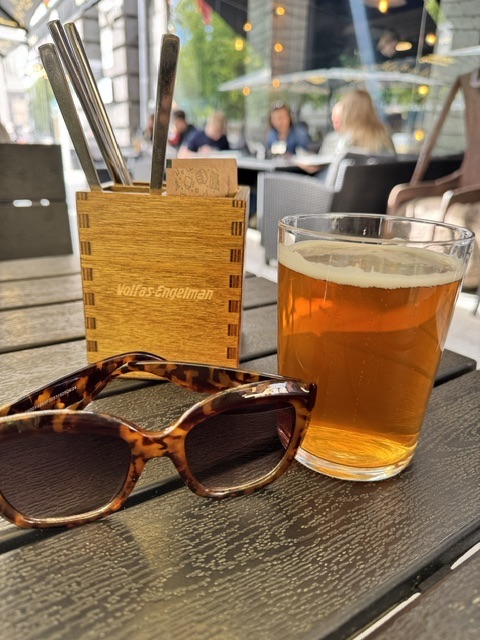
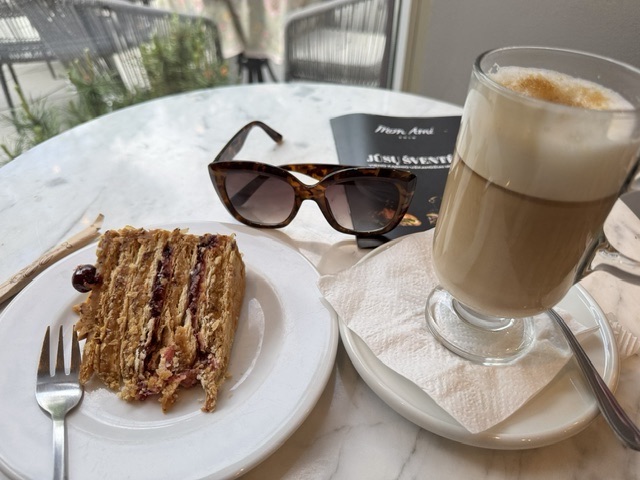
So, finding a pleasant restaurant, enjoying dinner and a beer, lingering over a coffee, I essentially join a long tradition of people pausing in this same space between work, trade, and home. People watching remains free.

0 Comments