29 May 2026
After exploring Vilnius the past three days, I agree with an early 2018 tourism campaign:
Nobody knows where it is, but when you find it, it’s amazing.
I expected to like Vilnius. I’m happy to admit I like it a lot. It is a wonderful mix of historic and modern, funny and tragic, strange and quirky. My kind of town!
Perhaps Vilnius began to all come together for me with the discovery of Frank Zappa.
How Did Frank Zappa End Up Here?
In my wanderings, I came upon perhaps a strange piece of artwork, encouraging me to ask the favored question of all tourists: Why?
The story began after Lithuania regained independence from the Soviet Union in 1990. Artists and intellectuals were eager to celebrate freedom, individuality, and rebellion after decades of Soviet control. Photographer Saulius Paukštys and a local fan club and artists decided the newly independent country needed a monument to that spirit.
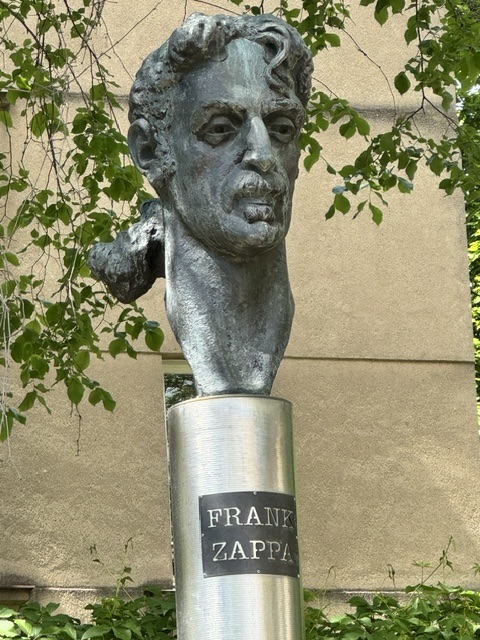

Thus, unveiled in 1995 atop a tall metal column, sits an incredibly good likeness of Frank Zappa. Zappa became their symbol not of music specifically, but of free thought and anti-authoritarianism. The bust seems even more charming when I learn that Frank Zappa had absolutely nothing to do with Lithuania. He never visited, had no Lithuanian roots, and probably never imagined a statue of himself would appear in Vilnius.
Sculptor Konstantinas Bogdanas, famous during Soviet times for creating statues of Lenin and communist leaders, was hired to sculpt the bust. That irony was intentional: the same artist who once immortalized Soviet rulers was now honoring an eccentric American rock musician.
The statue sits in a small park on the corner of K. Kalinausgo g. and Pylimo g. above Reformatų Park.
Children’s Joy is the True Masterpiece

Bastion Hill’s 24 cannons may all fire at once, but the true star of the bastion for me became the current children’s art exhibition – That Flower Looks Like a Drone.
Danish artist Eske Touborg’s project grew out of painting workshops held in Kyiv with Ukrainian children who had been liberated from Russian-occupied areas. As the exhibit explains, “20 metres of canvas was rolled out together with acrylics and spray paint,” creating joyful sessions that allowed the children “the chance to be children again.”
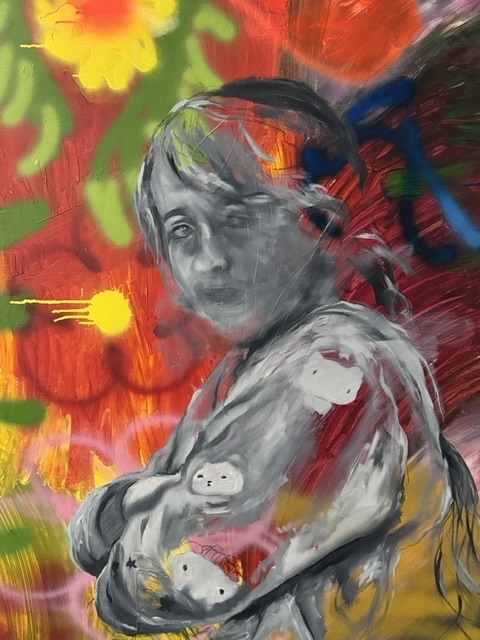
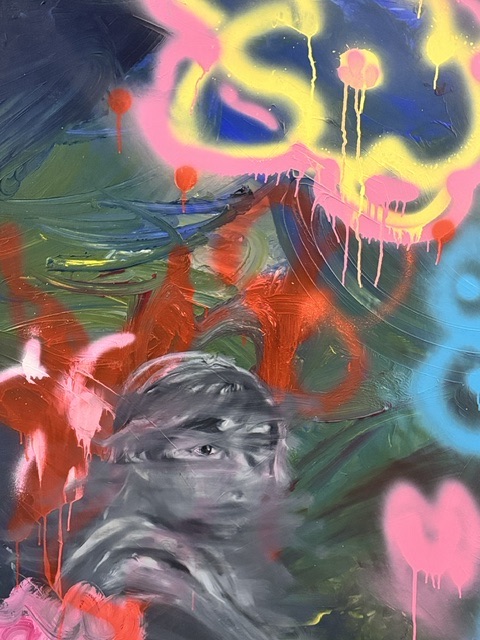


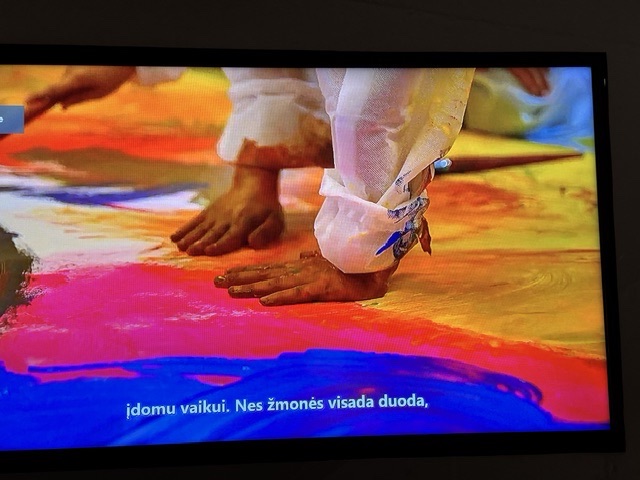
After the workshops, Touborg brought the canvas to Denmark, cut it into ten sections and added blurred portraits of the participating children. The finished works combine the children’s colorful, playful paintings with indistinct images of their faces.
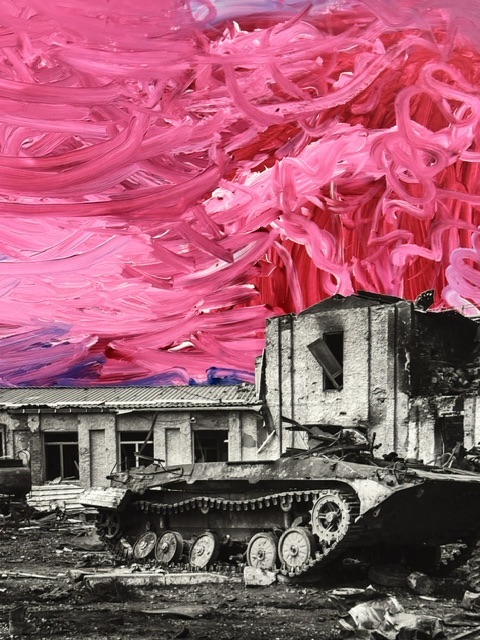
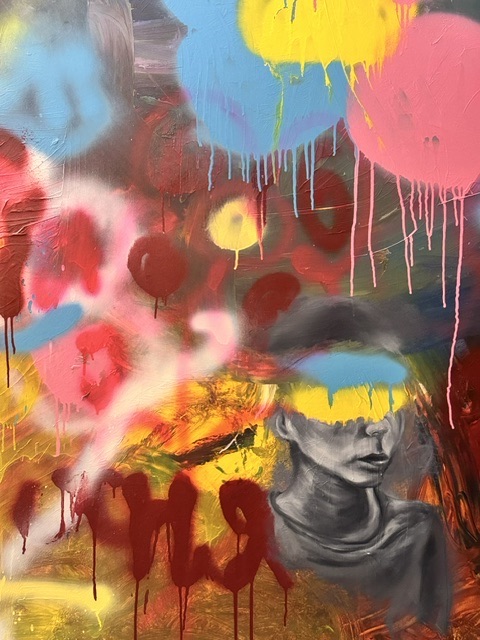

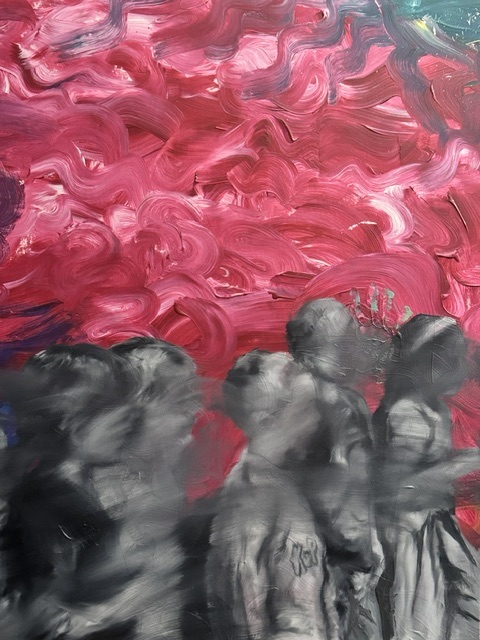
The contrast becomes the project’s message. The blurred portraits symbolize the loss and disruption of identity experienced by many abducted Ukrainian children, who were subjected to “new names, new languages and new loyalties forcibly imposed upon them.” At the same time, the vibrant backgrounds preserve the children’s creativity, energy, and resilience.
The exhibition explores how war affects childhood and identity, while emphasizing that, despite attempts to erase who they are, these children retain “their right to simply be kids.”
The title of the exhibition is a direct quote from one of the children who, after painting a flower, spontaneously remarked: That flower looks like a drone.”
Come for the History, Stay for the Beautiful and Slightly Strange
When I arrived in Vilnius, I was fleeing the oppressive heat in Berlin. I welcomed the 20° temperature drop. At first.
I swear I saw someone putting on a pair of gloves as I exited the hotel this morning. “Why are you standing out here when it’s so cold?” she asked the doorman.
To say Vilnius seems windy would be an understatement. Fierce gusts out of the northwest range in the 20-26 mph range. Standing atop Bastion Hill or Gediminas Castle, I realize why birds are walking.
And when dark clouds come in the afternoon with intermittent rain sprinkles, I realize the umbrella I brought must not be sacrificed for my comfort. I raise my jacket’s hood and trudge on. The sun will be back in five minutes. Yet, the wind stays.

A positive outcome exists: I achieve great photos of the numerous flags about town.
Speaking of Flags
I note many Ukrainian flags about town. There appears to be much heartfelt support for their neighboring country.
Lithuania has been one of the strongest supporters of Ukraine since the full-scale Russian invasion began. Because of its own history under Soviet occupation, the war feels personal to many Lithuanians. Ukrainian flags are common in Vilnius, support efforts are visible, and there is a strong sense that Ukraine’s fight is tied to Lithuania’s own security.
I also saw one American flag. Seemed out of place. Just sayin’.
This is a Palace I Could Call Home
The Palace of the Grand Dukes of Lithuania, now part of the Lithuanian National Museum, represents one of those places where you expect a quick visit and then realize hours could disappear. The museum curates in a way that actually makes history understandable. Instead of random treasures under glass, exhibits move chronologically through the rise of the Grand Duchy, the unions with Poland, wars, destruction, and eventually the long disappearance then modern reconstruction of the palace itself.
Apartment Tours 2 and 3 were especially impressive because each gave the palace a sense of life rather than simply displaying objects. Room by room, the exhibits explain who ruled here, how power operated, and how Lithuania became one of the largest states in Europe.
Portraits, ceremonial items, weaponry, documents, and reconstructed interiors help connect the rulers to the actual spaces they occupied. The flow through the rooms was logical and easy to follow, making centuries of history surprisingly approachable. Sometimes charming.
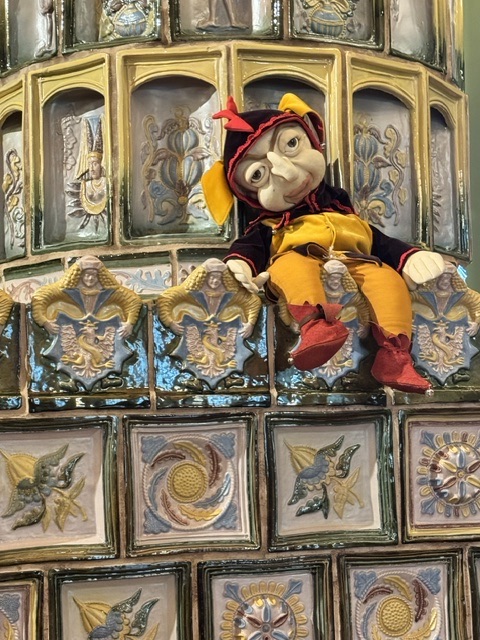
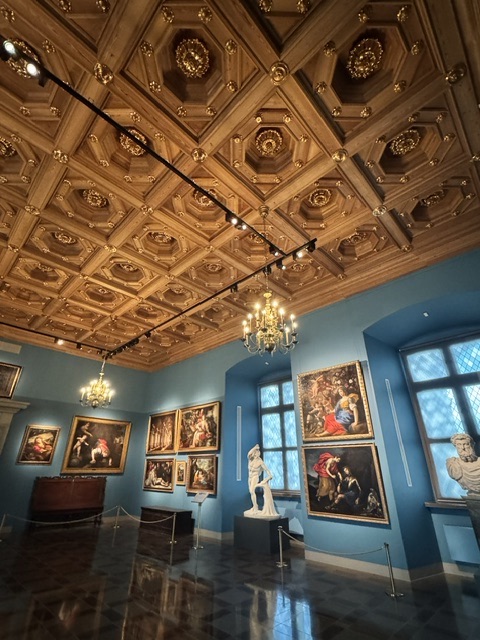
What stood out most, though, were the ceilings. So often royal palaces descend into exhausting displays of gold, ego, and excess, where every surface screams for attention. The rooms and ceilings showed restraint — detailed without becoming gaudy or overpowering. The palace had taste.
That may sound like a strange compliment for a royal residence, but after seeing enough European palaces overloaded with ornamentation and self-importance, this one felt balanced and dignified.
The reconstruction itself adds another layer to the experience. Much of the original palace was destroyed over centuries of occupation and conflict, so walking through the rebuilt halls becomes part history lesson, part statement of cultural survival. The museum is not simply preserving artifacts. It is reclaiming a national story that Lithuania refuses to let disappear.
On the 6th floor, I gained a sweeping panorama from Three Crosses and over the red roofs of Old Town, probably the best view among many offered throughout Vilnius because it was shielded from the wind. I could spend a lot of time just counting the church belfrys.
Unexpected Magic
Walking through Užupis has a completely different energy from the rest of Vilnius. It felt less concerned with monuments and more interested in creativity. The charm comes from wandering its streets and discovering murals tucked into alleyways and quirky sculptures that seem proudly unconventional.
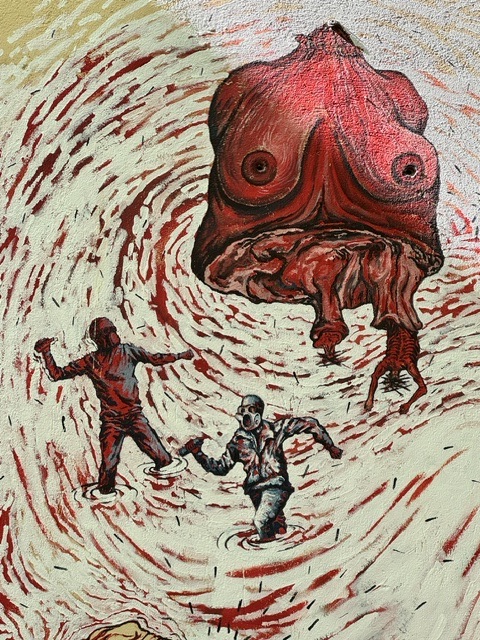
There exists a playful spirit to the neighborhood, but also something thoughtful and introspective beneath it all, as if the district never takes itself entirely seriously while still quietly valuing art, individuality, and imagination. All seems inclusive in the UZ Constitution!
Everyone has the right to live by the river, and the river has the right to flow by everyone.
Leaving UZ behind, I hike to Three Crosses some 550 feet above Vilnius. Even if physically challenging, the hike becomes magical.
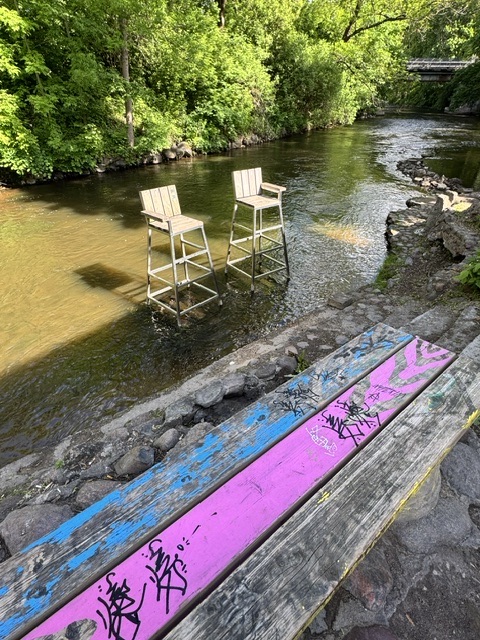
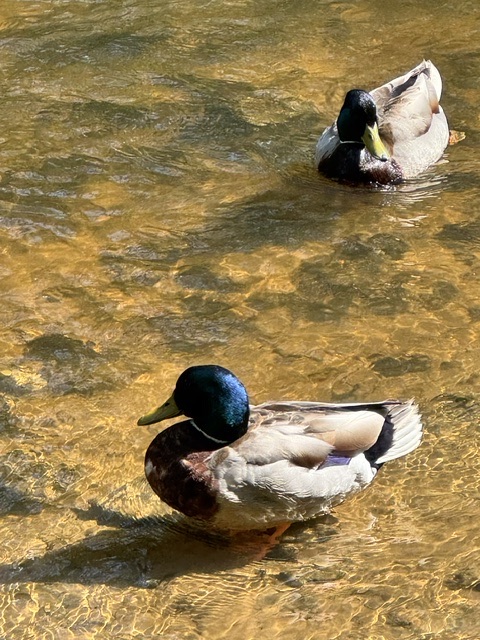
Walking along the Vilnia River and into Kalnų (Hill) Park, the city begins to loosen its grip and turn into something quieter and more natural. On the opposite bank, Bernardinų Garden feels alive —children’s playgrounds full of laughter, families drifting through greenery—while here the atmosphere is softer, more wooded, almost secluded.
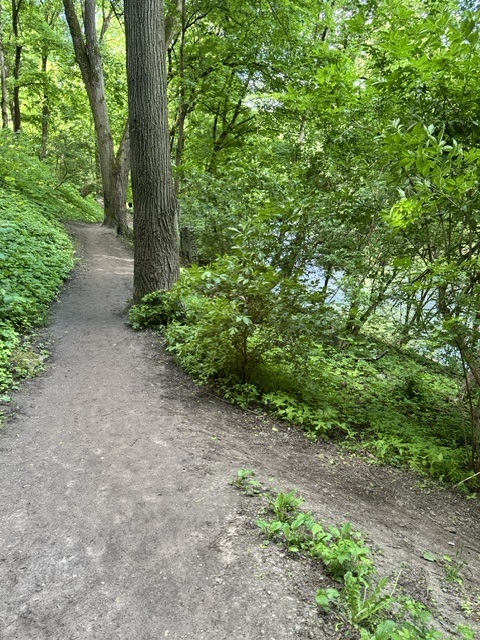

The narrow path winds forward beneath trees, over exposed roots and uneven stones, each step pulling further away from the city streets. It is the kind of walk that demands attention yet gently calms the soul. I recognize a slip of footing could land me in the river. Eventually the trail arrives at the base of the hill, and the climb becomes unavoidable: a long ascent of steps stretching upward into the trees.
There is an intention to count them, but it dissolves quickly into breath and effort. The focus narrows to movement, to pacing, to pausing when the knees insist on negotiation. Every so often, a break opens out into views across Vilnius—brief rewards before continuing upward, “just 50 more,” until the next pause is needed again.
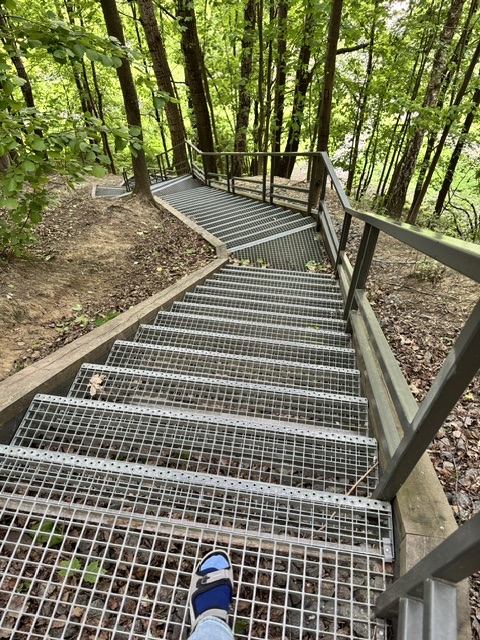
The climb becomes less about reaching the top and more about the steady conversation between body, hill, and city unfolding below.
Physically challenging but truly worth the effort. The peace amid nature, the solitude beneath the forest, and the views become my rewards.
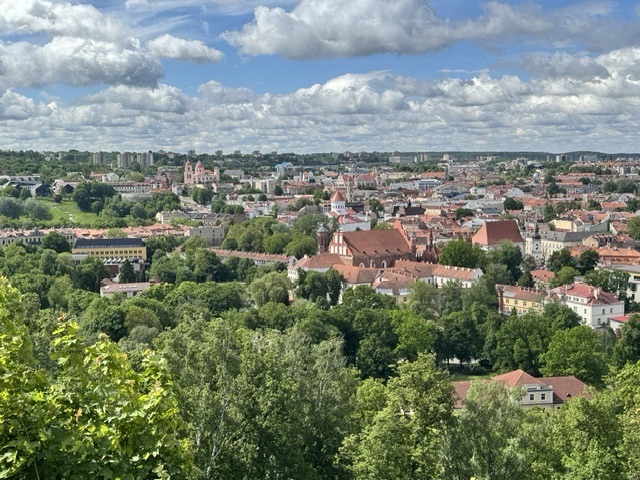
My step becomes lighter in the descent, reaching the base within minutes. There, ahead, another climb beckons: shorter but no less beautiful. At the top a concrete gazebo dedicated to fashion artist Janina Dłuska, one of the first female pilots in Vilnius. She died at what is now Vilnius International Airport while learning to fly. Her mother illegally built the gazebo in her memory. The family enjoyed fantastic views over Vilnius.
There are countless more monuments to explore here but, sadly, I must depart the forests. I wander thru Užupis one more time before returning to the lively hum of Old Town Vilnius.
And What’s With the Rocks?
As I wondered around Vilnius, I began to notice the placement of a lot of rocks. They are about as numerous as the roaring engines of commercial jets departing from the nearby airport.
Curiosity required I investigate. It seems each stone, no matter how large or small, possesses a story behind it. Like the stone at the corner of Pilies and Didžioji.
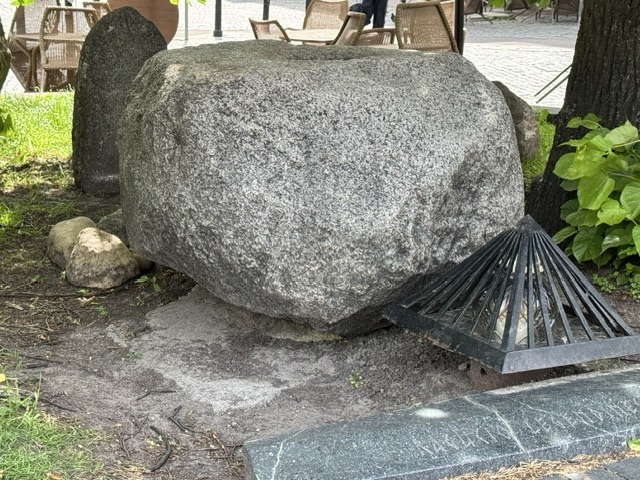
The Altar of Ragutis is a rock sculpture dedicated to Ragutis, the Baltic pagan god associated with brewing, fermentation and beer. The installation is symbolic rather than religious, celebrating traditional brewing culture and myth. It seems a quirky landmark linking mythology, craft beer, and the city’s contemporary urban legends.
A Sacred Flame in the Ragutis Sanctuary was lit on the 14th of November 2012 and has continuously burned since.
We ask you to respect the Sacred Flame and the Sanctuary as it is a place of peace and contemplation.
Okay, because Vilnius really does produce good beer so Ragutis seems to be answering our prayers.
What’s the Story behind the Easter Egg?
The Margutis egg originally sat in Užupis as a temporary placeholder while the Angel of Užupis was being funded and sculpted. The angel was meant to hatch from the egg. However, locals grew so fond of the 650 pound egg that when the Angel appeared in 2002, the egg was moved to its current Old Town location at Pylimo g. 43.
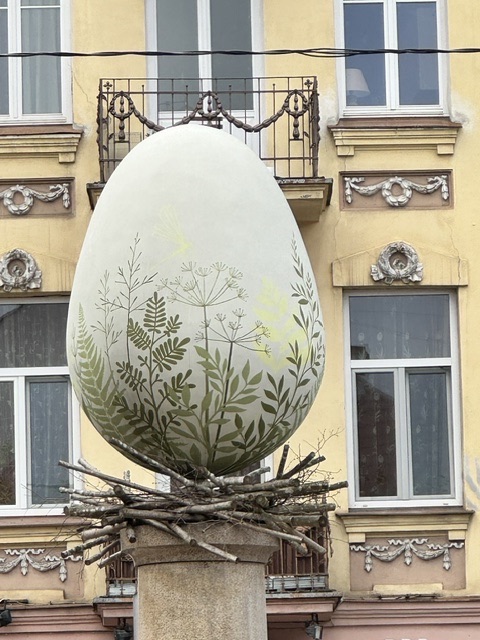
The sculpture is refreshed periodically. It now features botanical patterns and wild plants that celebrate harmony with nature and acts as a symbol of spring, rebirth, and life.
Impossible Street Names and Corners Strange
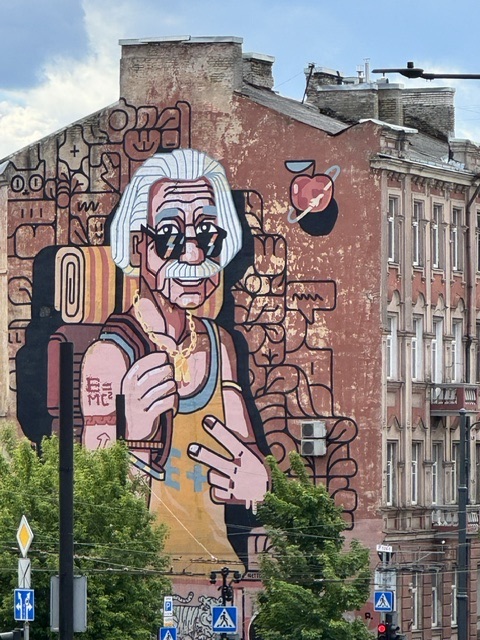
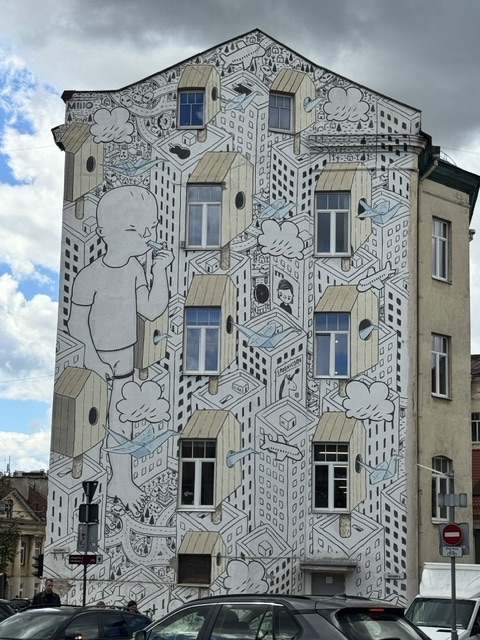
And amid the stones, important trees and babbling waters one discovers so many quirky arts and artists.

I’m sorry to be leaving tomorrow and miss the start of the Pink Soup Fest.
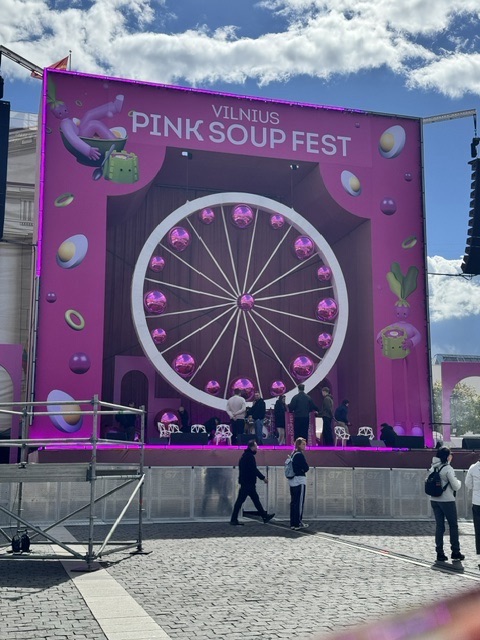
The Pink Soup Fest is a lighthearted food festival in Vilnius celebrating šaltibarščiai—Lithuania’s iconic cold beetroot soup. The city turns pink for the day: streets, drinks, outfits, and decorations all echo the soup’s bright color.
The festival includes music, street food stalls, and events like costume runs and themed parties. It’s part culinary celebration, part humorous cultural pride—turning a simple summer dish into a full-city, slightly surreal celebration to usher in summer.
I’m Not Sure What’s Happening Here, But I Like It
All these experiences—Užupis with its quiet oddities, the unexpected pockets of art, and those stretches of nature where the city dissolves into trees and river—start to blur together into something simple and undeniable: I love Vilnius. It’s not a city that announces itself loudly or tries too hard to impress. It reveals itself in layers, through small discoveries that feel personal rather than staged.
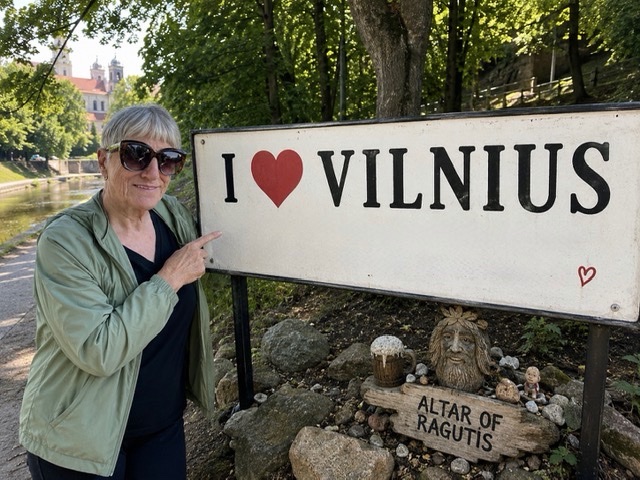
And maybe that’s exactly why it deserves a sign, like those global declarations of affection you find in cities encouraging selfies. Not something grand or polished, but slightly playful, slightly self-aware. I can already picture it placed near the Altar of Ragutis—where mythology, beer, and Užupis spirit quietly overlap—declaring what the city already knows: Vilnius doesn’t need to shout. It just needs to be walked, then it does the rest.
