30 March 2026
New country, new breakfast. While still centered around strong coffee, breakfast appears heavily influenced by the French, traditions left behind when the they left Algeria in 1962.
Morning meal is a tasty mix of sweet and savory – think coffee, breads, and pastries. Lots of breads line the tables, including traditional semolina-based bread, eaten with butter, honey, jam, olive oil, or cheese. I do taste the sfenj, a light but chewy fried doughnut dusted with sugar and dipped in honey. Something I must try later is baghrir, a semolina pancake soaked in honey and butter. However, this morning I enjoy my usual: yogurt and nuts.
The weather is definitely not what I expected. The morning temperature reaches a cool 56°F under cloudy skies and with very brisk winds of 23mph. Only bearable with 3 layers of long-sleeve shirts, a windbreaker and scarf. Thankfully, no rain.
Algiers
Long before modern Algeria, Phoenicians and Romans shaped Algiers. Then the city emerged into the medieval period under Berber dynasties and later the Ottomans. From the 16th to early 19th centuries, Algiers was the capital of an Ottoman regency. Its reputation became infamous in Europe as a pirate stronghold, a place that made fortunes from Mediterranean trade and privateering. The Casbah dates from this era. This dense maze of whitewashed houses, mosques, and palaces cling to the hillside above the sea.
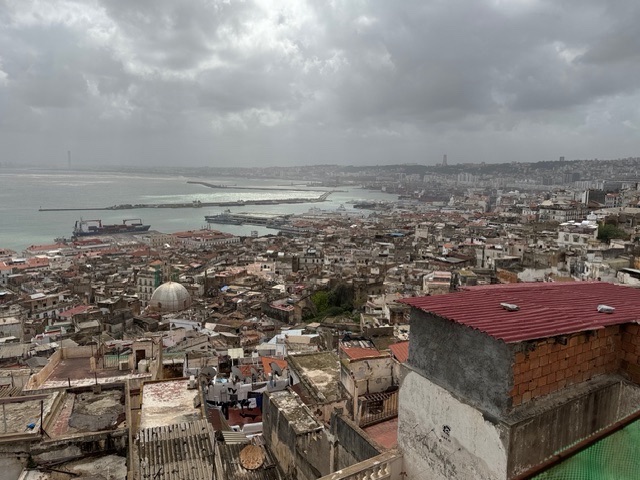
In 1830, the French invaded, beginning 132 years of their colonial rule, altering the city to reflect Western standards. Algiers reshaped itself with wide boulevards, European-style buildings, and a segregated social order that favored settlers, meaning the French.
The city became a focal point of the Algerian War of Independence (1954–1962), marked by bombings, repression, and urban guerrilla warfare. Independence in 1962 was celebrated in Algiers, but it also triggered the mass departure of Europeans and left deep political and social scars. Then, the civil unrest of the 1990s saw violence between the state and Islamist groups.
Today, the city feels stable and progressive. Algiers retains its grand colonial buildings which sit beside decaying structures, while the Casbah struggles with preservation despite its UNESCO status.
The city remains Algeria’s political and cultural heart, with universities, museums, cafés, and a lively waterfront. Infrastructure has improved with new highways, metro lines, and housing. However, unemployment, bureaucracy, and housing shortages continue. Algiers seems to be an interesting city of contrasts for us to explore.
UNESCO-listed Casbah
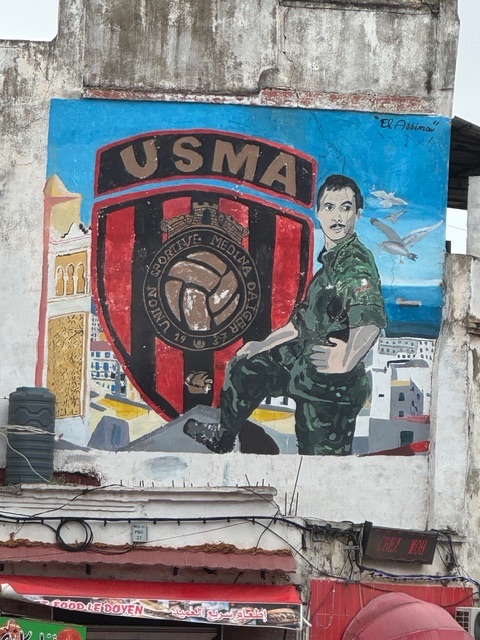
We bus through the city, past very high-security government and military enclaves, to the Casbah. We enter the newest of the five gates near the Statue of Bologhine ibn Ziri, recognized the first leader (972–984) of the Sanhaja Berber dynasty. Here, we begin our exploration.
Our guide informs us the Casbah was purposely built as a labyrinth for keeping foreigners lost. Then a strategic move – today it can trap curious tourists for days. Tip: Start at the top and walk down. There are LOTS of stairs.
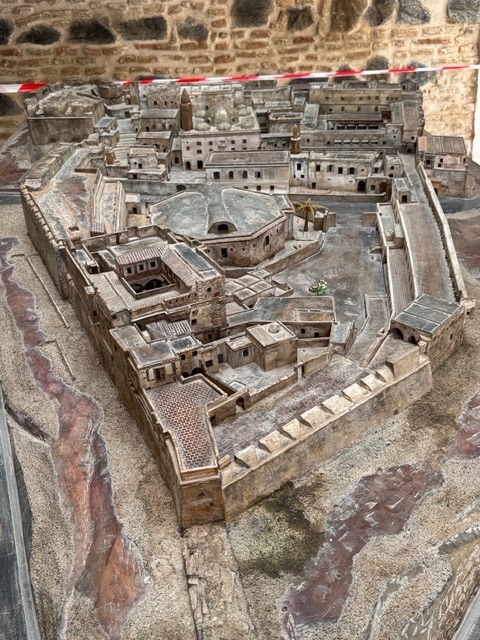
Model Algiers’ Casbah – a steep, tangled labyrinth of narrow lanes, stairways, and hidden courtyards cascading down toward the sea. Whitewashed houses lean into one another punctuated by beautifully carved wooden doors and small mosques.
Occasionally, I glimpse blue seas below. It feels lived-in rather than staged. Laundry lines crisscross alleys, children dart past, and elderly residents sit in doorways watching the neighborhood breathe. The Casbah carries centuries of history but also visible decay, giving it an atmosphere that becomes as sad as it is photogenic.
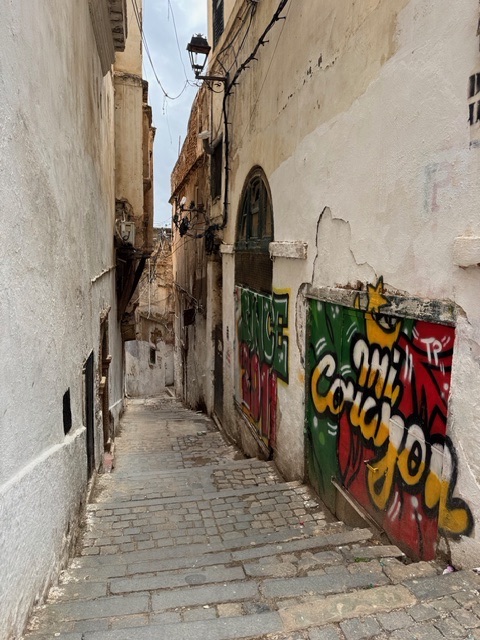
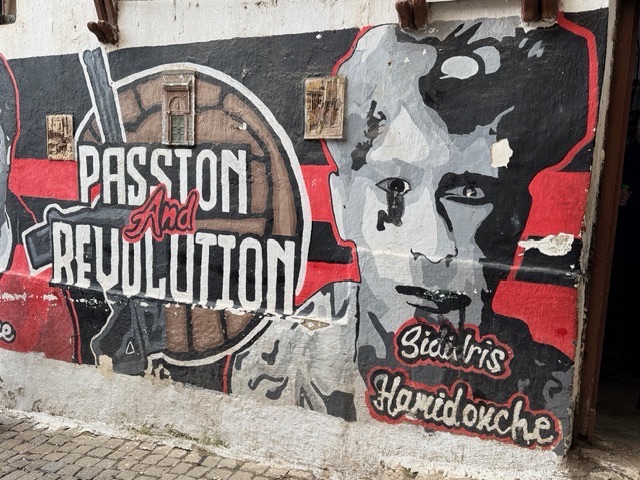
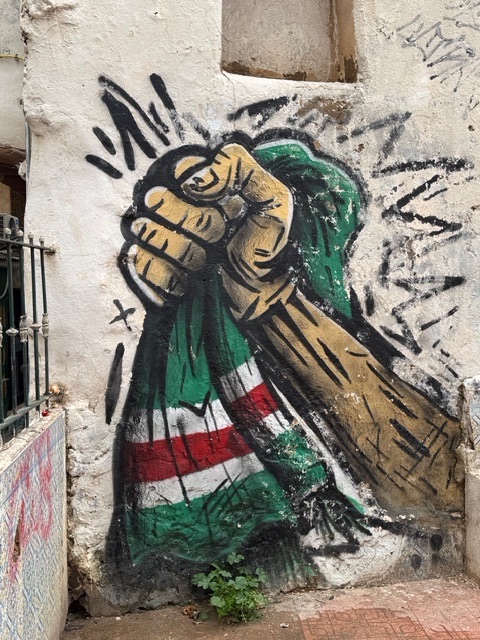
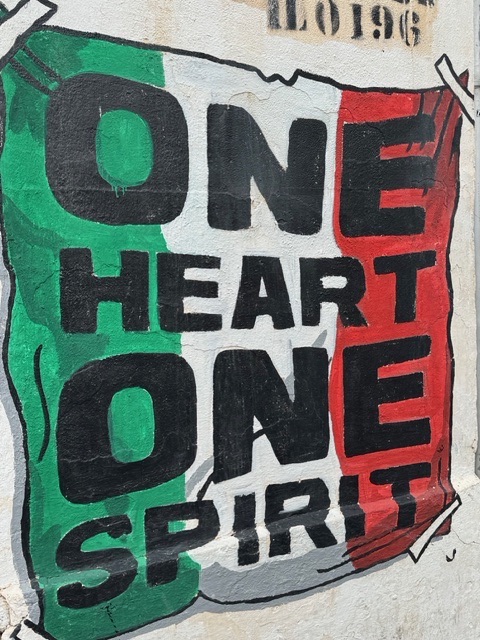
No doubt, some of the best parts of the Casbah are the narrow alleyways, its art and graffiti. I am informed the art is not just about the football but a way to protest. Wandering is preferred.
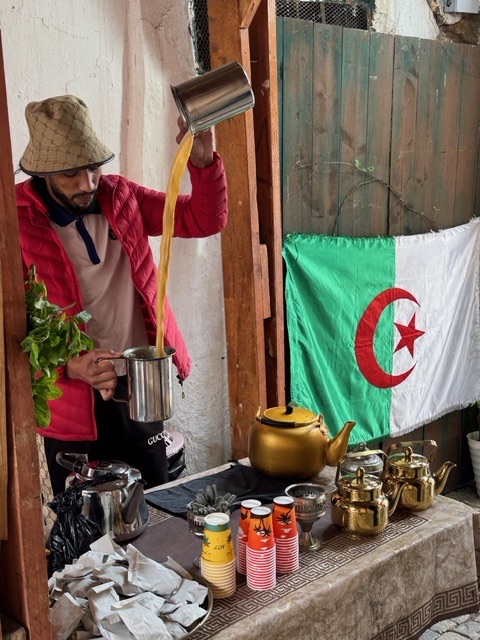
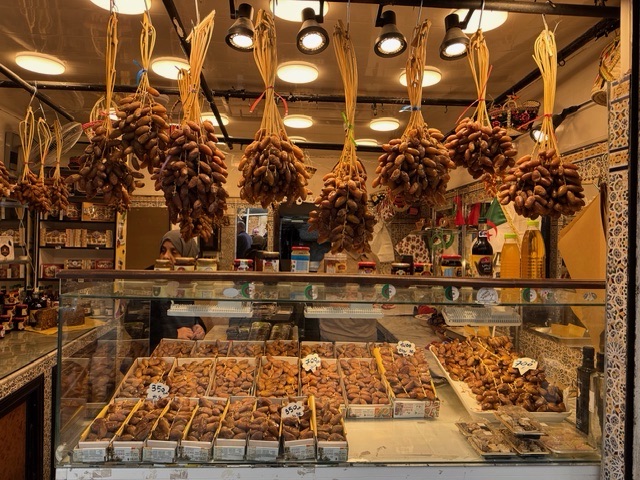
As for hard sells, they exist—but seem muted compared to places like Marrakech or Cairo. Without our guide, certainly I would encounter a few men offering guiding services, pointing out historic houses or proposing to lead me deeper into the maze, sometimes with an air of helpful insistence.
Small vendors may try to sell souvenirs or invite me into tiny workshops, but with a guide I am not experiencing aggressive pressure. Most heard language appears to be French. The biggest challenge becomes navigation rather than negotiation; it’s easy to get lost, which is precisely why I like having an official guide.
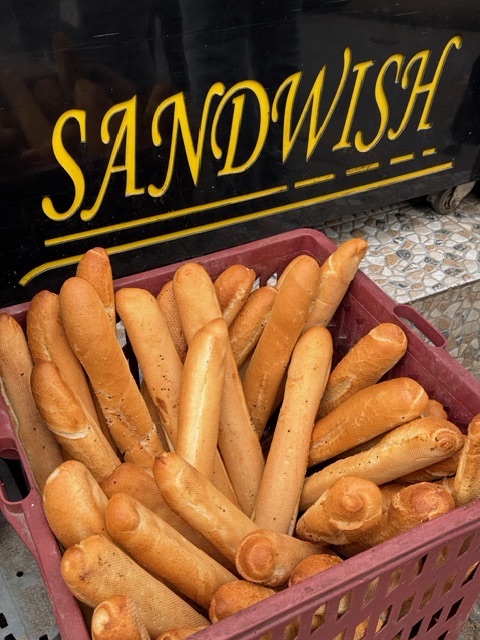
Plenty of street food from which to choose. For locals, their basic essentials are subsidized by the government this includes the staples of bread, wheat, coffee, vegetable oil, and milk. A baguette costs pennies.
La Grande Poste D’Alger
Algier’s architecture reflects both French and local influences. As one drives through the city, the architecture is clearly divided between the historic Ottoman and the more modern French influenced buildings.
One grand structure is La Grande Poste d’Alger, a reminder of the French colonial period. Built in 1910, it served as the city’s main post office, designed to make a statement—both administratively and architecturally. Its bright white façade, sweeping arches, and elaborate Moorish Revival style borrow from Islamic architectural elements while scaling them up to imperial proportions, creating a building that feels both local in motif and foreign in intent.
Palace of Algiers
Within the Casbah are unassuming alleys and doorways leading to the sumptuous interiors of Ottoman Palaces. We stepped inside to admire their beautiful interiors. Some of the best were in the Palace of Rias and Bastion 23. Many smaller palaces surround this area and comprise the Arts and Culture Center. Its proximity to the sea wall is an added attraction.
The Palace of Rias seems one of the most elegant surviving Ottoman-era palaces in Algiers. The house exemplifies the architecture of Ottoman Algiers, designed around privacy, light, and inward beauty rather than outward display.
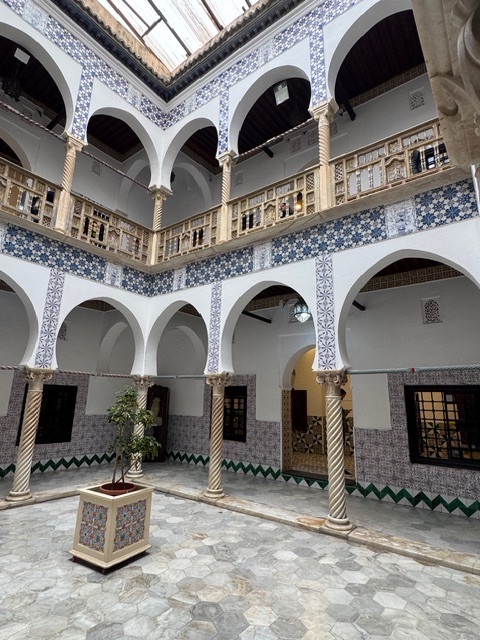
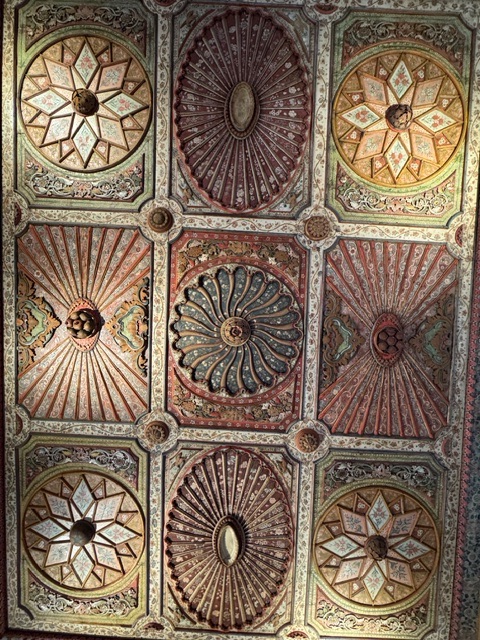
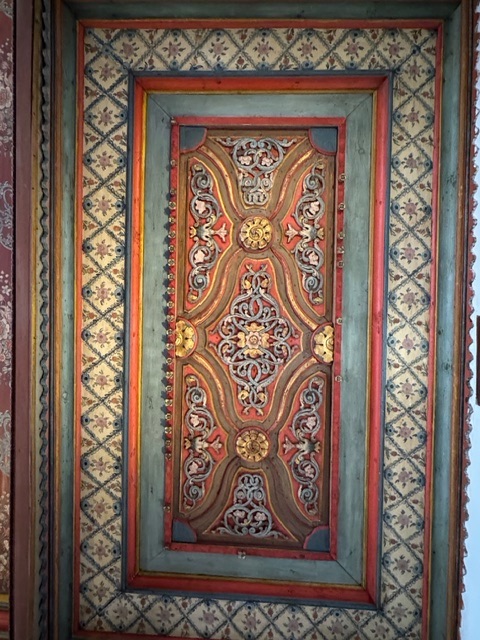
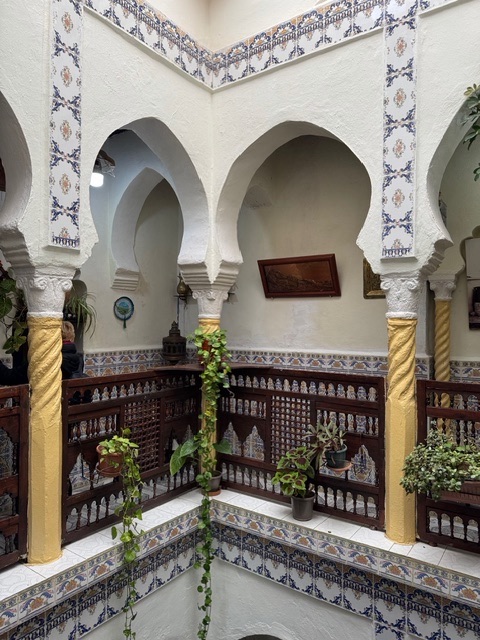
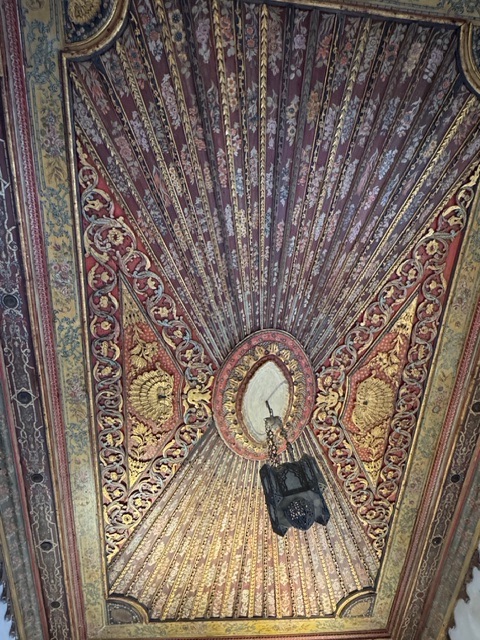
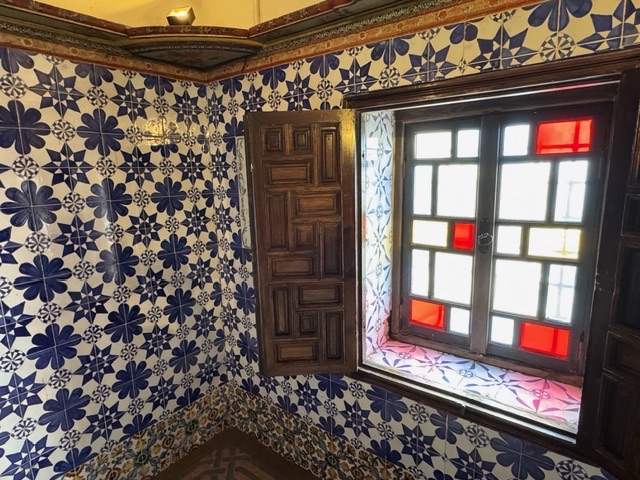
and gorgeous carved-wood ceilings.
The palaces are organized around a central courtyard with marble columns, tiled floors, carved plasterwork, and finely decorated wooden galleries. The carved wood ceilings are finely executed. The extended family, and often multiple wives, lived among its many rooms and levels.
Bastion 23 has been well-restored compared to other, more damaged areas of the Casbah. The buildings showcase the intricate Andalusian and Dutch tiles, as well as the carved thuja wood, reflecting its history as a palace of maritime leaders.
Ladies (below) dress in traditional Amazigh (Berber) attire, part of an historic haïk ensemble meant to provide privacy and protection. It features a long white wrap, a large cloth draped over the head and body to provide modesty and protection from sun and dust.
Decorative forehead jewelry reflects Amazigh heritage, with silver ornaments often symbolizing identity and family tradition. The woven straw bags show regional craftsmanship and practicality.
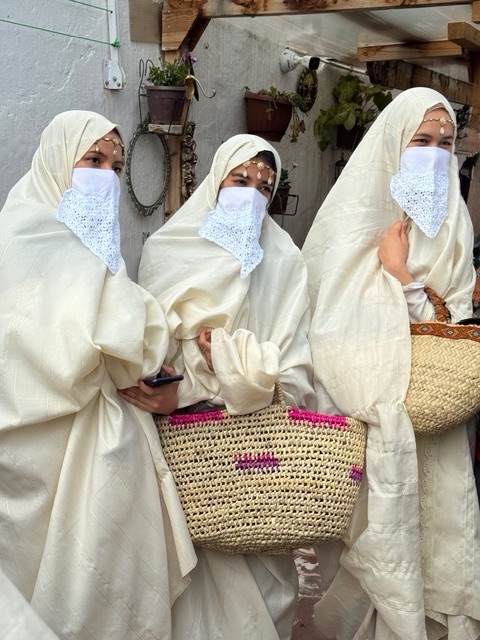
Shielding the lower face with a delicate lace face covering called an aadjar, allowed women to move comfortably in public while maintaining cultural expectations of discretion, especially in urban centers such as Algiers. It also helped shield the skin from sun, wind, and dust, which seems very practical in North Africa’s climate.
Today, this style is mainly worn for festivals and weddings.
Narrow Alleys with Private Homes and More
Like many Casbah houses, these homes turn their back on the street and reveal their splendor only once inside, reflecting social norms of the period. In their 400+ years, these homes have served many purposes from government houses to currently museums and art galleries. The terraces offer magnificent views over the Casbah and all of Algiers to the roaring seas.
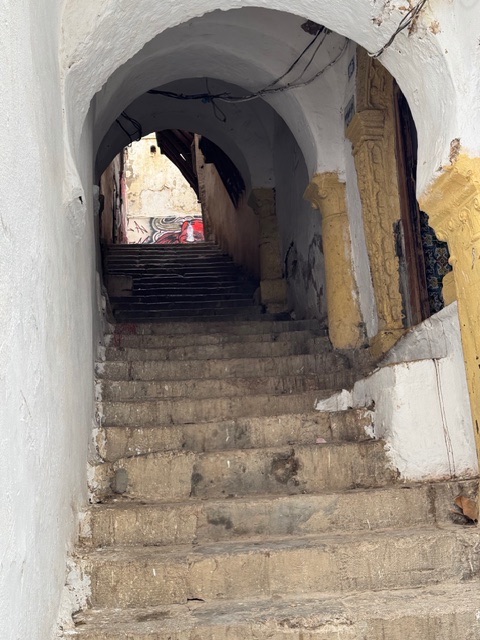
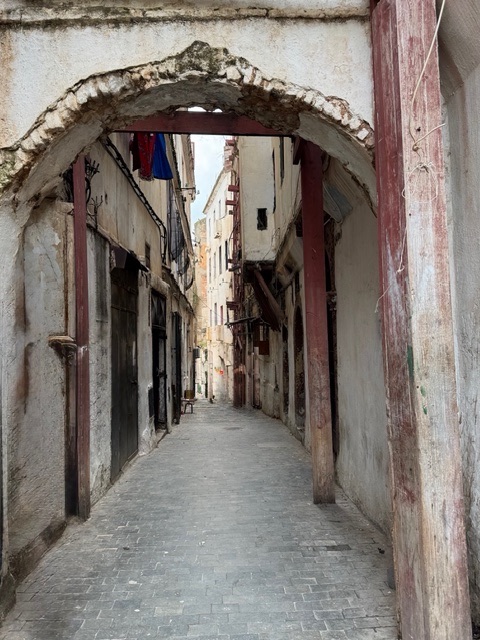
Many private family homes are also open to the public. They give a true sense of how families live. These homes are much like the Bey Palaces but smaller and more intimate. Multiple generations live in the homes, often three floors and a terrace on the roof.
Another doorway leads to the interior of what once was used as a Magazine. Here, cannonballs were made, a critical part of the Ottoman-era maritime defense system in the 17th and 18th centuries. Now, wonderfully large photos of historic Algerian buildings and locations hang on whitewashed walls. Underfoot lie exposed foundations to even earlier buildings of the Casbah.
Continuing to explore the area we find the impressive Ketchaoua Mosque and the nearby Martyrs’ Square. Everything from the top of the Casbah to the sea has been an education in the history, culture and current life of the people of Algiers. Exploring the Casbah helps one understand its role in Mediterranean history. I believe it would take several days to experience it all.
Martyrs’ Square
Martyrs’ Square represents one of Algiers’ most iconic spots. It sits at the border between the modern city and the old Casbah. Historically, it was the heart of Ottoman Algiers, close to the former Dey’s palace and the city’s main gate to the harbor. Under French rule, they renamed it Place du Gouvernement, all redesigned to project colonial power. Grand buildings and open sightlines meant to impress and control. After independence in 1962, this became Martyrs’ Square to honor those who died resisting colonial rule, transforming it from a symbol of authority into one of sacrifice and national memory.
Today, traffic, pedestrians, trams, and buses all converge around this wide open square to create a cacophony of noise and chaos. Excavations beneath the square revealed layers of Algiers’ past—Ottoman streets, Roman remains, and old foundations—some of which can be viewed near the metro entrance. From Martyrs’ Square, we walk downhill toward the port.
Notre-Dame d’Afrique Basilica
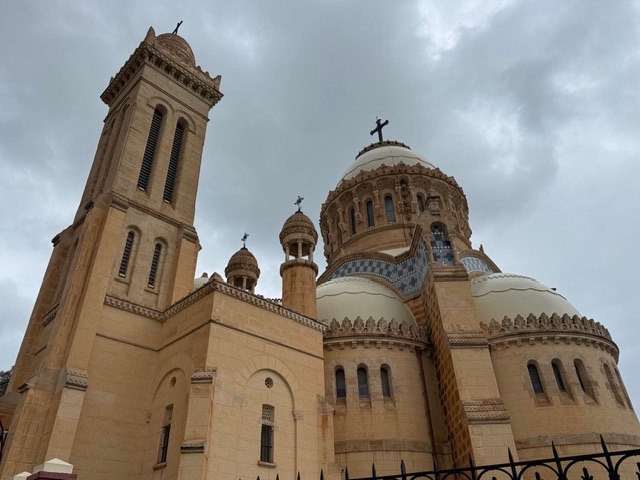
This basilica holds great architectural and historical significance. It also offers a fantastic panoramic view of Algiers and the sea. Notre-Dame d’Afrique, one of Algiers’ most iconic landmarks, perches dramatically on a cliff overlooking the Bay of Algiers.
Built between 1858 and 1872 during the French colonial period, the basilica was designed in a Romano-Byzantine style. It deliberately blends European church architecture with North African decorative elements. From the start, it was meant to be both a religious monument and a visual statement, visible from the sea as ships approached the city. It delivers on this goal.
What sets Notre-Dame d’Afrique apart historically rests in its reflection for coexistence. Inside, above the altar, an inscription reads “Notre-Dame d’Afrique, priez pour nous et pour les musulmans,” a rare and deliberate appeal for “Our Lady of Africa, pray for us and for the Muslims.” Over time, the church became a place not only for Catholics but also for local Muslims and Jews who came to light candles or seek blessings, especially sailors’ families and women praying for protection.
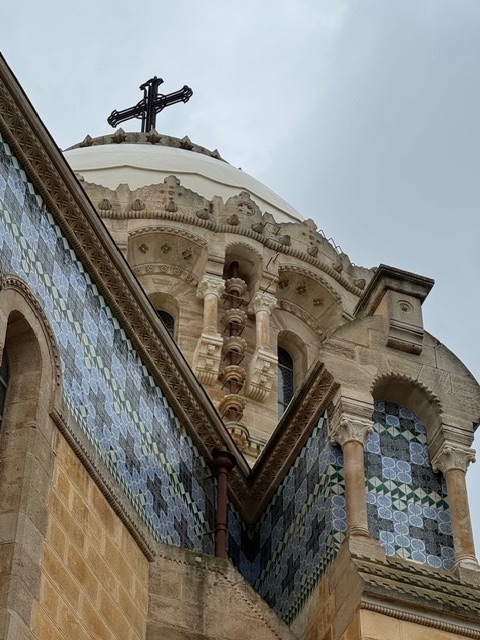
Its setting is as memorable as the building itself. The exterior’s cream-colored stone, domes, and arched windows glow in the Mediterranean light. Its terrace offers one of the best panoramic views in Algiers, stretching across the harbor and the white city below. Inside, I find a richly decorated space with mosaics, painted ceilings, and numerous small plaques and objects thanking the Virgin for answered prayers left by worshippers.
Maqam Echahid
The Martyrs Monument, or Maqam Echahid, represents one of the country’s most recognizable landmarks. It stands on a hill overlooking the entire city of Algiers. Inaugurated in 1982, it commemorates the 20th anniversary of Algeria’s independence from France.
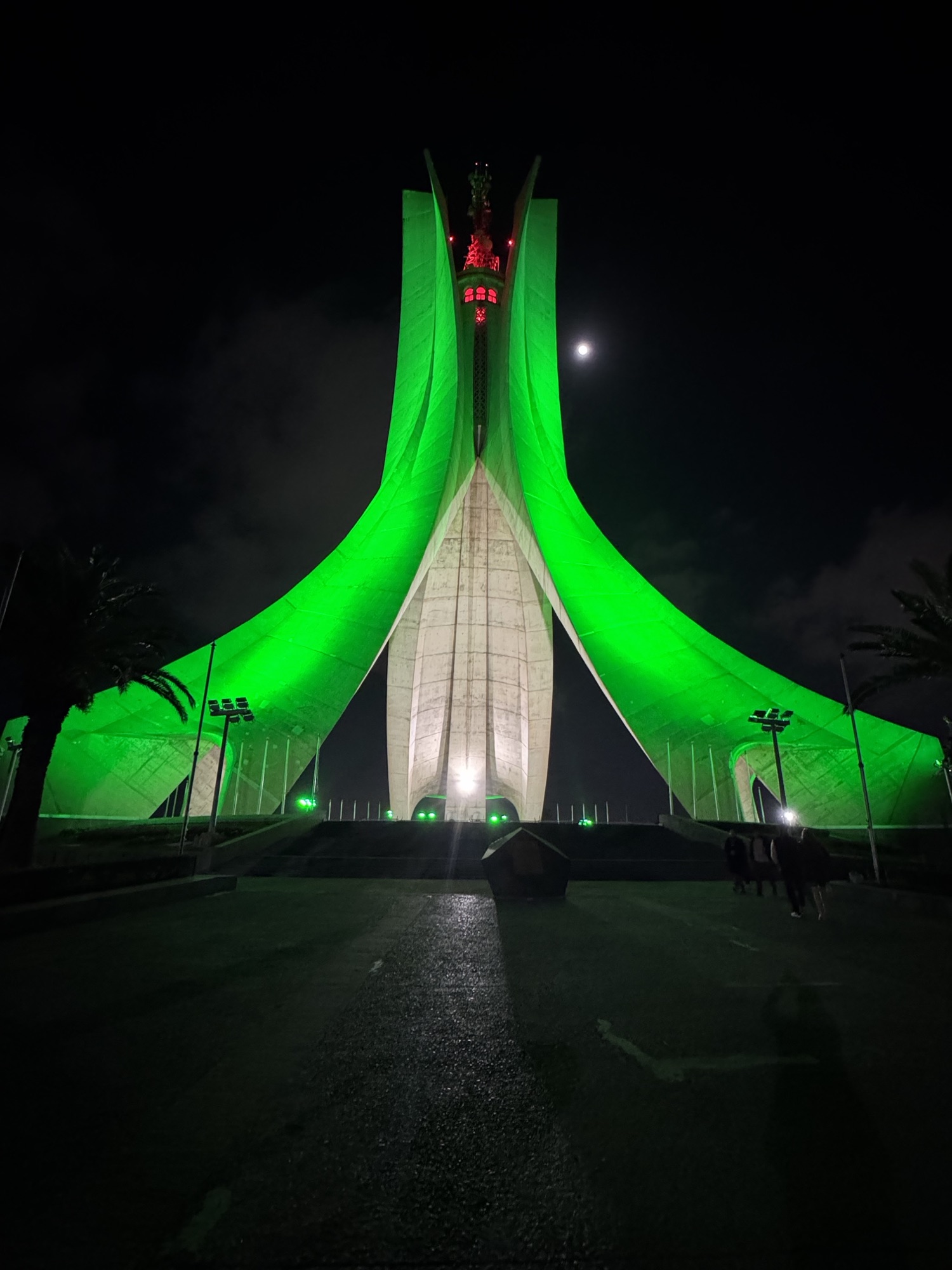
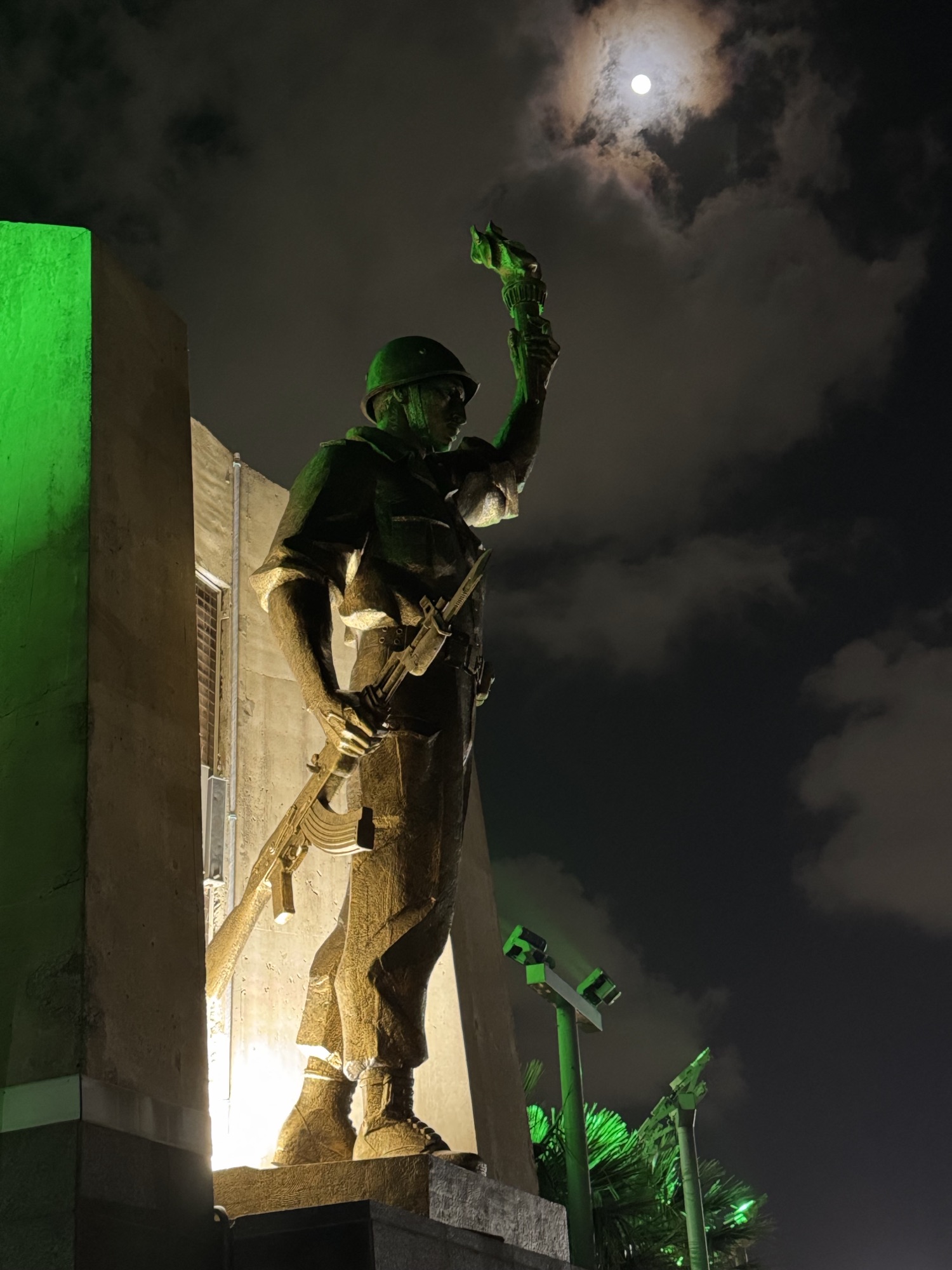
The monument rises about 302 feet and consists of three sweeping concrete palm leaf structures that meet at the top. Each pillar represents a major stage in Algeria’s struggle for freedom, culminating in the Algerian War of Independence. At the base of each pillar stands a statue of a soldier symbolizing different eras of resistance.
At night, the monument is lit in the colors of the Algerian flag. The site is both a place of remembrance and a powerful national symbol, reflecting sacrifice, resilience, and pride.
Overnight in Algiers
We return to our lodging at the Sofitel in time for a glass of chilled Algerian wine before dinner.
While visiting any country, I am interested in history, archaeology, culture, religion and rules. Subjects I always research is currency and alcohol. I do not avoid countries one way or the other, but I do prefer to have a glass of wine with my dinner or in a lounge, especially one with a view.
Algeria is a place where both currency and alcohol are worth understanding ahead of time. Expectations don’t always match reality.
Currency
Currency: Algeria uses the Algerian dinar (DZD), and it’s a cash-based economy for visitors. Credit cards are rarely accepted outside a handful of high-end hotels, and ATMs are unreliable. Only a few banks will accept a foreign Visa ATM.
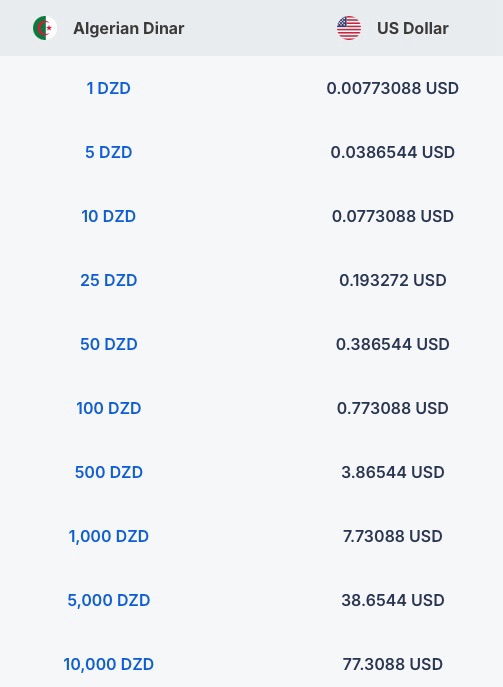
Official exchange should be done at banks, in airports or major hotels. However, there is also a healthy Black Market trade.
My American dollars become limited after traveling for over two weeks in US $-hungry countries. Local currencies are worthless once one departs its shores. My guide went to great lengths tonight, driving to three banks, before finding an ATM that accepted my card.
Alcohol
Alcohol is legal but culturally low-key. Algeria is a Muslim-majority country, and alcohol is not part of everyday public life, yet it hasn’t vanished either. Wine does exist locally, a legacy of the colonial era. I won’t see it openly advertised, and most casual restaurants don’t serve it at all.
That said, alcohol is available in international hotels such as the ones on this tour, some upscale restaurants, and a few licensed bars—especially in Algiers, Oran, and coastal cities. Hotel lounges offer me the safest bet for a glass of wine or beer.

Besides a roaring, colorful sea, Algiers is blessed with a plethora of cats. One can find a representative of every size and color on the streets and even at the beach with these ladies.
Thus, tonight, flush with new-found cash, I relax over a glass of wine in our hotel lounge after a day immersed in history, archaeology, culture and cats.
Fi sahtek
في صحتك
To your health

0 Comments