Travel
Exploring Inner Transylvania
Saxon Villages of Prejmer and Viscri – 24 May 2019
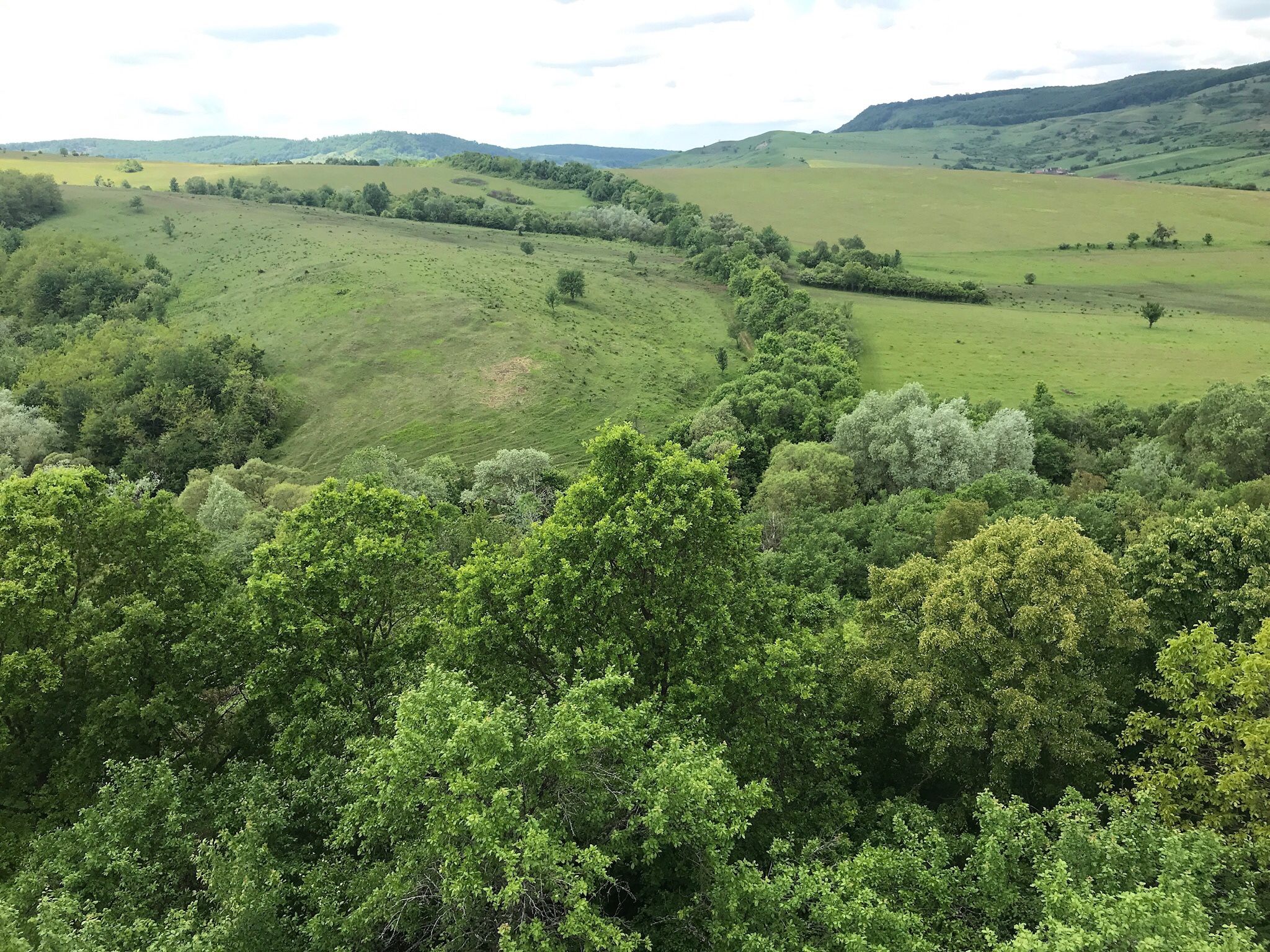 This morning, we motor further into the Transylvania region of Romania. The countryside is peaceful and verdant, the villages quiet with the rustic feel of what I would expect of rural Romania. Mountains surround a flat valley of rich green fields and expanses of bright yellow rapeseed. Rivers of snow trickle down the distant peaks of the Carpathians while sun shines on white storks shopping the farmer’s hay fields for frogs and grasshoppers. There is the occasional man and his herd of cows. Lush, healthy forests of beech and timber march up the hillsides for as far as I can see. This is perhaps some of the most beautiful land in the world where I have driven.
 Brașov lays within the loving southeastern curve of the Carpathian Mountains and its location is breathtaking. Its oldest traces of human activity and settlements date to the Neolithic age (about 9500 BC). Brașov is an important Saxon city and its architecture, fortifications, towers, churches, town square, and history are outstanding. Not only is the city the birthplace of the Romanian national anthem, but the birthplace of one of Vlad Dracul’s lady friends.
  Any science fiction buff recognizes the Carpathian Mountains. These mountains form a 900-mile range in Central and Eastern Europe with peaks reaching upwards of 7800 feet. Over half of the Carpathians lie in Romania, where the forests are home to brown bears, lynxes and wolves. Its passes are gateways to Transylvania, the land of the Magyar, the Moc and Romanian peoples – and Count Dracula. There is a drapery of snow across distant peaks and a layer of clouds hover over the range. I can hear the “children of the night” howling my welcome.
 At the entrance to Strada Lipscani in Old Town is the mandatory Roman Statue recognized throughout the world. Rome’s she wolf nurtures Romulus and Remus. The Italians gave it to Romania in 1906 but it does look sort of out of place. But, it is a good entry point to Old Town. One can stroll these streets for hours enjoying the mix of architecture, much of it influenced by classical and French influences, Greco-Roman, neoclassical, and baroque; a little Art Deco here and a little communist efficiency there.
 Varna drapes around Bulgaria’s Black Sea Coast and the lovely Gulf of Varna. Originally called Odessos and an important Thracian seaside port, Varna has been a major economic and cultural center for over 3000 years. Lots of history, mild temperatures, ancient Roman ruins, turquoise seas, and the oldest gold treasure in the world – the walled city of Varna sounds like my kind of destination.